

248
6 Memristor Circuits: Invariant Manifolds, Coexisting Attractors, Extreme. . .
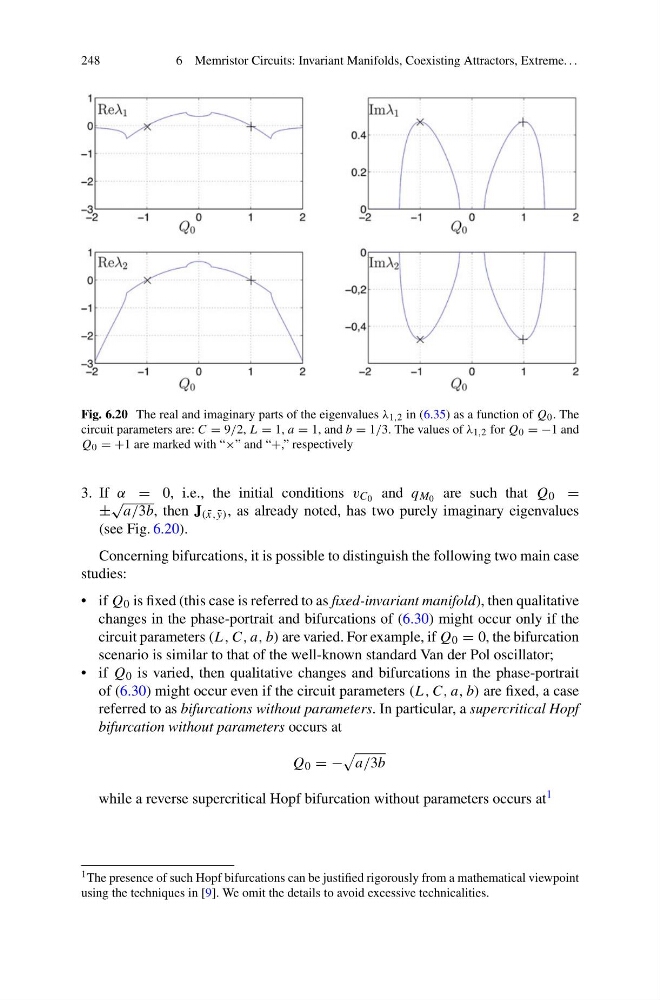
Fig. 6.20 The real and imaginary parts of the eigenvalues λ 1,2 in (6.35) as a function of Q 0 . The
circuit parameters are: C = 9/2, L = 1, a = 1, and b = 1/3. The values of λ 1,2 for Q 0 = −1 and
Q 0 = +1 are marked with “×” and “+,” respectively
3. If α = 0, i.e., the initial conditions v C 0 and q M 0 are such that Q 0 =
±
√
a/3b, then J ( ¯
x, ¯
y) , as already noted, has two purely imaginary eigenvalues
(see Fig. 6.20).
Concerning bifurcations, it is possible to distinguish the following two main case
studies:
• if Q 0 is fixed (this case is referred to as fixed-invariant manifold), then qualitative
changes in the phase-portrait and bifurcations of (6.30) might occur only if the
circuit parameters (L, C, a, b) are varied. For example, if Q 0 = 0, the bifurcation
scenario is similar to that of the well-known standard Van der Pol oscillator;
• if Q 0 is varied, then qualitative changes and bifurcations in the phase-portrait
of (6.30) might occur even if the circuit parameters (L, C, a, b) are fixed, a case
referred to as bifurcations without parameters. In particular, a supercritical Hopf
bifurcation without parameters occurs at
Q 0 = −
a/3b
while a reverse supercritical Hopf bifurcation without parameters occurs at 1
1 The presence of such Hopf bifurcations can be justified rigorously from a mathematical viewpoint
using the techniques in [9]. We omit the details to avoid excessive technicalities.
6 Memristor Circuits: Invariant Manifolds, Coexisting Attractors, Extreme. . .
Fig. 6.20 The real and imaginary parts of the eigenvalues λ 1,2 in (6.35) as a function of Q 0 . The
circuit parameters are: C = 9/2, L = 1, a = 1, and b = 1/3. The values of λ 1,2 for Q 0 = −1 and
Q 0 = +1 are marked with “×” and “+,” respectively
3. If α = 0, i.e., the initial conditions v C 0 and q M 0 are such that Q 0 =
±
√
a/3b, then J ( ¯
x, ¯
y) , as already noted, has two purely imaginary eigenvalues
(see Fig. 6.20).
Concerning bifurcations, it is possible to distinguish the following two main case
studies:
• if Q 0 is fixed (this case is referred to as fixed-invariant manifold), then qualitative
changes in the phase-portrait and bifurcations of (6.30) might occur only if the
circuit parameters (L, C, a, b) are varied. For example, if Q 0 = 0, the bifurcation
scenario is similar to that of the well-known standard Van der Pol oscillator;
• if Q 0 is varied, then qualitative changes and bifurcations in the phase-portrait
of (6.30) might occur even if the circuit parameters (L, C, a, b) are fixed, a case
referred to as bifurcations without parameters. In particular, a supercritical Hopf
bifurcation without parameters occurs at
Q 0 = −
a/3b
while a reverse supercritical Hopf bifurcation without parameters occurs at 1
1 The presence of such Hopf bifurcations can be justified rigorously from a mathematical viewpoint
using the techniques in [9]. We omit the details to avoid excessive technicalities.