

5.8 Formulation of Memristor Circuits Equations
207
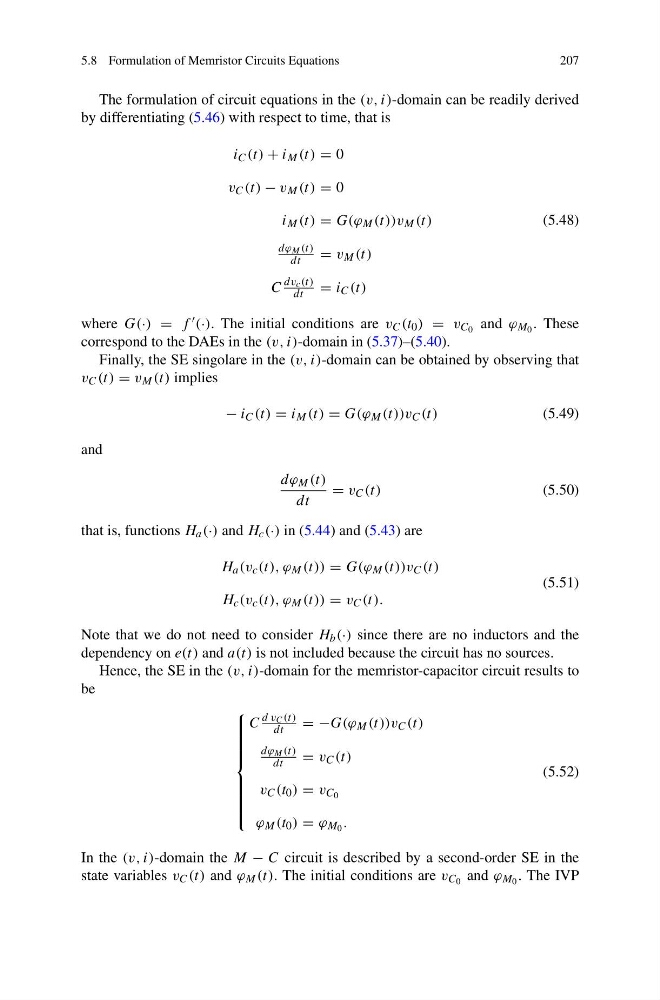
The formulation of circuit equations in the (v, i)-domain can be readily derived
by differentiating (5.46) with respect to time, that is
i C (t) + i M (t) = 0
v C (t) − v M (t) = 0
i M (t) = G(ϕ M (t))v M (t)
dϕ M (t)
dt
= v M (t)
C
dv c (t)
dt = i C (t)
(5.48)
where G(·) = f (·). The initial conditions are v C (t 0 ) = v C 0 and ϕ M 0 . These
correspond to the DAEs in the (v, i)-domain in (5.37)–(5.40).
Finally, the SE singolare in the (v, i)-domain can be obtained by observing that
v C (t) = v M (t) implies
− i C (t) = i M (t) = G(ϕ M (t))v C (t)
(5.49)
and
dϕ M (t)
dt
= v C (t)
(5.50)
that is, functions H a (·) and H c (·) in (5.44) and (5.43) are
H a (v c (t), ϕ M (t)) = G(ϕ M (t))v C (t)
H c (v c (t), ϕ M (t)) = v C (t).
(5.51)
Note that we do not need to consider H b (·) since there are no inductors and the
dependency on e(t) and a(t) is not included because the circuit has no sources.
Hence, the SE in the (v, i)-domain for the memristor-capacitor circuit results to
be
⎧
⎪ ⎪ ⎪ ⎪ ⎪ ⎪ ⎪ ⎨
⎪ ⎪ ⎪ ⎪ ⎪ ⎪ ⎪ ⎩
C
d v C (t)
dt
= −G(ϕ M (t))v C (t)
dϕ M (t)
dt
= v C (t)
v C (t 0 ) = v C 0
ϕ M (t 0 ) = ϕ M 0 .
(5.52)
In the (v, i)-domain the M − C circuit is described by a second-order SE in the
state variables v C (t) and ϕ M (t). The initial conditions are v C 0 and ϕ M 0 . The IVP
207
The formulation of circuit equations in the (v, i)-domain can be readily derived
by differentiating (5.46) with respect to time, that is
i C (t) + i M (t) = 0
v C (t) − v M (t) = 0
i M (t) = G(ϕ M (t))v M (t)
dϕ M (t)
dt
= v M (t)
C
dv c (t)
dt = i C (t)
(5.48)
where G(·) = f (·). The initial conditions are v C (t 0 ) = v C 0 and ϕ M 0 . These
correspond to the DAEs in the (v, i)-domain in (5.37)–(5.40).
Finally, the SE singolare in the (v, i)-domain can be obtained by observing that
v C (t) = v M (t) implies
− i C (t) = i M (t) = G(ϕ M (t))v C (t)
(5.49)
and
dϕ M (t)
dt
= v C (t)
(5.50)
that is, functions H a (·) and H c (·) in (5.44) and (5.43) are
H a (v c (t), ϕ M (t)) = G(ϕ M (t))v C (t)
H c (v c (t), ϕ M (t)) = v C (t).
(5.51)
Note that we do not need to consider H b (·) since there are no inductors and the
dependency on e(t) and a(t) is not included because the circuit has no sources.
Hence, the SE in the (v, i)-domain for the memristor-capacitor circuit results to
be
⎧
⎪ ⎪ ⎪ ⎪ ⎪ ⎪ ⎪ ⎨
⎪ ⎪ ⎪ ⎪ ⎪ ⎪ ⎪ ⎩
C
d v C (t)
dt
= −G(ϕ M (t))v C (t)
dϕ M (t)
dt
= v C (t)
v C (t 0 ) = v C 0
ϕ M (t 0 ) = ϕ M 0 .
(5.52)
In the (v, i)-domain the M − C circuit is described by a second-order SE in the
state variables v C (t) and ϕ M (t). The initial conditions are v C 0 and ϕ M 0 . The IVP