

5.5 Flux-Charge Analysis Method (FCAM) for Class LM of Memristor Circuits
187
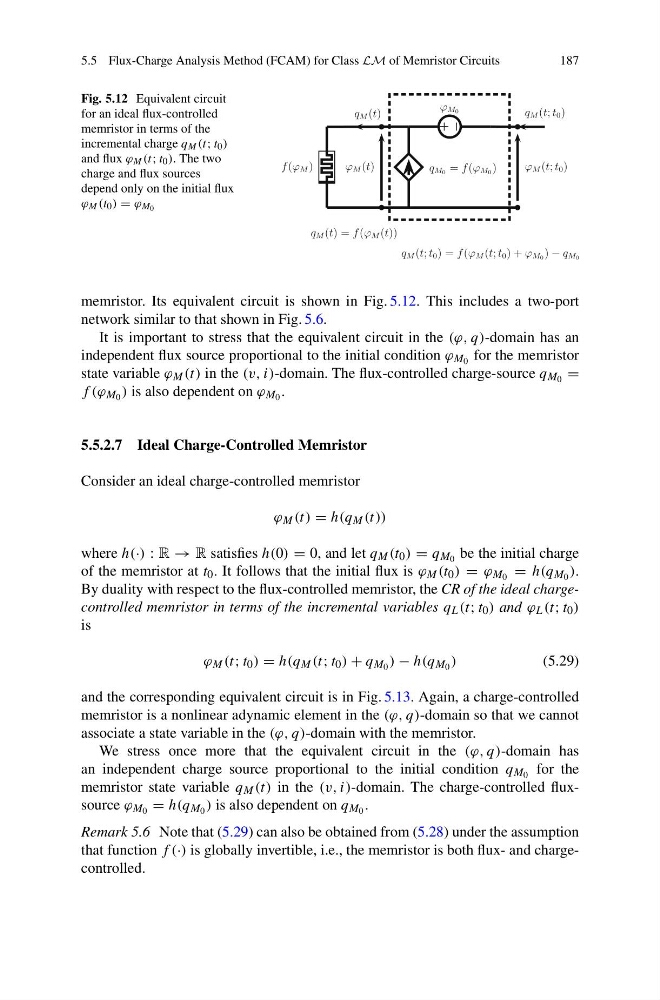
Fig. 5.12 Equivalent circuit
for an ideal flux-controlled
memristor in terms of the
incremental charge q M (t; t 0 )
and flux ϕ M (t; t 0 ). The two
charge and flux sources
depend only on the initial flux
ϕ M (t 0 ) = ϕ M 0
memristor. Its equivalent circuit is shown in Fig. 5.12. This includes a two-port
network similar to that shown in Fig. 5.6.
It is important to stress that the equivalent circuit in the (ϕ, q)-domain has an
independent flux source proportional to the initial condition ϕ M 0 for the memristor
state variable ϕ M (t) in the (v, i)-domain. The flux-controlled charge-source q M 0 =
f (ϕ M 0 ) is also dependent on ϕ M 0 .
5.5.2.7 Ideal Charge-Controlled Memristor
Consider an ideal charge-controlled memristor
ϕ M (t) = h(q M (t))
where h(·) : R → R satisfies h(0) = 0, and let q M (t 0 ) = q M 0 be the initial charge
of the memristor at t 0 . It follows that the initial flux is ϕ M (t 0 ) = ϕ M 0 = h(q M 0 ).
By duality with respect to the flux-controlled memristor, the CR of the ideal chargecontrolled memristor in terms of the incremental variables q L (t; t 0 ) and ϕ L (t; t 0 )
is
ϕ M (t; t 0 ) = h(q M (t; t 0 ) + q M 0 ) − h(q M 0 )
(5.29)
and the corresponding equivalent circuit is in Fig. 5.13. Again, a charge-controlled
memristor is a nonlinear adynamic element in the (ϕ, q)-domain so that we cannot
associate a state variable in the (ϕ, q)-domain with the memristor.
We stress once more that the equivalent circuit in the (ϕ, q)-domain has
an independent charge source proportional to the initial condition q M 0 for the
memristor state variable q M (t) in the (v, i)-domain. The charge-controlled fluxsource ϕ M 0 = h(q M 0 ) is also dependent on q M 0 .
Remark 5.6 Note that (5.29) can also be obtained from (5.28) under the assumption
that function f (·) is globally invertible, i.e., the memristor is both flux- and chargecontrolled.
187
Fig. 5.12 Equivalent circuit
for an ideal flux-controlled
memristor in terms of the
incremental charge q M (t; t 0 )
and flux ϕ M (t; t 0 ). The two
charge and flux sources
depend only on the initial flux
ϕ M (t 0 ) = ϕ M 0
memristor. Its equivalent circuit is shown in Fig. 5.12. This includes a two-port
network similar to that shown in Fig. 5.6.
It is important to stress that the equivalent circuit in the (ϕ, q)-domain has an
independent flux source proportional to the initial condition ϕ M 0 for the memristor
state variable ϕ M (t) in the (v, i)-domain. The flux-controlled charge-source q M 0 =
f (ϕ M 0 ) is also dependent on ϕ M 0 .
5.5.2.7 Ideal Charge-Controlled Memristor
Consider an ideal charge-controlled memristor
ϕ M (t) = h(q M (t))
where h(·) : R → R satisfies h(0) = 0, and let q M (t 0 ) = q M 0 be the initial charge
of the memristor at t 0 . It follows that the initial flux is ϕ M (t 0 ) = ϕ M 0 = h(q M 0 ).
By duality with respect to the flux-controlled memristor, the CR of the ideal chargecontrolled memristor in terms of the incremental variables q L (t; t 0 ) and ϕ L (t; t 0 )
is
ϕ M (t; t 0 ) = h(q M (t; t 0 ) + q M 0 ) − h(q M 0 )
(5.29)
and the corresponding equivalent circuit is in Fig. 5.13. Again, a charge-controlled
memristor is a nonlinear adynamic element in the (ϕ, q)-domain so that we cannot
associate a state variable in the (ϕ, q)-domain with the memristor.
We stress once more that the equivalent circuit in the (ϕ, q)-domain has
an independent charge source proportional to the initial condition q M 0 for the
memristor state variable q M (t) in the (v, i)-domain. The charge-controlled fluxsource ϕ M 0 = h(q M 0 ) is also dependent on q M 0 .
Remark 5.6 Note that (5.29) can also be obtained from (5.28) under the assumption
that function f (·) is globally invertible, i.e., the memristor is both flux- and chargecontrolled.