

188
5 Flux-Charge Analysis Method of Memristor Circuits
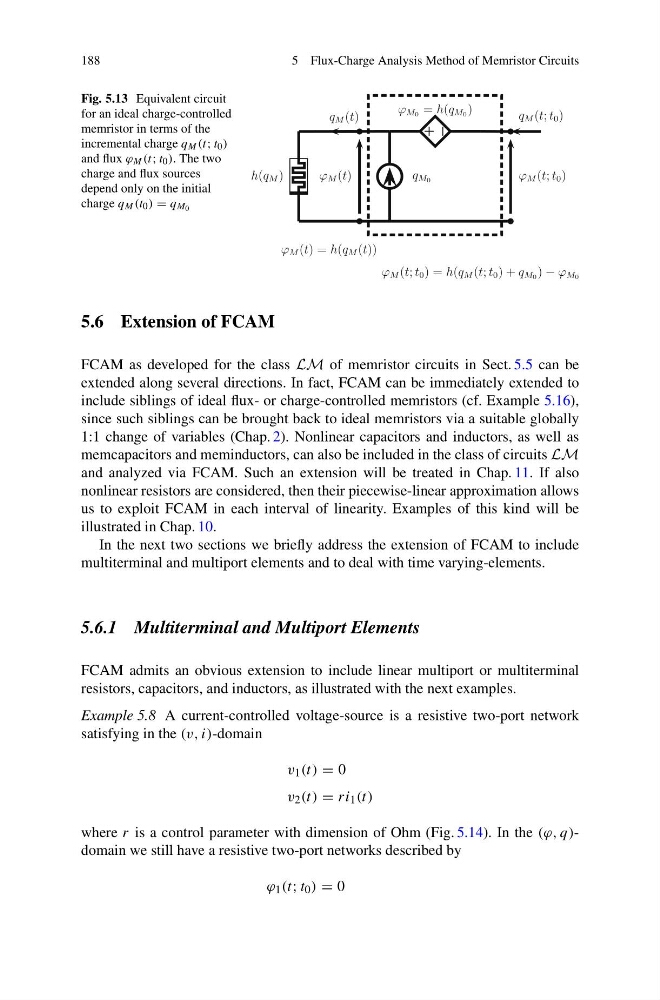
Fig. 5.13 Equivalent circuit
for an ideal charge-controlled
memristor in terms of the
incremental charge q M (t; t 0 )
and flux ϕ M (t; t 0 ). The two
charge and flux sources
depend only on the initial
charge q M (t 0 ) = q M 0
5.6 Extension of FCAM
FCAM as developed for the class LM of memristor circuits in Sect. 5.5 can be
extended along several directions. In fact, FCAM can be immediately extended to
include siblings of ideal flux- or charge-controlled memristors (cf. Example 5.16),
since such siblings can be brought back to ideal memristors via a suitable globally
1:1 change of variables (Chap. 2). Nonlinear capacitors and inductors, as well as
memcapacitors and meminductors, can also be included in the class of circuits LM
and analyzed via FCAM. Such an extension will be treated in Chap. 11. If also
nonlinear resistors are considered, then their piecewise-linear approximation allows
us to exploit FCAM in each interval of linearity. Examples of this kind will be
illustrated in Chap. 10.
In the next two sections we briefly address the extension of FCAM to include
multiterminal and multiport elements and to deal with time varying-elements.
5.6.1 Multiterminal and Multiport Elements
FCAM admits an obvious extension to include linear multiport or multiterminal
resistors, capacitors, and inductors, as illustrated with the next examples.
Example 5.8 A current-controlled voltage-source is a resistive two-port network
satisfying in the (v, i)-domain
v 1 (t) = 0
v 2 (t) = ri 1 (t)
where r is a control parameter with dimension of Ohm (Fig. 5.14). In the (ϕ, q)domain we still have a resistive two-port networks described by
ϕ 1 (t; t 0 ) = 0
5 Flux-Charge Analysis Method of Memristor Circuits
Fig. 5.13 Equivalent circuit
for an ideal charge-controlled
memristor in terms of the
incremental charge q M (t; t 0 )
and flux ϕ M (t; t 0 ). The two
charge and flux sources
depend only on the initial
charge q M (t 0 ) = q M 0
5.6 Extension of FCAM
FCAM as developed for the class LM of memristor circuits in Sect. 5.5 can be
extended along several directions. In fact, FCAM can be immediately extended to
include siblings of ideal flux- or charge-controlled memristors (cf. Example 5.16),
since such siblings can be brought back to ideal memristors via a suitable globally
1:1 change of variables (Chap. 2). Nonlinear capacitors and inductors, as well as
memcapacitors and meminductors, can also be included in the class of circuits LM
and analyzed via FCAM. Such an extension will be treated in Chap. 11. If also
nonlinear resistors are considered, then their piecewise-linear approximation allows
us to exploit FCAM in each interval of linearity. Examples of this kind will be
illustrated in Chap. 10.
In the next two sections we briefly address the extension of FCAM to include
multiterminal and multiport elements and to deal with time varying-elements.
5.6.1 Multiterminal and Multiport Elements
FCAM admits an obvious extension to include linear multiport or multiterminal
resistors, capacitors, and inductors, as illustrated with the next examples.
Example 5.8 A current-controlled voltage-source is a resistive two-port network
satisfying in the (v, i)-domain
v 1 (t) = 0
v 2 (t) = ri 1 (t)
where r is a control parameter with dimension of Ohm (Fig. 5.14). In the (ϕ, q)domain we still have a resistive two-port networks described by
ϕ 1 (t; t 0 ) = 0