

186
5 Flux-Charge Analysis Method of Memristor Circuits
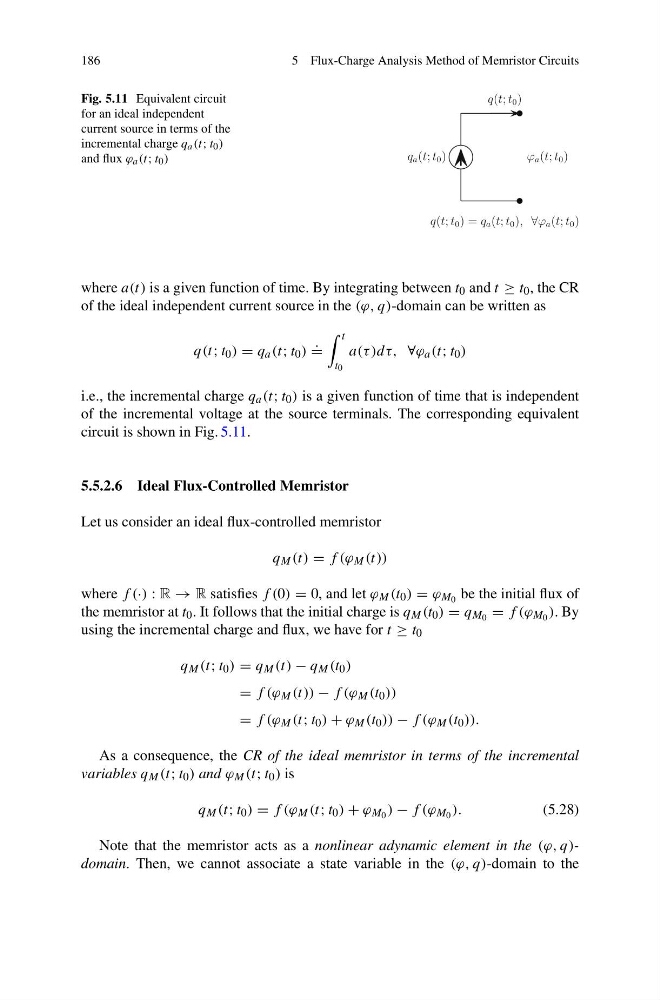
Fig. 5.11 Equivalent circuit
for an ideal independent
current source in terms of the
incremental charge q a (t; t 0 )
and flux ϕ a (t; t 0 )
where a(t) is a given function of time. By integrating between t 0 and t ≥ t 0 , the CR
of the ideal independent current source in the (ϕ, q)-domain can be written as
q(t; t 0 ) = q a (t; t 0 )
.
=
t
t 0
a(τ )dτ, ∀ϕ a (t; t 0 )
i.e., the incremental charge q a (t; t 0 ) is a given function of time that is independent
of the incremental voltage at the source terminals. The corresponding equivalent
circuit is shown in Fig. 5.11.
5.5.2.6 Ideal Flux-Controlled Memristor
Let us consider an ideal flux-controlled memristor
q M (t) = f (ϕ M (t))
where f (·) : R → R satisfies f (0) = 0, and let ϕ M (t 0 ) = ϕ M 0 be the initial flux of
the memristor at t 0 . It follows that the initial charge is q M (t 0 ) = q M 0 = f (ϕ M 0 ). By
using the incremental charge and flux, we have for t ≥ t 0
q M (t; t 0 ) = q M (t) − q M (t 0 )
= f (ϕ M (t)) − f (ϕ M (t 0 ))
= f (ϕ M (t; t 0 ) + ϕ M (t 0 )) − f (ϕ M (t 0 )).
As a consequence, the CR of the ideal memristor in terms of the incremental
variables q M (t; t 0 ) and ϕ M (t; t 0 ) is
q M (t; t 0 ) = f (ϕ M (t; t 0 ) + ϕ M 0 ) − f (ϕ M 0 ).
(5.28)
Note that the memristor acts as a nonlinear adynamic element in the (ϕ, q)domain. Then, we cannot associate a state variable in the (ϕ, q)-domain to the
5 Flux-Charge Analysis Method of Memristor Circuits
Fig. 5.11 Equivalent circuit
for an ideal independent
current source in terms of the
incremental charge q a (t; t 0 )
and flux ϕ a (t; t 0 )
where a(t) is a given function of time. By integrating between t 0 and t ≥ t 0 , the CR
of the ideal independent current source in the (ϕ, q)-domain can be written as
q(t; t 0 ) = q a (t; t 0 )
.
=
t
t 0
a(τ )dτ, ∀ϕ a (t; t 0 )
i.e., the incremental charge q a (t; t 0 ) is a given function of time that is independent
of the incremental voltage at the source terminals. The corresponding equivalent
circuit is shown in Fig. 5.11.
5.5.2.6 Ideal Flux-Controlled Memristor
Let us consider an ideal flux-controlled memristor
q M (t) = f (ϕ M (t))
where f (·) : R → R satisfies f (0) = 0, and let ϕ M (t 0 ) = ϕ M 0 be the initial flux of
the memristor at t 0 . It follows that the initial charge is q M (t 0 ) = q M 0 = f (ϕ M 0 ). By
using the incremental charge and flux, we have for t ≥ t 0
q M (t; t 0 ) = q M (t) − q M (t 0 )
= f (ϕ M (t)) − f (ϕ M (t 0 ))
= f (ϕ M (t; t 0 ) + ϕ M (t 0 )) − f (ϕ M (t 0 )).
As a consequence, the CR of the ideal memristor in terms of the incremental
variables q M (t; t 0 ) and ϕ M (t; t 0 ) is
q M (t; t 0 ) = f (ϕ M (t; t 0 ) + ϕ M 0 ) − f (ϕ M 0 ).
(5.28)
Note that the memristor acts as a nonlinear adynamic element in the (ϕ, q)domain. Then, we cannot associate a state variable in the (ϕ, q)-domain to the