

5.5 Flux-Charge Analysis Method (FCAM) for Class LM of Memristor Circuits
185
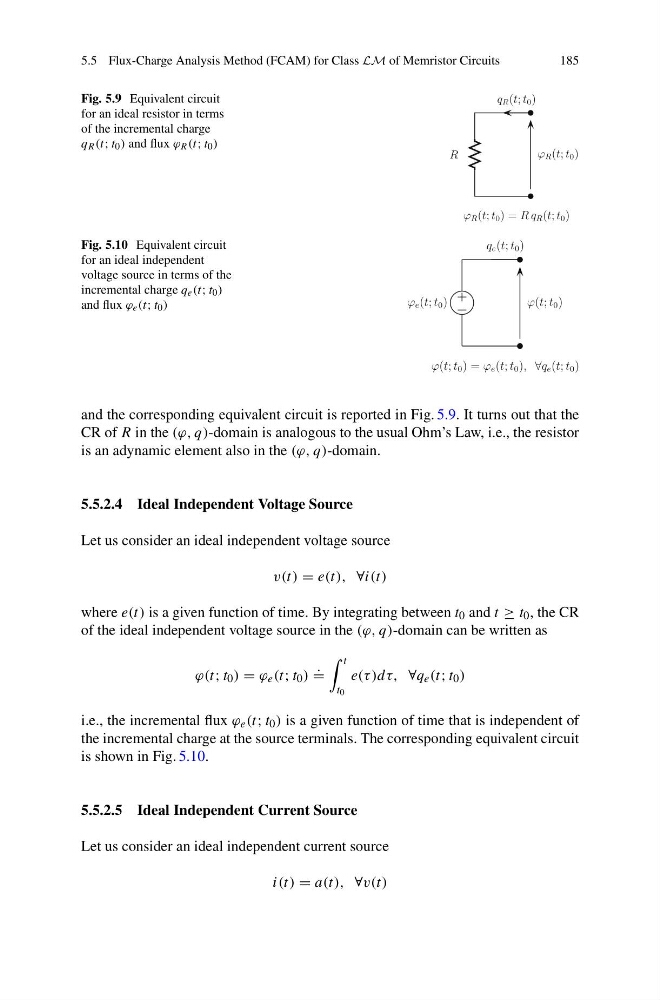
Fig. 5.9 Equivalent circuit
for an ideal resistor in terms
of the incremental charge
q R (t; t 0 ) and flux ϕ R (t; t 0 )
Fig. 5.10 Equivalent circuit
for an ideal independent
voltage source in terms of the
incremental charge q e (t; t 0 )
and flux ϕ e (t; t 0 )
and the corresponding equivalent circuit is reported in Fig. 5.9. It turns out that the
CR of R in the (ϕ, q)-domain is analogous to the usual Ohm’s Law, i.e., the resistor
is an adynamic element also in the (ϕ, q)-domain.
5.5.2.4 Ideal Independent Voltage Source
Let us consider an ideal independent voltage source
v(t) = e(t), ∀i(t)
where e(t) is a given function of time. By integrating between t 0 and t ≥ t 0 , the CR
of the ideal independent voltage source in the (ϕ, q)-domain can be written as
ϕ(t; t 0 ) = ϕ e (t; t 0 )
.
=
t
t 0
e(τ )dτ, ∀q e (t; t 0 )
i.e., the incremental flux ϕ e (t; t 0 ) is a given function of time that is independent of
the incremental charge at the source terminals. The corresponding equivalent circuit
is shown in Fig. 5.10.
5.5.2.5 Ideal Independent Current Source
Let us consider an ideal independent current source
i(t) = a(t), ∀v(t)
185
Fig. 5.9 Equivalent circuit
for an ideal resistor in terms
of the incremental charge
q R (t; t 0 ) and flux ϕ R (t; t 0 )
Fig. 5.10 Equivalent circuit
for an ideal independent
voltage source in terms of the
incremental charge q e (t; t 0 )
and flux ϕ e (t; t 0 )
and the corresponding equivalent circuit is reported in Fig. 5.9. It turns out that the
CR of R in the (ϕ, q)-domain is analogous to the usual Ohm’s Law, i.e., the resistor
is an adynamic element also in the (ϕ, q)-domain.
5.5.2.4 Ideal Independent Voltage Source
Let us consider an ideal independent voltage source
v(t) = e(t), ∀i(t)
where e(t) is a given function of time. By integrating between t 0 and t ≥ t 0 , the CR
of the ideal independent voltage source in the (ϕ, q)-domain can be written as
ϕ(t; t 0 ) = ϕ e (t; t 0 )
.
=
t
t 0
e(τ )dτ, ∀q e (t; t 0 )
i.e., the incremental flux ϕ e (t; t 0 ) is a given function of time that is independent of
the incremental charge at the source terminals. The corresponding equivalent circuit
is shown in Fig. 5.10.
5.5.2.5 Ideal Independent Current Source
Let us consider an ideal independent current source
i(t) = a(t), ∀v(t)