

5.3 Fundamental Examples on Kirchhoff Laws
171
Analysis in the (v, i)-Domain
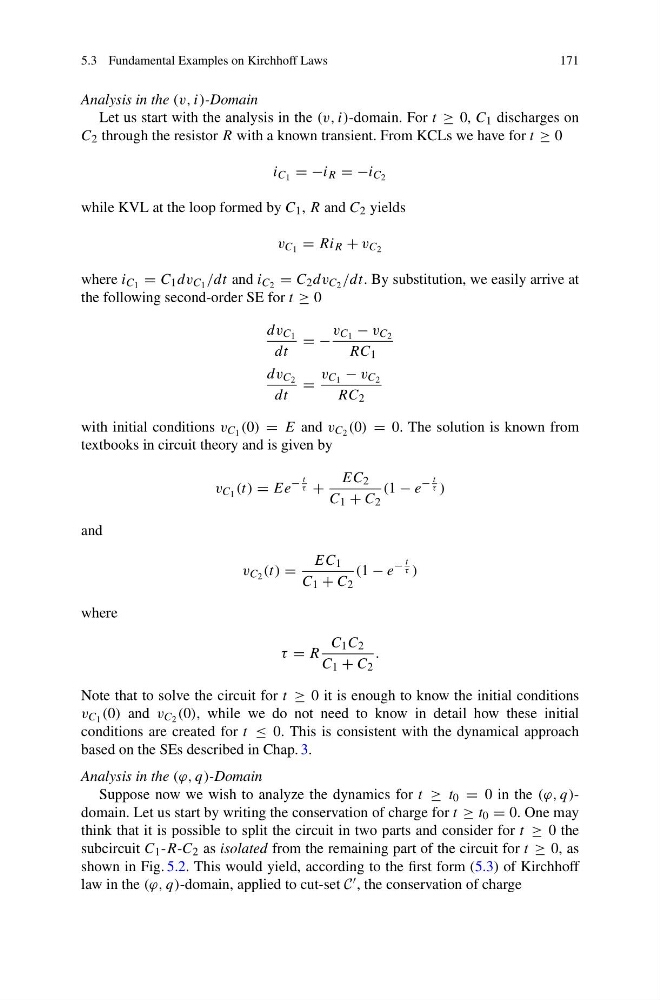
Let us start with the analysis in the (v, i)-domain. For t ≥ 0, C 1 discharges on
C 2 through the resistor R with a known transient. From KCLs we have for t ≥ 0
i C 1 = −i R = −i C 2
while KVL at the loop formed by C 1 , R and C 2 yields
v C 1 = Ri R + v C 2
where i C 1 = C 1 dv C 1 /dt and i C 2 = C 2 dv C 2 /dt. By substitution, we easily arrive at
the following second-order SE for t ≥ 0
dv C 1
dt
= −
v C 1 − v C 2
RC 1
dv C 2
dt
=
v C 1 − v C 2
RC 2
with initial conditions v C 1 (0) = E and v C 2 (0) = 0. The solution is known from
textbooks in circuit theory and is given by
v C 1 (t) = Ee
−
t
τ +
EC 2
C 1 + C 2
(1 − e
−
t
τ )
and
v C 2 (t) =
EC 1
C 1 + C 2
(1 − e
−
t
τ )
where
τ = R
C 1 C 2
C 1 + C 2
.
Note that to solve the circuit for t ≥ 0 it is enough to know the initial conditions
v C 1 (0) and v C 2 (0), while we do not need to know in detail how these initial
conditions are created for t ≤ 0. This is consistent with the dynamical approach
based on the SEs described in Chap. 3.
Analysis in the (ϕ, q)-Domain
Suppose now we wish to analyze the dynamics for t ≥ t 0 = 0 in the (ϕ, q)domain. Let us start by writing the conservation of charge for t ≥ t 0 = 0. One may
think that it is possible to split the circuit in two parts and consider for t ≥ 0 the
subcircuit C 1 -R-C 2 as isolated from the remaining part of the circuit for t ≥ 0, as
shown in Fig. 5.2. This would yield, according to the first form (5.3) of Kirchhoff
law in the (ϕ, q)-domain, applied to cut-set C , the conservation of charge
171
Analysis in the (v, i)-Domain
Let us start with the analysis in the (v, i)-domain. For t ≥ 0, C 1 discharges on
C 2 through the resistor R with a known transient. From KCLs we have for t ≥ 0
i C 1 = −i R = −i C 2
while KVL at the loop formed by C 1 , R and C 2 yields
v C 1 = Ri R + v C 2
where i C 1 = C 1 dv C 1 /dt and i C 2 = C 2 dv C 2 /dt. By substitution, we easily arrive at
the following second-order SE for t ≥ 0
dv C 1
dt
= −
v C 1 − v C 2
RC 1
dv C 2
dt
=
v C 1 − v C 2
RC 2
with initial conditions v C 1 (0) = E and v C 2 (0) = 0. The solution is known from
textbooks in circuit theory and is given by
v C 1 (t) = Ee
−
t
τ +
EC 2
C 1 + C 2
(1 − e
−
t
τ )
and
v C 2 (t) =
EC 1
C 1 + C 2
(1 − e
−
t
τ )
where
τ = R
C 1 C 2
C 1 + C 2
.
Note that to solve the circuit for t ≥ 0 it is enough to know the initial conditions
v C 1 (0) and v C 2 (0), while we do not need to know in detail how these initial
conditions are created for t ≤ 0. This is consistent with the dynamical approach
based on the SEs described in Chap. 3.
Analysis in the (ϕ, q)-Domain
Suppose now we wish to analyze the dynamics for t ≥ t 0 = 0 in the (ϕ, q)domain. Let us start by writing the conservation of charge for t ≥ t 0 = 0. One may
think that it is possible to split the circuit in two parts and consider for t ≥ 0 the
subcircuit C 1 -R-C 2 as isolated from the remaining part of the circuit for t ≥ 0, as
shown in Fig. 5.2. This would yield, according to the first form (5.3) of Kirchhoff
law in the (ϕ, q)-domain, applied to cut-set C , the conservation of charge