

170
5 Flux-Charge Analysis Method of Memristor Circuits
Equations (5.7) and (5.8) express the principles of conservation of incremental charge and flux: Incremental charge and flux can neither be created nor
destroyed, i.e., the quantity of incremental charge and flux is always conserved
for t ≥ t 0 .
5.3 Fundamental Examples on Kirchhoff Laws
The examples in this section and the next one illustrate possible difficulties to use
the first two forms of Kirchhoff laws in the (ϕ, q)-domain. The same examples
show that these difficulties can be completely overcome by using the third form
of Kirchhoff laws in the (ϕ, q)-domain, that is based on incremental values of
charge and flux of each two-terminal element. We start with examples concerning
linear circuits and then we consider in the next section a crucial basic example of
memristor circuit.
5.3.1 Linear Circuits
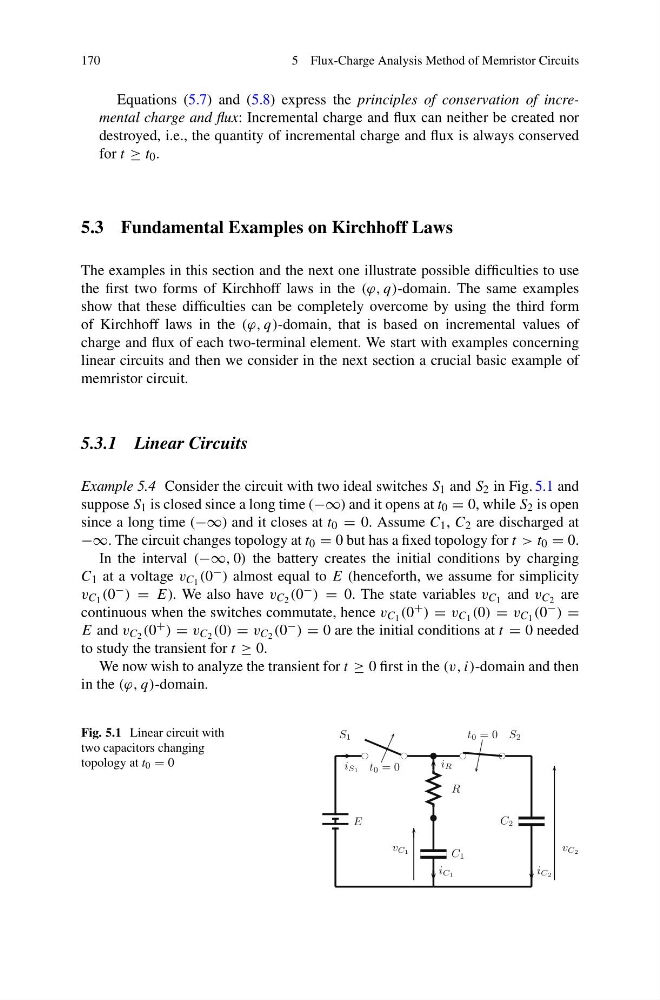
Example 5.4 Consider the circuit with two ideal switches S 1 and S 2 in Fig. 5.1 and
suppose S 1 is closed since a long time (−∞) and it opens at t 0 = 0, while S 2 is open
since a long time (−∞) and it closes at t 0 = 0. Assume C 1 , C 2 are discharged at
−∞. The circuit changes topology at t 0 = 0 but has a fixed topology for t > t 0 = 0.
In the interval (−∞, 0) the battery creates the initial conditions by charging
C 1 at a voltage v C 1 (0 − ) almost equal to E (henceforth, we assume for simplicity
v C 1 (0 − ) = E). We also have v C 2 (0 − ) = 0. The state variables v C 1 and v C 2 are
continuous when the switches commutate, hence v C 1 (0 + ) = v C 1 (0) = v C 1 (0 − ) =
E and v C 2 (0 + ) = v C 2 (0) = v C 2 (0 − ) = 0 are the initial conditions at t = 0 needed
to study the transient for t ≥ 0.
We now wish to analyze the transient for t ≥ 0 first in the (v, i)-domain and then
in the (ϕ, q)-domain.
Fig. 5.1 Linear circuit with
two capacitors changing
topology at t 0 = 0
E
S 1
t 0 = 0
R
C 1
S 2
t 0 = 0
C 2
v C1
i C1
i C2
i R
i S1
v C2
5 Flux-Charge Analysis Method of Memristor Circuits
Equations (5.7) and (5.8) express the principles of conservation of incremental charge and flux: Incremental charge and flux can neither be created nor
destroyed, i.e., the quantity of incremental charge and flux is always conserved
for t ≥ t 0 .
5.3 Fundamental Examples on Kirchhoff Laws
The examples in this section and the next one illustrate possible difficulties to use
the first two forms of Kirchhoff laws in the (ϕ, q)-domain. The same examples
show that these difficulties can be completely overcome by using the third form
of Kirchhoff laws in the (ϕ, q)-domain, that is based on incremental values of
charge and flux of each two-terminal element. We start with examples concerning
linear circuits and then we consider in the next section a crucial basic example of
memristor circuit.
5.3.1 Linear Circuits
Example 5.4 Consider the circuit with two ideal switches S 1 and S 2 in Fig. 5.1 and
suppose S 1 is closed since a long time (−∞) and it opens at t 0 = 0, while S 2 is open
since a long time (−∞) and it closes at t 0 = 0. Assume C 1 , C 2 are discharged at
−∞. The circuit changes topology at t 0 = 0 but has a fixed topology for t > t 0 = 0.
In the interval (−∞, 0) the battery creates the initial conditions by charging
C 1 at a voltage v C 1 (0 − ) almost equal to E (henceforth, we assume for simplicity
v C 1 (0 − ) = E). We also have v C 2 (0 − ) = 0. The state variables v C 1 and v C 2 are
continuous when the switches commutate, hence v C 1 (0 + ) = v C 1 (0) = v C 1 (0 − ) =
E and v C 2 (0 + ) = v C 2 (0) = v C 2 (0 − ) = 0 are the initial conditions at t = 0 needed
to study the transient for t ≥ 0.
We now wish to analyze the transient for t ≥ 0 first in the (v, i)-domain and then
in the (ϕ, q)-domain.
Fig. 5.1 Linear circuit with
two capacitors changing
topology at t 0 = 0
E
S 1
t 0 = 0
R
C 1
S 2
t 0 = 0
C 2
v C1
i C1
i C2
i R
i S1
v C2