

156
4 Nonlinear Dynamics and Bifurcations in Autonomous RLC Circuits
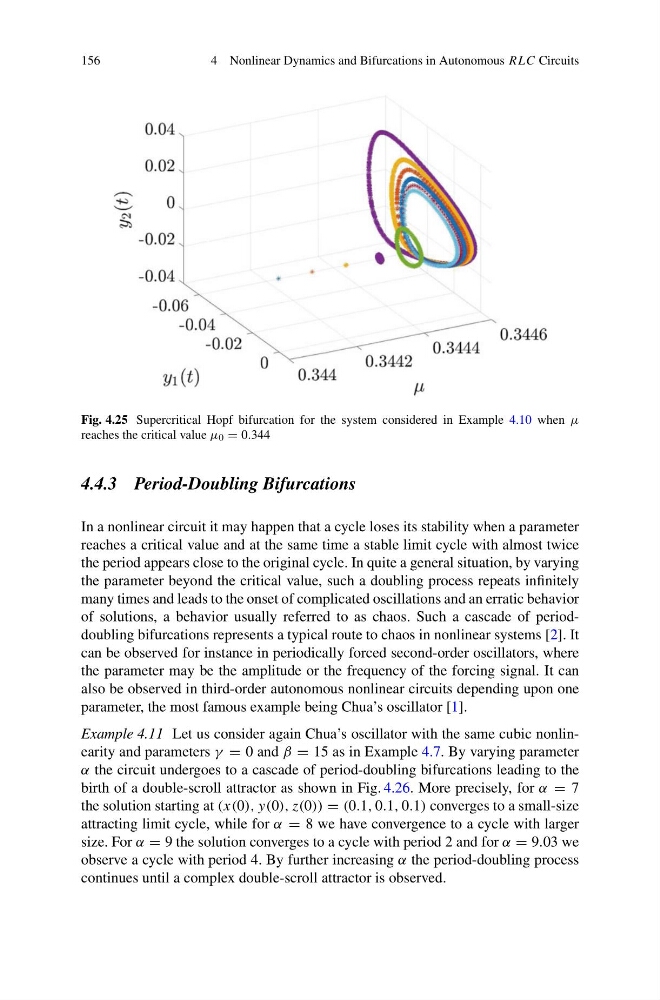
Fig. 4.25 Supercritical Hopf bifurcation for the system considered in Example 4.10 when μ
reaches the critical value μ 0 = 0.344
4.4.3 Period-Doubling Bifurcations
In a nonlinear circuit it may happen that a cycle loses its stability when a parameter
reaches a critical value and at the same time a stable limit cycle with almost twice
the period appears close to the original cycle. In quite a general situation, by varying
the parameter beyond the critical value, such a doubling process repeats infinitely
many times and leads to the onset of complicated oscillations and an erratic behavior
of solutions, a behavior usually referred to as chaos. Such a cascade of perioddoubling bifurcations represents a typical route to chaos in nonlinear systems [2]. It
can be observed for instance in periodically forced second-order oscillators, where
the parameter may be the amplitude or the frequency of the forcing signal. It can
also be observed in third-order autonomous nonlinear circuits depending upon one
parameter, the most famous example being Chua’s oscillator [1].
Example 4.11 Let us consider again Chua’s oscillator with the same cubic nonlinearity and parameters γ = 0 and β = 15 as in Example 4.7. By varying parameter
α the circuit undergoes to a cascade of period-doubling bifurcations leading to the
birth of a double-scroll attractor as shown in Fig. 4.26. More precisely, for α = 7
the solution starting at (x(0), y(0), z(0)) = (0.1, 0.1, 0.1) converges to a small-size
attracting limit cycle, while for α = 8 we have convergence to a cycle with larger
size. For α = 9 the solution converges to a cycle with period 2 and for α = 9.03 we
observe a cycle with period 4. By further increasing α the period-doubling process
continues until a complex double-scroll attractor is observed.
4 Nonlinear Dynamics and Bifurcations in Autonomous RLC Circuits
Fig. 4.25 Supercritical Hopf bifurcation for the system considered in Example 4.10 when μ
reaches the critical value μ 0 = 0.344
4.4.3 Period-Doubling Bifurcations
In a nonlinear circuit it may happen that a cycle loses its stability when a parameter
reaches a critical value and at the same time a stable limit cycle with almost twice
the period appears close to the original cycle. In quite a general situation, by varying
the parameter beyond the critical value, such a doubling process repeats infinitely
many times and leads to the onset of complicated oscillations and an erratic behavior
of solutions, a behavior usually referred to as chaos. Such a cascade of perioddoubling bifurcations represents a typical route to chaos in nonlinear systems [2]. It
can be observed for instance in periodically forced second-order oscillators, where
the parameter may be the amplitude or the frequency of the forcing signal. It can
also be observed in third-order autonomous nonlinear circuits depending upon one
parameter, the most famous example being Chua’s oscillator [1].
Example 4.11 Let us consider again Chua’s oscillator with the same cubic nonlinearity and parameters γ = 0 and β = 15 as in Example 4.7. By varying parameter
α the circuit undergoes to a cascade of period-doubling bifurcations leading to the
birth of a double-scroll attractor as shown in Fig. 4.26. More precisely, for α = 7
the solution starting at (x(0), y(0), z(0)) = (0.1, 0.1, 0.1) converges to a small-size
attracting limit cycle, while for α = 8 we have convergence to a cycle with larger
size. For α = 9 the solution converges to a cycle with period 2 and for α = 9.03 we
observe a cycle with period 4. By further increasing α the period-doubling process
continues until a complex double-scroll attractor is observed.