

4.4 Bifurcations of Equilibrium Points and Periodic Orbits
155
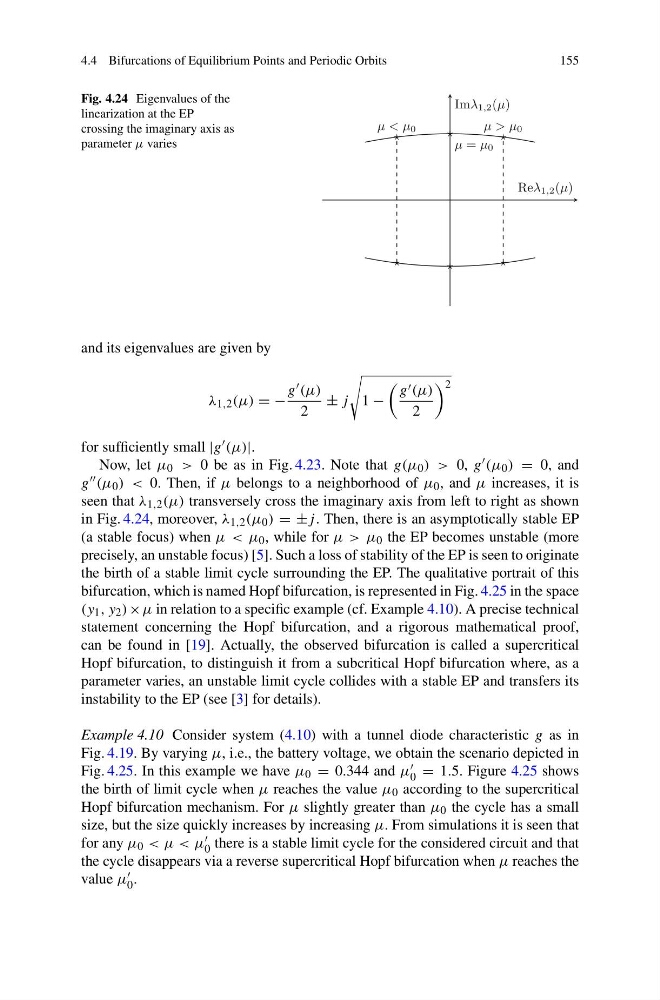
Fig. 4.24 Eigenvalues of the
linearization at the EP
crossing the imaginary axis as
parameter μ varies
and its eigenvalues are given by
λ 1,2 (μ) = −
g (μ)
2
± j
1 −
g (μ)
2
2
for sufficiently small |g (μ)|.
Now, let μ 0 > 0 be as in Fig. 4.23. Note that g(μ 0 ) > 0, g (μ 0 ) = 0, and
g (μ 0 ) < 0. Then, if μ belongs to a neighborhood of μ 0 , and μ increases, it is
seen that λ 1,2 (μ) transversely cross the imaginary axis from left to right as shown
in Fig. 4.24, moreover, λ 1,2 (μ 0 ) = ±j . Then, there is an asymptotically stable EP
(a stable focus) when μ < μ 0 , while for μ > μ 0 the EP becomes unstable (more
precisely, an unstable focus) [5]. Such a loss of stability of the EP is seen to originate
the birth of a stable limit cycle surrounding the EP. The qualitative portrait of this
bifurcation, which is named Hopf bifurcation, is represented in Fig. 4.25 in the space
(y 1 , y 2 ) × μ in relation to a specific example (cf. Example 4.10). A precise technical
statement concerning the Hopf bifurcation, and a rigorous mathematical proof,
can be found in [19]. Actually, the observed bifurcation is called a supercritical
Hopf bifurcation, to distinguish it from a subcritical Hopf bifurcation where, as a
parameter varies, an unstable limit cycle collides with a stable EP and transfers its
instability to the EP (see [3] for details).
Example 4.10 Consider system (4.10) with a tunnel diode characteristic g as in
Fig. 4.19. By varying μ, i.e., the battery voltage, we obtain the scenario depicted in
Fig. 4.25. In this example we have μ 0 = 0.344 and μ
0 = 1.5. Figure 4.25 shows
the birth of limit cycle when μ reaches the value μ 0 according to the supercritical
Hopf bifurcation mechanism. For μ slightly greater than μ 0 the cycle has a small
size, but the size quickly increases by increasing μ. From simulations it is seen that
for any μ 0 < μ < μ
0 there is a stable limit cycle for the considered circuit and that
the cycle disappears via a reverse supercritical Hopf bifurcation when μ reaches the
value μ
0 .
155
Fig. 4.24 Eigenvalues of the
linearization at the EP
crossing the imaginary axis as
parameter μ varies
and its eigenvalues are given by
λ 1,2 (μ) = −
g (μ)
2
± j
1 −
g (μ)
2
2
for sufficiently small |g (μ)|.
Now, let μ 0 > 0 be as in Fig. 4.23. Note that g(μ 0 ) > 0, g (μ 0 ) = 0, and
g (μ 0 ) < 0. Then, if μ belongs to a neighborhood of μ 0 , and μ increases, it is
seen that λ 1,2 (μ) transversely cross the imaginary axis from left to right as shown
in Fig. 4.24, moreover, λ 1,2 (μ 0 ) = ±j . Then, there is an asymptotically stable EP
(a stable focus) when μ < μ 0 , while for μ > μ 0 the EP becomes unstable (more
precisely, an unstable focus) [5]. Such a loss of stability of the EP is seen to originate
the birth of a stable limit cycle surrounding the EP. The qualitative portrait of this
bifurcation, which is named Hopf bifurcation, is represented in Fig. 4.25 in the space
(y 1 , y 2 ) × μ in relation to a specific example (cf. Example 4.10). A precise technical
statement concerning the Hopf bifurcation, and a rigorous mathematical proof,
can be found in [19]. Actually, the observed bifurcation is called a supercritical
Hopf bifurcation, to distinguish it from a subcritical Hopf bifurcation where, as a
parameter varies, an unstable limit cycle collides with a stable EP and transfers its
instability to the EP (see [3] for details).
Example 4.10 Consider system (4.10) with a tunnel diode characteristic g as in
Fig. 4.19. By varying μ, i.e., the battery voltage, we obtain the scenario depicted in
Fig. 4.25. In this example we have μ 0 = 0.344 and μ
0 = 1.5. Figure 4.25 shows
the birth of limit cycle when μ reaches the value μ 0 according to the supercritical
Hopf bifurcation mechanism. For μ slightly greater than μ 0 the cycle has a small
size, but the size quickly increases by increasing μ. From simulations it is seen that
for any μ 0 < μ < μ
0 there is a stable limit cycle for the considered circuit and that
the cycle disappears via a reverse supercritical Hopf bifurcation when μ reaches the
value μ
0 .