

150
4 Nonlinear Dynamics and Bifurcations in Autonomous RLC Circuits
attractors from a certain class of 3D vector fields [1]. This means that Chua’s
oscillator can be used to mimic the behavior of other piecewise-linear oscillators and
also approximate the behavior of many others which exhibit smooth nonlinearities.
Remark 4.5 There are several relevant application fields for the complex dynamics
displayed by Chua’s oscillator as data encryption via chaotic signals for secure
communications [16, 17]. Several studies are available on the implementation of
cellular nonlinear networks with basic cells composed by Chua’s oscillators and
the study of the ensuing complex spatiotemporal and synchronization phenomena
observed in these structures, see, e.g., [18], and references therein.
4.4 Bifurcations of Equilibrium Points and Periodic Orbits
One of the most interesting aspects of nonlinear dynamic circuits is dependence on
parameters. The qualitative structure of the dynamics can change, even significantly,
when parameters are varied. For example, there may be the birth or disappearance
of EPs, or the change of stability of an EP, when a parameter reaches a certain value.
Something analogous may happen for periodic orbits (cycles). Such qualitative
changes in the dynamics are called bifurcations and the parameter values at which
they occur are named bifurcation points or critical parameter values. In this chapter
we discuss at an elementary level some basic bifurcations of EPs and periodic orbits
that are of interest for the topics dealt with in the book. The reader is referred to the
fundamental textbooks [2, 3] for a thorough treatment.
4.4.1 Saddle-Node Bifurcations
The saddle-node bifurcation is the basic mechanism by which EPs are created or
destroyed. As a parameter is varied, two EPs of a nonlinear circuit move toward
each other, collide, and mutually annihilate. We refer the reader to [3] for other
types of bifurcations of an EP, as the transcritical and pitchfork bifurcation.
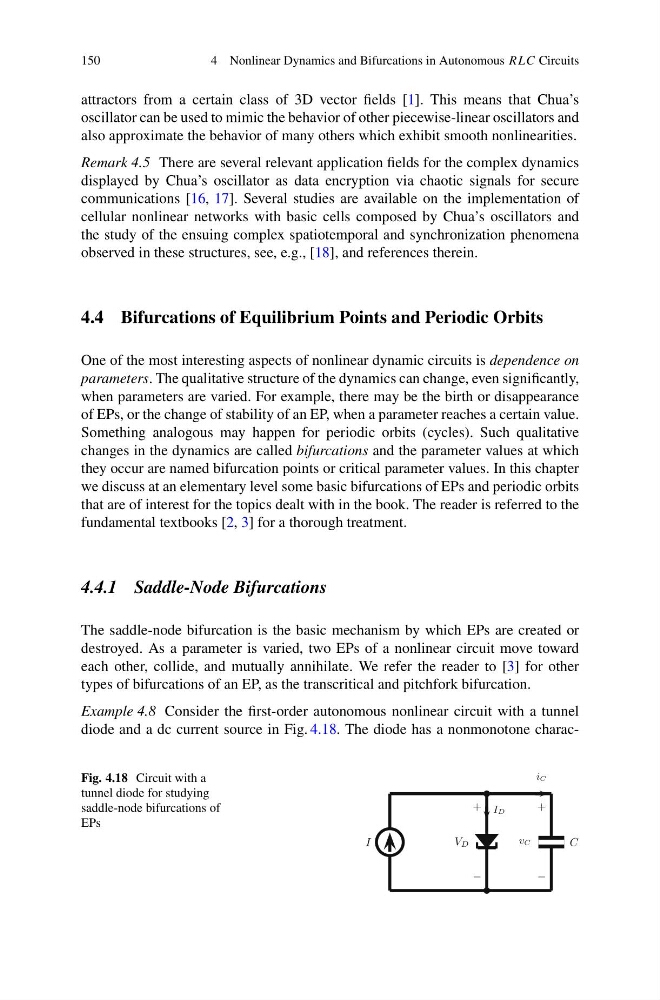
Example 4.8 Consider the first-order autonomous nonlinear circuit with a tunnel
diode and a dc current source in Fig. 4.18. The diode has a nonmonotone characFig. 4.18 Circuit with a
tunnel diode for studying
saddle-node bifurcations of
EPs
4 Nonlinear Dynamics and Bifurcations in Autonomous RLC Circuits
attractors from a certain class of 3D vector fields [1]. This means that Chua’s
oscillator can be used to mimic the behavior of other piecewise-linear oscillators and
also approximate the behavior of many others which exhibit smooth nonlinearities.
Remark 4.5 There are several relevant application fields for the complex dynamics
displayed by Chua’s oscillator as data encryption via chaotic signals for secure
communications [16, 17]. Several studies are available on the implementation of
cellular nonlinear networks with basic cells composed by Chua’s oscillators and
the study of the ensuing complex spatiotemporal and synchronization phenomena
observed in these structures, see, e.g., [18], and references therein.
4.4 Bifurcations of Equilibrium Points and Periodic Orbits
One of the most interesting aspects of nonlinear dynamic circuits is dependence on
parameters. The qualitative structure of the dynamics can change, even significantly,
when parameters are varied. For example, there may be the birth or disappearance
of EPs, or the change of stability of an EP, when a parameter reaches a certain value.
Something analogous may happen for periodic orbits (cycles). Such qualitative
changes in the dynamics are called bifurcations and the parameter values at which
they occur are named bifurcation points or critical parameter values. In this chapter
we discuss at an elementary level some basic bifurcations of EPs and periodic orbits
that are of interest for the topics dealt with in the book. The reader is referred to the
fundamental textbooks [2, 3] for a thorough treatment.
4.4.1 Saddle-Node Bifurcations
The saddle-node bifurcation is the basic mechanism by which EPs are created or
destroyed. As a parameter is varied, two EPs of a nonlinear circuit move toward
each other, collide, and mutually annihilate. We refer the reader to [3] for other
types of bifurcations of an EP, as the transcritical and pitchfork bifurcation.
Example 4.8 Consider the first-order autonomous nonlinear circuit with a tunnel
diode and a dc current source in Fig. 4.18. The diode has a nonmonotone characFig. 4.18 Circuit with a
tunnel diode for studying
saddle-node bifurcations of
EPs