

4.3 Third-Order Circuits
149
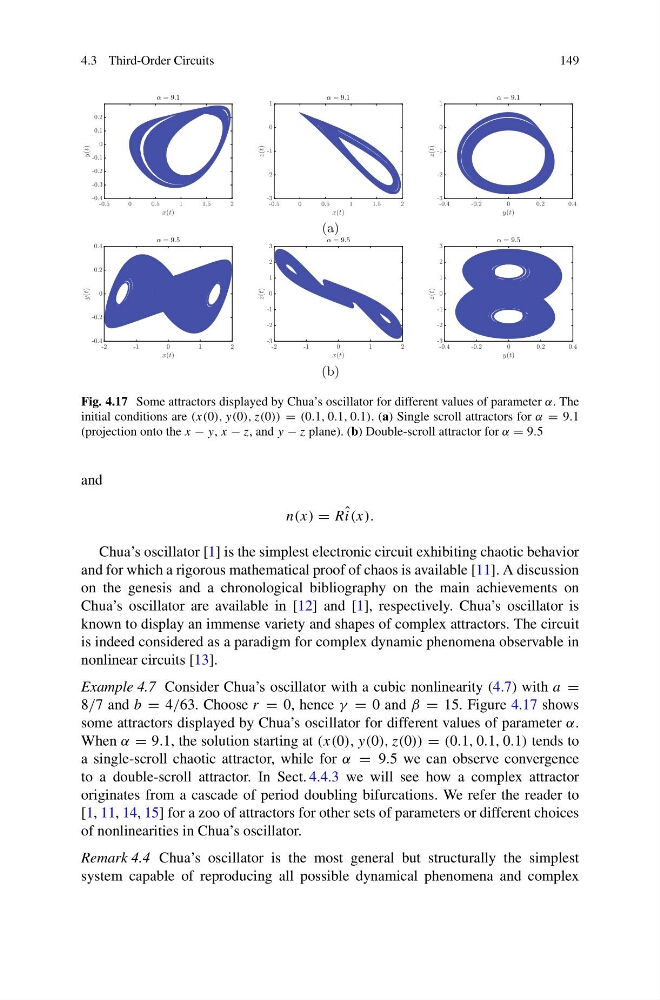
Fig. 4.17 Some attractors displayed by Chua’s oscillator for different values of parameter α. The
initial conditions are (x(0), y(0), z(0)) = (0.1, 0.1, 0.1). (a) Single scroll attractors for α = 9.1
(projection onto the x − y, x − z, and y − z plane). (b) Double-scroll attractor for α = 9.5
and
n(x) = R ˆ
i(x).
Chua’s oscillator [1] is the simplest electronic circuit exhibiting chaotic behavior
and for which a rigorous mathematical proof of chaos is available [11]. A discussion
on the genesis and a chronological bibliography on the main achievements on
Chua’s oscillator are available in [12] and [1], respectively. Chua’s oscillator is
known to display an immense variety and shapes of complex attractors. The circuit
is indeed considered as a paradigm for complex dynamic phenomena observable in
nonlinear circuits [13].
Example 4.7 Consider Chua’s oscillator with a cubic nonlinearity (4.7) with a =
8/7 and b = 4/63. Choose r = 0, hence γ = 0 and β = 15. Figure 4.17 shows
some attractors displayed by Chua’s oscillator for different values of parameter α.
When α = 9.1, the solution starting at (x(0), y(0), z(0)) = (0.1, 0.1, 0.1) tends to
a single-scroll chaotic attractor, while for α = 9.5 we can observe convergence
to a double-scroll attractor. In Sect. 4.4.3 we will see how a complex attractor
originates from a cascade of period doubling bifurcations. We refer the reader to
[1, 11, 14, 15] for a zoo of attractors for other sets of parameters or different choices
of nonlinearities in Chua’s oscillator.
Remark 4.4 Chua’s oscillator is the most general but structurally the simplest
system capable of reproducing all possible dynamical phenomena and complex
149
Fig. 4.17 Some attractors displayed by Chua’s oscillator for different values of parameter α. The
initial conditions are (x(0), y(0), z(0)) = (0.1, 0.1, 0.1). (a) Single scroll attractors for α = 9.1
(projection onto the x − y, x − z, and y − z plane). (b) Double-scroll attractor for α = 9.5
and
n(x) = R ˆ
i(x).
Chua’s oscillator [1] is the simplest electronic circuit exhibiting chaotic behavior
and for which a rigorous mathematical proof of chaos is available [11]. A discussion
on the genesis and a chronological bibliography on the main achievements on
Chua’s oscillator are available in [12] and [1], respectively. Chua’s oscillator is
known to display an immense variety and shapes of complex attractors. The circuit
is indeed considered as a paradigm for complex dynamic phenomena observable in
nonlinear circuits [13].
Example 4.7 Consider Chua’s oscillator with a cubic nonlinearity (4.7) with a =
8/7 and b = 4/63. Choose r = 0, hence γ = 0 and β = 15. Figure 4.17 shows
some attractors displayed by Chua’s oscillator for different values of parameter α.
When α = 9.1, the solution starting at (x(0), y(0), z(0)) = (0.1, 0.1, 0.1) tends to
a single-scroll chaotic attractor, while for α = 9.5 we can observe convergence
to a double-scroll attractor. In Sect. 4.4.3 we will see how a complex attractor
originates from a cascade of period doubling bifurcations. We refer the reader to
[1, 11, 14, 15] for a zoo of attractors for other sets of parameters or different choices
of nonlinearities in Chua’s oscillator.
Remark 4.4 Chua’s oscillator is the most general but structurally the simplest
system capable of reproducing all possible dynamical phenomena and complex