

4.3 Third-Order Circuits
147
4.3 Third-Order Circuits
The possible dynamic behaviors of a second-order autonomous circuit, although
of practical interest, continue to be quite limited. In fact, it can be shown that in
a generic second-order autonomous system of differential equations defined by a
smooth vector field the limit set of each trajectory 2 is either an EP or a cycle
(periodic attractor) [10]. On the other hand, third-order autonomous dynamical
circuits can display much more complicated dynamics, named chaotic dynamics,
that are characterized by an erratic, non-periodic, behavior of solutions and limit
sets with a complicated fractal structure. One of the most famous examples of this
kind is Chua’s oscillator [1], which is briefly discussed in the next section.
4.3.1 Chua’s Oscillator
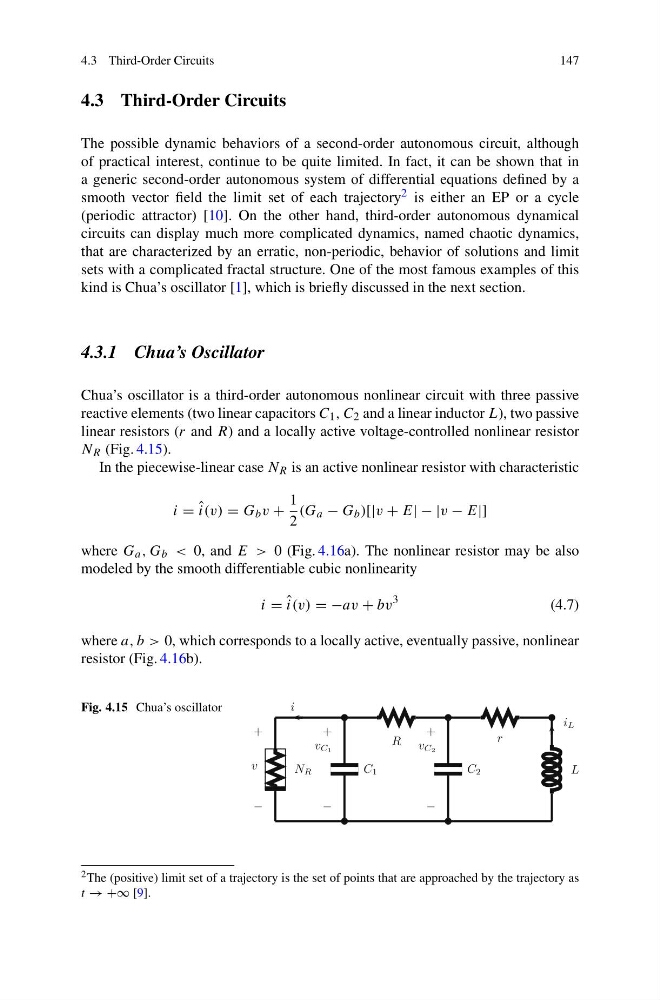
Chua’s oscillator is a third-order autonomous nonlinear circuit with three passive
reactive elements (two linear capacitors C 1 , C 2 and a linear inductor L), two passive
linear resistors (r and R) and a locally active voltage-controlled nonlinear resistor
N R (Fig. 4.15).
In the piecewise-linear case N R is an active nonlinear resistor with characteristic
i = ˆ
i(v) = G b v +
1
2
(G a − G b )[|v + E| − |v − E|]
where G a , G b < 0, and E > 0 (Fig. 4.16a). The nonlinear resistor may be also
modeled by the smooth differentiable cubic nonlinearity
i = ˆ
i(v) = −av + bv
3
(4.7)
where a, b > 0, which corresponds to a locally active, eventually passive, nonlinear
resistor (Fig. 4.16b).
Fig. 4.15 Chua’s oscillator
2 The (positive) limit set of a trajectory is the set of points that are approached by the trajectory as
t → +∞ [9].
147
4.3 Third-Order Circuits
The possible dynamic behaviors of a second-order autonomous circuit, although
of practical interest, continue to be quite limited. In fact, it can be shown that in
a generic second-order autonomous system of differential equations defined by a
smooth vector field the limit set of each trajectory 2 is either an EP or a cycle
(periodic attractor) [10]. On the other hand, third-order autonomous dynamical
circuits can display much more complicated dynamics, named chaotic dynamics,
that are characterized by an erratic, non-periodic, behavior of solutions and limit
sets with a complicated fractal structure. One of the most famous examples of this
kind is Chua’s oscillator [1], which is briefly discussed in the next section.
4.3.1 Chua’s Oscillator
Chua’s oscillator is a third-order autonomous nonlinear circuit with three passive
reactive elements (two linear capacitors C 1 , C 2 and a linear inductor L), two passive
linear resistors (r and R) and a locally active voltage-controlled nonlinear resistor
N R (Fig. 4.15).
In the piecewise-linear case N R is an active nonlinear resistor with characteristic
i = ˆ
i(v) = G b v +
1
2
(G a − G b )[|v + E| − |v − E|]
where G a , G b < 0, and E > 0 (Fig. 4.16a). The nonlinear resistor may be also
modeled by the smooth differentiable cubic nonlinearity
i = ˆ
i(v) = −av + bv
3
(4.7)
where a, b > 0, which corresponds to a locally active, eventually passive, nonlinear
resistor (Fig. 4.16b).
Fig. 4.15 Chua’s oscillator
2 The (positive) limit set of a trajectory is the set of points that are approached by the trajectory as
t → +∞ [9].