

4.1 First-Order Circuits
133
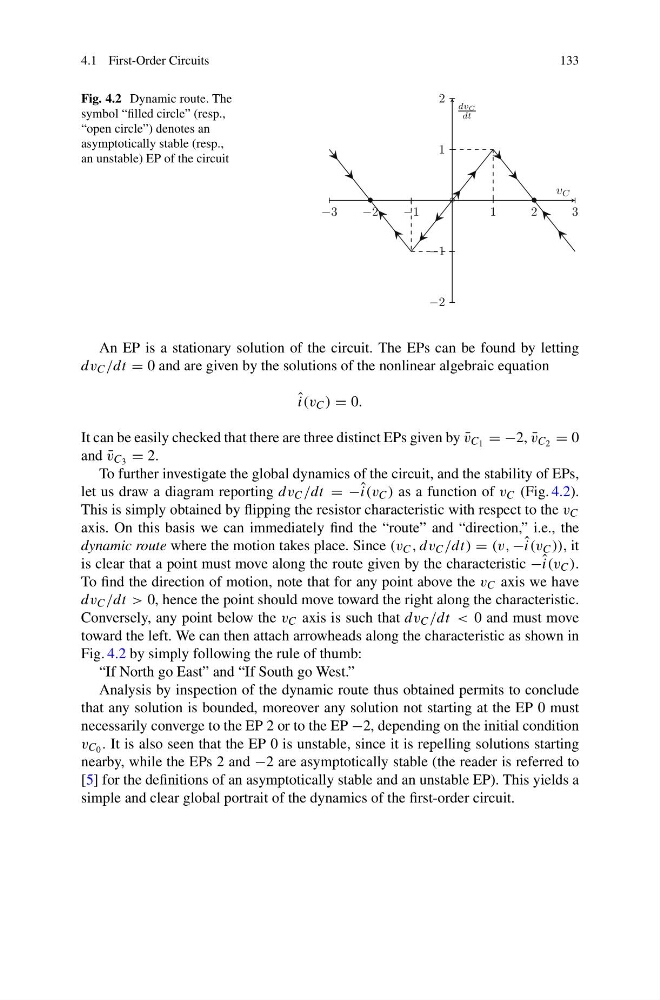
Fig. 4.2 Dynamic route. The
symbol “filled circle” (resp.,
“open circle”) denotes an
asymptotically stable (resp.,
an unstable) EP of the circuit
An EP is a stationary solution of the circuit. The EPs can be found by letting
dv C /dt = 0 and are given by the solutions of the nonlinear algebraic equation
ˆ
i(v C ) = 0.
It can be easily checked that there are three distinct EPs given by ¯
v C 1 = −2, ¯
v C 2 = 0
and ¯
v C 3 = 2.
To further investigate the global dynamics of the circuit, and the stability of EPs,
let us draw a diagram reporting dv C /dt = − ˆ
i(v C ) as a function of v C (Fig. 4.2).
This is simply obtained by flipping the resistor characteristic with respect to the v C
axis. On this basis we can immediately find the “route” and “direction,” i.e., the
dynamic route where the motion takes place. Since (v C , dv C /dt) = (v, − ˆ
i(v C )), it
is clear that a point must move along the route given by the characteristic − ˆ
i(v C ).
To find the direction of motion, note that for any point above the v C axis we have
dv C /dt > 0, hence the point should move toward the right along the characteristic.
Conversely, any point below the v C axis is such that dv C /dt < 0 and must move
toward the left. We can then attach arrowheads along the characteristic as shown in
Fig. 4.2 by simply following the rule of thumb:
“If North go East” and “If South go West.”
Analysis by inspection of the dynamic route thus obtained permits to conclude
that any solution is bounded, moreover any solution not starting at the EP 0 must
necessarily converge to the EP 2 or to the EP −2, depending on the initial condition
v C 0 . It is also seen that the EP 0 is unstable, since it is repelling solutions starting
nearby, while the EPs 2 and −2 are asymptotically stable (the reader is referred to
[5] for the definitions of an asymptotically stable and an unstable EP). This yields a
simple and clear global portrait of the dynamics of the first-order circuit.
133
Fig. 4.2 Dynamic route. The
symbol “filled circle” (resp.,
“open circle”) denotes an
asymptotically stable (resp.,
an unstable) EP of the circuit
An EP is a stationary solution of the circuit. The EPs can be found by letting
dv C /dt = 0 and are given by the solutions of the nonlinear algebraic equation
ˆ
i(v C ) = 0.
It can be easily checked that there are three distinct EPs given by ¯
v C 1 = −2, ¯
v C 2 = 0
and ¯
v C 3 = 2.
To further investigate the global dynamics of the circuit, and the stability of EPs,
let us draw a diagram reporting dv C /dt = − ˆ
i(v C ) as a function of v C (Fig. 4.2).
This is simply obtained by flipping the resistor characteristic with respect to the v C
axis. On this basis we can immediately find the “route” and “direction,” i.e., the
dynamic route where the motion takes place. Since (v C , dv C /dt) = (v, − ˆ
i(v C )), it
is clear that a point must move along the route given by the characteristic − ˆ
i(v C ).
To find the direction of motion, note that for any point above the v C axis we have
dv C /dt > 0, hence the point should move toward the right along the characteristic.
Conversely, any point below the v C axis is such that dv C /dt < 0 and must move
toward the left. We can then attach arrowheads along the characteristic as shown in
Fig. 4.2 by simply following the rule of thumb:
“If North go East” and “If South go West.”
Analysis by inspection of the dynamic route thus obtained permits to conclude
that any solution is bounded, moreover any solution not starting at the EP 0 must
necessarily converge to the EP 2 or to the EP −2, depending on the initial condition
v C 0 . It is also seen that the EP 0 is unstable, since it is repelling solutions starting
nearby, while the EPs 2 and −2 are asymptotically stable (the reader is referred to
[5] for the definitions of an asymptotically stable and an unstable EP). This yields a
simple and clear global portrait of the dynamics of the first-order circuit.