

3.3 State Equations
121
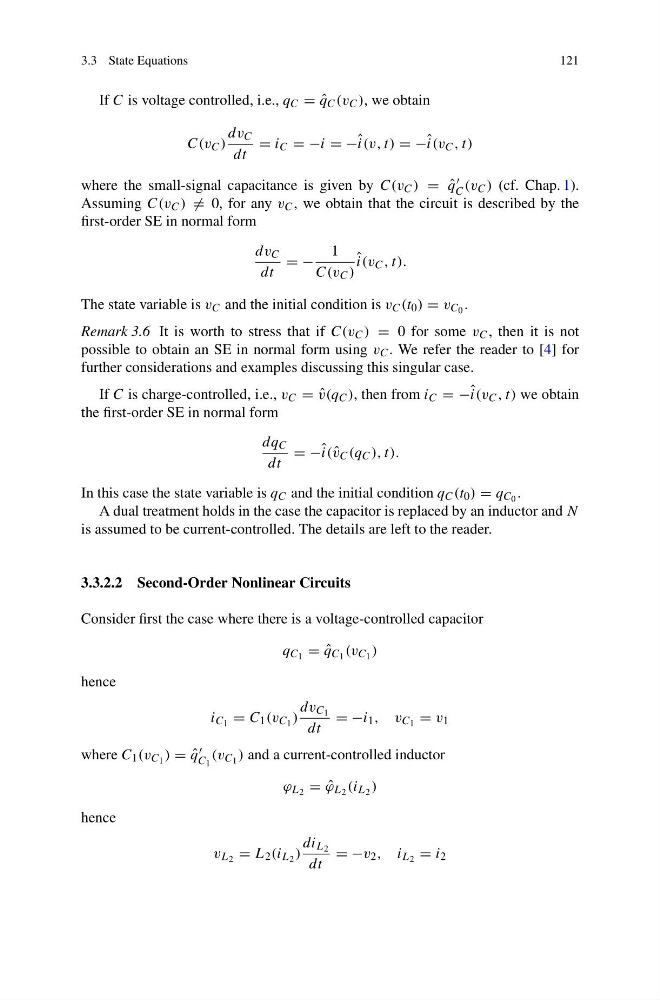
If C is voltage controlled, i.e., q C = ˆ
q C (v C ), we obtain
C(v C )
dv C
dt
= i C = −i = − ˆ
i(v, t) = − ˆ
i(v C , t)
where the small-signal capacitance is given by C(v C ) = ˆ
q
C (v C ) (cf. Chap. 1).
Assuming C(v C ) = 0, for any v C , we obtain that the circuit is described by the
first-order SE in normal form
dv C
dt
= −
1
C(v C )
ˆ
i(v C , t).
The state variable is v C and the initial condition is v C (t 0 ) = v C 0 .
Remark 3.6 It is worth to stress that if C(v C ) = 0 for some v C , then it is not
possible to obtain an SE in normal form using v C . We refer the reader to [4] for
further considerations and examples discussing this singular case.
If C is charge-controlled, i.e., v C = ˆ
v(q C ), then from i C = − ˆ
i(v C , t) we obtain
the first-order SE in normal form
dq C
dt
= − ˆ
i( ˆ
v C (q C ), t).
In this case the state variable is q C and the initial condition q C (t 0 ) = q C 0 .
A dual treatment holds in the case the capacitor is replaced by an inductor and N
is assumed to be current-controlled. The details are left to the reader.
3.3.2.2 Second-Order Nonlinear Circuits
Consider first the case where there is a voltage-controlled capacitor
q C 1 = ˆ
q C 1 (v C 1 )
hence
i C 1 = C 1 (v C 1 )
dv C 1
dt
= −i 1 , v C 1 = v 1
where C 1 (v C 1 ) = ˆ
q
C 1
(v C 1 ) and a current-controlled inductor
ϕ L 2 = ˆ
ϕ L 2 (i L 2 )
hence
v L 2 = L 2 (i L 2 )
di L 2
dt
= −v 2 , i L 2 = i 2
121
If C is voltage controlled, i.e., q C = ˆ
q C (v C ), we obtain
C(v C )
dv C
dt
= i C = −i = − ˆ
i(v, t) = − ˆ
i(v C , t)
where the small-signal capacitance is given by C(v C ) = ˆ
q
C (v C ) (cf. Chap. 1).
Assuming C(v C ) = 0, for any v C , we obtain that the circuit is described by the
first-order SE in normal form
dv C
dt
= −
1
C(v C )
ˆ
i(v C , t).
The state variable is v C and the initial condition is v C (t 0 ) = v C 0 .
Remark 3.6 It is worth to stress that if C(v C ) = 0 for some v C , then it is not
possible to obtain an SE in normal form using v C . We refer the reader to [4] for
further considerations and examples discussing this singular case.
If C is charge-controlled, i.e., v C = ˆ
v(q C ), then from i C = − ˆ
i(v C , t) we obtain
the first-order SE in normal form
dq C
dt
= − ˆ
i( ˆ
v C (q C ), t).
In this case the state variable is q C and the initial condition q C (t 0 ) = q C 0 .
A dual treatment holds in the case the capacitor is replaced by an inductor and N
is assumed to be current-controlled. The details are left to the reader.
3.3.2.2 Second-Order Nonlinear Circuits
Consider first the case where there is a voltage-controlled capacitor
q C 1 = ˆ
q C 1 (v C 1 )
hence
i C 1 = C 1 (v C 1 )
dv C 1
dt
= −i 1 , v C 1 = v 1
where C 1 (v C 1 ) = ˆ
q
C 1
(v C 1 ) and a current-controlled inductor
ϕ L 2 = ˆ
ϕ L 2 (i L 2 )
hence
v L 2 = L 2 (i L 2 )
di L 2
dt
= −v 2 , i L 2 = i 2