

Re-NetTA. Re-Manufacturing Networks for Tertiary Architectures
307
it was designed to perform. Reconditioning regards the return of a used product to a
satisfactory working condition, by rebuilding or repairing its major components (with
a possible inferior performance, so the warranty is generally less than the new ones).
Instead, re-manufacturing is the operation through which a used product returns at
least to its original performance with a warranty that is equivalent to or better than
that of the newly manufactured product. Recycling regards the process by which the
waste is transformed into a secondary material for performing the original purpose or
other purposes. Hence, in terms of value, according to the standard BS 8887:2:2009,
re-manufacturing is the only process that returns a product characterized by the same,
or higher, value than the original product.
Currently, in the built environment, only the movable parts of buildings such
as furniture, chairs, desks, shelves are sometimes re-manufactured. Pursuing the
circular economy objectives, the Center for Remanufacturing and Reusefounded
the European Remanufacturing Network (2016) for academic research in order to
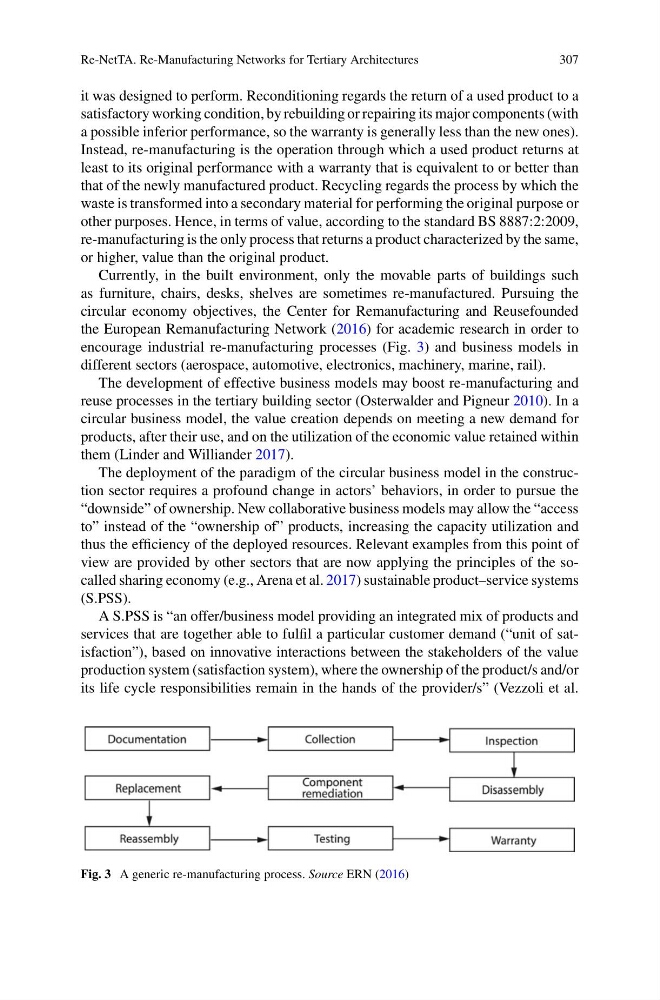
encourage industrial re-manufacturing processes (Fig. 3) and business models in
different sectors (aerospace, automotive, electronics, machinery, marine, rail).
The development of effective business models may boost re-manufacturing and
reuse processes in the tertiary building sector (Osterwalder and Pigneur 2010). In a
circular business model, the value creation depends on meeting a new demand for
products, after their use, and on the utilization of the economic value retained within
them (Linder and Williander 2017).
The deployment of the paradigm of the circular business model in the construction sector requires a profound change in actors’ behaviors, in order to pursue the
“downside” of ownership. New collaborative business models may allow the “access
to” instead of the “ownership of” products, increasing the capacity utilization and
thus the efficiency of the deployed resources. Relevant examples from this point of
view are provided by other sectors that are now applying the principles of the socalled sharing economy (e.g., Arena et al. 2017) sustainable product–service systems
(S.PSS).
A S.PSS is “an offer/business model providing an integrated mix of products and
services that are together able to fulfil a particular customer demand (“unit of satisfaction”), based on innovative interactions between the stakeholders of the value
production system (satisfaction system), where the ownership of the product/s and/or
its life cycle responsibilities remain in the hands of the provider/s” (Vezzoli et al.
Fig. 3 A generic re-manufacturing process. Source ERN (2016)
307
it was designed to perform. Reconditioning regards the return of a used product to a
satisfactory working condition, by rebuilding or repairing its major components (with
a possible inferior performance, so the warranty is generally less than the new ones).
Instead, re-manufacturing is the operation through which a used product returns at
least to its original performance with a warranty that is equivalent to or better than
that of the newly manufactured product. Recycling regards the process by which the
waste is transformed into a secondary material for performing the original purpose or
other purposes. Hence, in terms of value, according to the standard BS 8887:2:2009,
re-manufacturing is the only process that returns a product characterized by the same,
or higher, value than the original product.
Currently, in the built environment, only the movable parts of buildings such
as furniture, chairs, desks, shelves are sometimes re-manufactured. Pursuing the
circular economy objectives, the Center for Remanufacturing and Reusefounded
the European Remanufacturing Network (2016) for academic research in order to
encourage industrial re-manufacturing processes (Fig. 3) and business models in
different sectors (aerospace, automotive, electronics, machinery, marine, rail).
The development of effective business models may boost re-manufacturing and
reuse processes in the tertiary building sector (Osterwalder and Pigneur 2010). In a
circular business model, the value creation depends on meeting a new demand for
products, after their use, and on the utilization of the economic value retained within
them (Linder and Williander 2017).
The deployment of the paradigm of the circular business model in the construction sector requires a profound change in actors’ behaviors, in order to pursue the
“downside” of ownership. New collaborative business models may allow the “access
to” instead of the “ownership of” products, increasing the capacity utilization and
thus the efficiency of the deployed resources. Relevant examples from this point of
view are provided by other sectors that are now applying the principles of the socalled sharing economy (e.g., Arena et al. 2017) sustainable product–service systems
(S.PSS).
A S.PSS is “an offer/business model providing an integrated mix of products and
services that are together able to fulfil a particular customer demand (“unit of satisfaction”), based on innovative interactions between the stakeholders of the value
production system (satisfaction system), where the ownership of the product/s and/or
its life cycle responsibilities remain in the hands of the provider/s” (Vezzoli et al.
Fig. 3 A generic re-manufacturing process. Source ERN (2016)