

308
C. Talamo et al.
2014). The S.PSS models are based on radical innovations, not so much on technological ones, but more on new interactions/partnerships between the stakeholders of
a particular satisfaction production chain (life cycle/s).
This new vision is closely related to the Life Cycle Management (LCM): a comprehensive analysis along with a change of the processes related to the product life
cycle is necessary for sustainable development. Life Cycle Assessment (LCA) and
Life Cycle Cost (LCC) are the supporting tools for decision-making, assessing the
environmental and economic impacts of strategies (Lavagna 2008; Monticelli 2013).
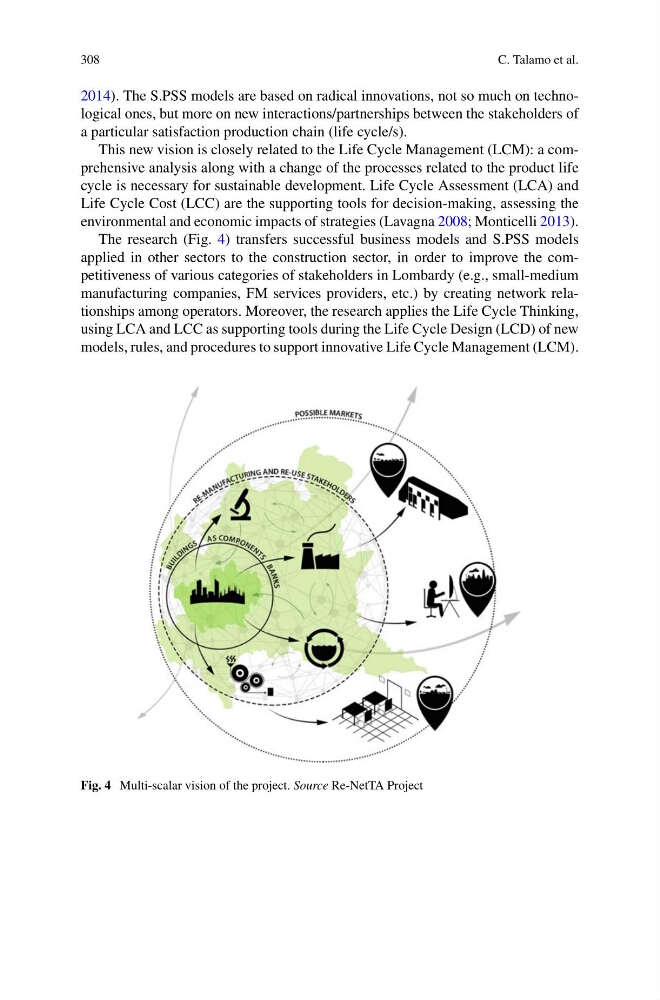
The research (Fig. 4) transfers successful business models and S.PSS models
applied in other sectors to the construction sector, in order to improve the competitiveness of various categories of stakeholders in Lombardy (e.g., small-medium
manufacturing companies, FM services providers, etc.) by creating network relationships among operators. Moreover, the research applies the Life Cycle Thinking,
using LCA and LCC as supporting tools during the Life Cycle Design (LCD) of new
models, rules, and procedures to support innovative Life Cycle Management (LCM).
Fig. 4 Multi-scalar vision of the project. Source Re-NetTA Project
C. Talamo et al.
2014). The S.PSS models are based on radical innovations, not so much on technological ones, but more on new interactions/partnerships between the stakeholders of
a particular satisfaction production chain (life cycle/s).
This new vision is closely related to the Life Cycle Management (LCM): a comprehensive analysis along with a change of the processes related to the product life
cycle is necessary for sustainable development. Life Cycle Assessment (LCA) and
Life Cycle Cost (LCC) are the supporting tools for decision-making, assessing the
environmental and economic impacts of strategies (Lavagna 2008; Monticelli 2013).
The research (Fig. 4) transfers successful business models and S.PSS models
applied in other sectors to the construction sector, in order to improve the competitiveness of various categories of stakeholders in Lombardy (e.g., small-medium
manufacturing companies, FM services providers, etc.) by creating network relationships among operators. Moreover, the research applies the Life Cycle Thinking,
using LCA and LCC as supporting tools during the Life Cycle Design (LCD) of new
models, rules, and procedures to support innovative Life Cycle Management (LCM).
Fig. 4 Multi-scalar vision of the project. Source Re-NetTA Project