

306
C. Talamo et al.
and dry disassembled solutions, characterized by high obsolescence, requiring frequent interventions of disassembling/renewal/transformation. The report of Regione
Lombardia (2016) shows that Lombardy is the first Italian region for exhibition activities, with over 600,000 m
2 of gross covered surfaces. The regional offer of exhibition
spaces is concentrated in Milan (62% of the overall availability of covered spaces).
The presence in Lombardy of a substantial vast tertiary building stock, characterized by subject to frequent renewals/transformations, due to accelerated
obsolescence, generates increasing quantities of materials and components—often
dry-assembled—still embodying high added value.
Starting from these data, the research considers the specific field of the tertiary
sector and “temporary use,” that generates a great amount of waste, in the Lombardy
Region.
3 Actions to Close the Cycle: Re-Manufacturing and ReUse
Business Models
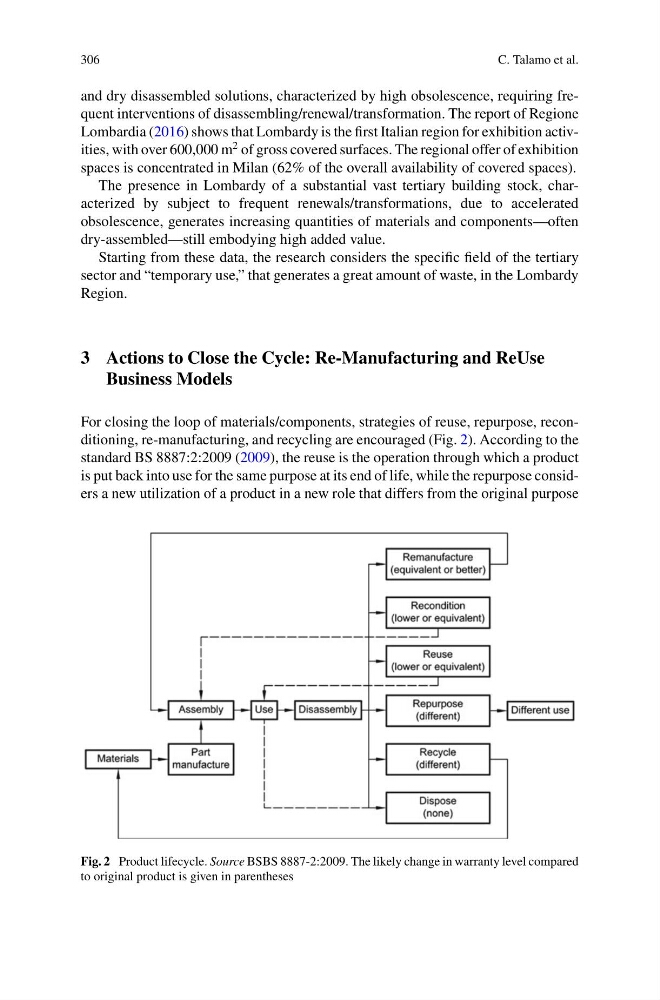
For closing the loop of materials/components, strategies of reuse, repurpose, reconditioning, re-manufacturing, and recycling are encouraged (Fig. 2). According to the
standard BS 8887:2:2009 (2009), the reuse is the operation through which a product
is put back into use for the same purpose at its end of life, while the repurpose considers a new utilization of a product in a new role that differs from the original purpose
Fig. 2 Product lifecycle. Source BSBS 8887-2:2009. The likely change in warranty level compared
to original product is given in parentheses
C. Talamo et al.
and dry disassembled solutions, characterized by high obsolescence, requiring frequent interventions of disassembling/renewal/transformation. The report of Regione
Lombardia (2016) shows that Lombardy is the first Italian region for exhibition activities, with over 600,000 m
2 of gross covered surfaces. The regional offer of exhibition
spaces is concentrated in Milan (62% of the overall availability of covered spaces).
The presence in Lombardy of a substantial vast tertiary building stock, characterized by subject to frequent renewals/transformations, due to accelerated
obsolescence, generates increasing quantities of materials and components—often
dry-assembled—still embodying high added value.
Starting from these data, the research considers the specific field of the tertiary
sector and “temporary use,” that generates a great amount of waste, in the Lombardy
Region.
3 Actions to Close the Cycle: Re-Manufacturing and ReUse
Business Models
For closing the loop of materials/components, strategies of reuse, repurpose, reconditioning, re-manufacturing, and recycling are encouraged (Fig. 2). According to the
standard BS 8887:2:2009 (2009), the reuse is the operation through which a product
is put back into use for the same purpose at its end of life, while the repurpose considers a new utilization of a product in a new role that differs from the original purpose
Fig. 2 Product lifecycle. Source BSBS 8887-2:2009. The likely change in warranty level compared
to original product is given in parentheses