

270
A. Zanelli et al.
construction. Despite this, the specific sector of textiles and polymers still has a low
market penetration in the wider predominant building components sector. In this
scenario, innovation occurs more often led by novel designs and structural concepts
at the macro-scale (building level) than by looking at the eco-sustainability of the
textiles and polymers at the micro-scale (matter level).
After this decade of advances, harmonizing the local regulatory standards (Mollaert et al. 2016), and sharing knowledge through networks
2 and multidisciplinary
research projects,
3 urgent open issues under scientists responsibility are: (1) a fairer
and environmentally conscious design-driven innovation path; (2) the designers’ lack
of in-depth knowledge on membranes and foils; and (3) the gap between the increasing interest in innovative designs and the limited number of experimental testing
laboratories.
4 A Research-Integrated Design Methodology, Enabling
Biotechnologies in Textile Architecture
Since 2015, the multidisciplinary research laboratory TEXTILESHUB (TH Lab)
at Politecnico di Milano has been carrying out, in a complementary and mutually
reinforcing manner, design consultancies, educational exercises, and experimental
scientific campaigns. The common goal of these theoretical and practical activities
is assessing the applicability of novel natural/synthetic flexible materials, making
progress in the creative and innovative use of ultra-lightweight building systems.
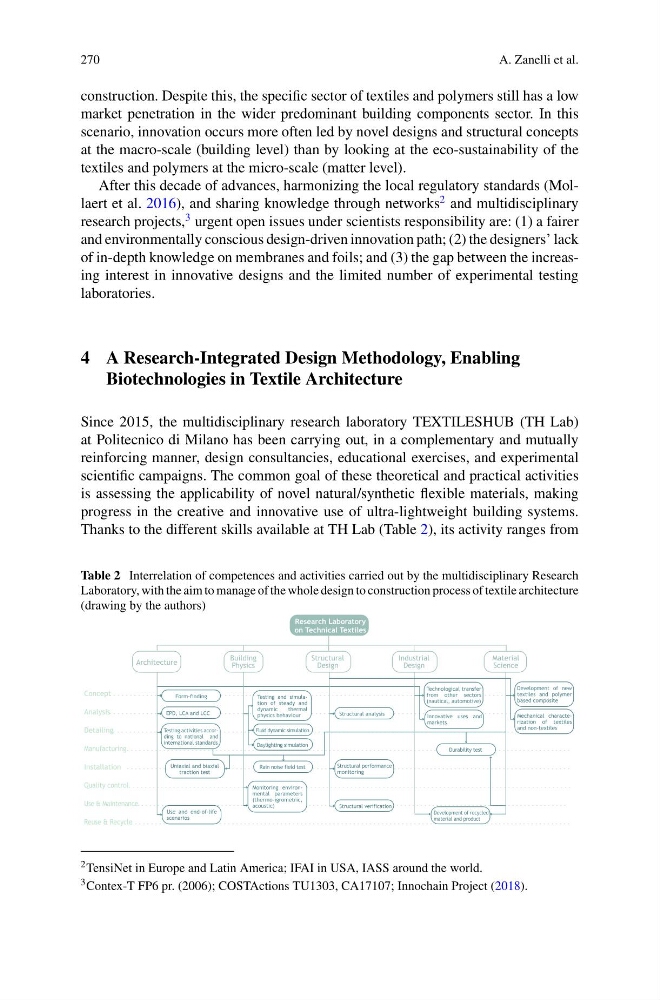
Thanks to the different skills available at TH Lab (Table 2), its activity ranges from
Table 2 Interrelation of competences and activities carried out by the multidisciplinary Research
Laboratory, with the aim to manage of the whole design to construction process of textile architecture
(drawing by the authors)
2 TensiNet in Europe and Latin America; IFAI in USA, IASS around the world.
3 Contex-T FP6 pr. (2006); COSTActions TU1303, CA17107; Innochain Project (2018).
A. Zanelli et al.
construction. Despite this, the specific sector of textiles and polymers still has a low
market penetration in the wider predominant building components sector. In this
scenario, innovation occurs more often led by novel designs and structural concepts
at the macro-scale (building level) than by looking at the eco-sustainability of the
textiles and polymers at the micro-scale (matter level).
After this decade of advances, harmonizing the local regulatory standards (Mollaert et al. 2016), and sharing knowledge through networks
2 and multidisciplinary
research projects,
3 urgent open issues under scientists responsibility are: (1) a fairer
and environmentally conscious design-driven innovation path; (2) the designers’ lack
of in-depth knowledge on membranes and foils; and (3) the gap between the increasing interest in innovative designs and the limited number of experimental testing
laboratories.
4 A Research-Integrated Design Methodology, Enabling
Biotechnologies in Textile Architecture
Since 2015, the multidisciplinary research laboratory TEXTILESHUB (TH Lab)
at Politecnico di Milano has been carrying out, in a complementary and mutually
reinforcing manner, design consultancies, educational exercises, and experimental
scientific campaigns. The common goal of these theoretical and practical activities
is assessing the applicability of novel natural/synthetic flexible materials, making
progress in the creative and innovative use of ultra-lightweight building systems.
Thanks to the different skills available at TH Lab (Table 2), its activity ranges from
Table 2 Interrelation of competences and activities carried out by the multidisciplinary Research
Laboratory, with the aim to manage of the whole design to construction process of textile architecture
(drawing by the authors)
2 TensiNet in Europe and Latin America; IFAI in USA, IASS around the world.
3 Contex-T FP6 pr. (2006); COSTActions TU1303, CA17107; Innochain Project (2018).