

Closing the Loops in Textile Architecture …
271
testing mechanical and optical behavior to measuring performances of membranes
and composites. TH Lab also gives service to firms and manufacturers: From 2017, it
is an accredited laboratory for uniaxial and biaxial tensile tests, under the signatory of
ILAC mutual recognition agreements (Services Accredia 2019). Welding and sewing
machines are there available for the researchers’ prototyping activities.
The authors, who are members of TH Lab, adopt the methodological approach of
architectural technology, which is essentially a systemic design approach applied to
the built environment and in a multi-scale perspective, where the material choice plays
a crucial role throughout the whole design process—in relation to the requirements
and environmental constraints—and it strengthens the specialized disciplines—materials engineering, chemistry, building physics—to drive the innovation into the building sector (Meadows and Wright 2008).
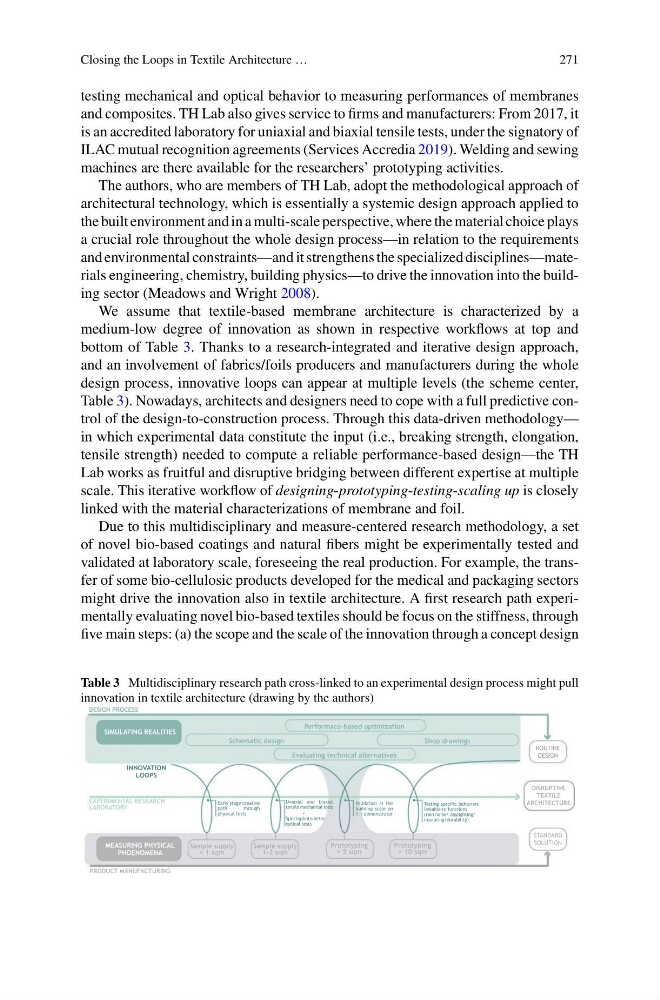
We assume that textile-based membrane architecture is characterized by a
medium-low degree of innovation as shown in respective workflows at top and
bottom of Table 3. Thanks to a research-integrated and iterative design approach,
and an involvement of fabrics/foils producers and manufacturers during the whole
design process, innovative loops can appear at multiple levels (the scheme center,
Table 3). Nowadays, architects and designers need to cope with a full predictive control of the design-to-construction process. Through this data-driven methodology—
in which experimental data constitute the input (i.e., breaking strength, elongation,
tensile strength) needed to compute a reliable performance-based design—the TH
Lab works as fruitful and disruptive bridging between different expertise at multiple
scale. This iterative workflow of designing-prototyping-testing-scaling up is closely
linked with the material characterizations of membrane and foil.
Due to this multidisciplinary and measure-centered research methodology, a set
of novel bio-based coatings and natural fibers might be experimentally tested and
validated at laboratory scale, foreseeing the real production. For example, the transfer of some bio-cellulosic products developed for the medical and packaging sectors
might drive the innovation also in textile architecture. A first research path experimentally evaluating novel bio-based textiles should be focus on the stiffness, through
five main steps: (a) the scope and the scale of the innovation through a concept design
Table 3 Multidisciplinary research path cross-linked to an experimental design process might pull
innovation in textile architecture (drawing by the authors)
271
testing mechanical and optical behavior to measuring performances of membranes
and composites. TH Lab also gives service to firms and manufacturers: From 2017, it
is an accredited laboratory for uniaxial and biaxial tensile tests, under the signatory of
ILAC mutual recognition agreements (Services Accredia 2019). Welding and sewing
machines are there available for the researchers’ prototyping activities.
The authors, who are members of TH Lab, adopt the methodological approach of
architectural technology, which is essentially a systemic design approach applied to
the built environment and in a multi-scale perspective, where the material choice plays
a crucial role throughout the whole design process—in relation to the requirements
and environmental constraints—and it strengthens the specialized disciplines—materials engineering, chemistry, building physics—to drive the innovation into the building sector (Meadows and Wright 2008).
We assume that textile-based membrane architecture is characterized by a
medium-low degree of innovation as shown in respective workflows at top and
bottom of Table 3. Thanks to a research-integrated and iterative design approach,
and an involvement of fabrics/foils producers and manufacturers during the whole
design process, innovative loops can appear at multiple levels (the scheme center,
Table 3). Nowadays, architects and designers need to cope with a full predictive control of the design-to-construction process. Through this data-driven methodology—
in which experimental data constitute the input (i.e., breaking strength, elongation,
tensile strength) needed to compute a reliable performance-based design—the TH
Lab works as fruitful and disruptive bridging between different expertise at multiple
scale. This iterative workflow of designing-prototyping-testing-scaling up is closely
linked with the material characterizations of membrane and foil.
Due to this multidisciplinary and measure-centered research methodology, a set
of novel bio-based coatings and natural fibers might be experimentally tested and
validated at laboratory scale, foreseeing the real production. For example, the transfer of some bio-cellulosic products developed for the medical and packaging sectors
might drive the innovation also in textile architecture. A first research path experimentally evaluating novel bio-based textiles should be focus on the stiffness, through
five main steps: (a) the scope and the scale of the innovation through a concept design
Table 3 Multidisciplinary research path cross-linked to an experimental design process might pull
innovation in textile architecture (drawing by the authors)