

256
L. Biolzi et al.
tensile strength of OPC-DHE1 concrete mix increased by 67%, 70%, and 77% at 7,
28, and 56 days of curing, respectively, compared to those of OPC concrete. This
improvement is attributed to the high tensile strength, elastic modulus, and effective anchoring mechanism of DHE steel fibers, which restrained the extension of
macro-cracks in concrete (Afroughsabet et al. 2016). It was also observed that the
simultaneous use of CSA cement and steel fibers was very effective in enhancing
the splitting tensile strength of concrete, and the best performing mix was attained
in the CSA-DHE concrete mix. The splitting tensile strength of the aforementioned
mix was increased by 57%, 95%, and 97% at 7, 28, and 56 days of curing, respectively, compared to those of OPC concrete. This improvement can be attributed to
a more effective bond between the steel fibers and the CSA cement matrix due to
self-stressing that resulted from the expansive behavior of CSA cement. The effect
of curing age on the improvement of splitting tensile strength is relatively higher
in FRC compared to plain concrete. For instance, the splitting tensile strength of
CSA-DHE mix was increased by 42% and 60% at 28 and 56 days compared to its
7-day strength, respectively, while the increase was 28% and 42% for CSA concrete,
respectively.
3.4 Modulus of Elasticity
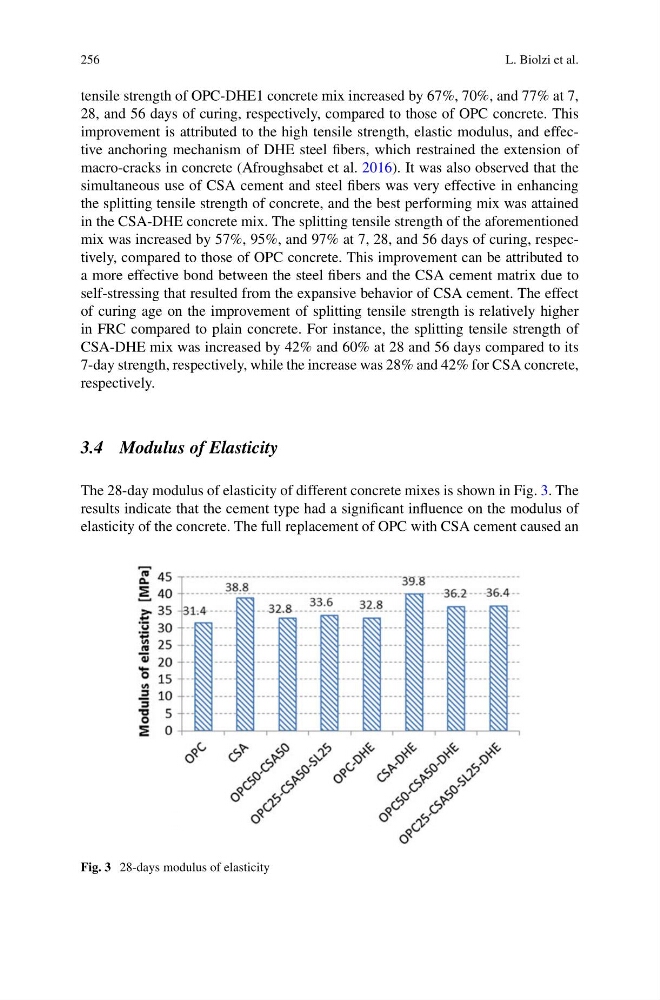
The 28-day modulus of elasticity of different concrete mixes is shown in Fig. 3. The
results indicate that the cement type had a significant influence on the modulus of
elasticity of the concrete. The full replacement of OPC with CSA cement caused an
Fig. 3 28-days modulus of elasticity
L. Biolzi et al.
tensile strength of OPC-DHE1 concrete mix increased by 67%, 70%, and 77% at 7,
28, and 56 days of curing, respectively, compared to those of OPC concrete. This
improvement is attributed to the high tensile strength, elastic modulus, and effective anchoring mechanism of DHE steel fibers, which restrained the extension of
macro-cracks in concrete (Afroughsabet et al. 2016). It was also observed that the
simultaneous use of CSA cement and steel fibers was very effective in enhancing
the splitting tensile strength of concrete, and the best performing mix was attained
in the CSA-DHE concrete mix. The splitting tensile strength of the aforementioned
mix was increased by 57%, 95%, and 97% at 7, 28, and 56 days of curing, respectively, compared to those of OPC concrete. This improvement can be attributed to
a more effective bond between the steel fibers and the CSA cement matrix due to
self-stressing that resulted from the expansive behavior of CSA cement. The effect
of curing age on the improvement of splitting tensile strength is relatively higher
in FRC compared to plain concrete. For instance, the splitting tensile strength of
CSA-DHE mix was increased by 42% and 60% at 28 and 56 days compared to its
7-day strength, respectively, while the increase was 28% and 42% for CSA concrete,
respectively.
3.4 Modulus of Elasticity
The 28-day modulus of elasticity of different concrete mixes is shown in Fig. 3. The
results indicate that the cement type had a significant influence on the modulus of
elasticity of the concrete. The full replacement of OPC with CSA cement caused an
Fig. 3 28-days modulus of elasticity