

Sustainable Concretes for Structural Applications
257
increase of 24% in the 28-day modulus of elasticity. This increase can be explained
by the ability of CSA cement to densify the microstructure of the cement matrix and
improve the characteristics of ITZ, which consequently lead to an enhancement in
the modulus of elasticity of concrete.
The combination of OPC and CSA cements at equal percentages of 50% led to a
slight increase in the modulus of elasticity.
Additionally, the substitution of a portion of OPC with slag in CSA-blend concrete
mix resulted in an increase of 7% compared to that of OPC. The lowest modulus of
elasticity was attained by the mix containing 100% OPC, while the best performing
mix was the CSA mix, which attained a modulus of elasticity of 38.8 GPa.
The modulus of elasticity of OPC, CSA, OPC50-CSA50, and OPC25-CSA50SL25 concrete mixes containing 1% DHE steel fibers were 4%, 3%, 10%, and 8%
higher than those of the corresponding mixes without fibers, respectively. This result
suggests that the addition of steel fibers with higher elastic modulus compared to
that of the cement matrix can improve the modulus of elasticity of concrete.
3.5 Flexural Behavior
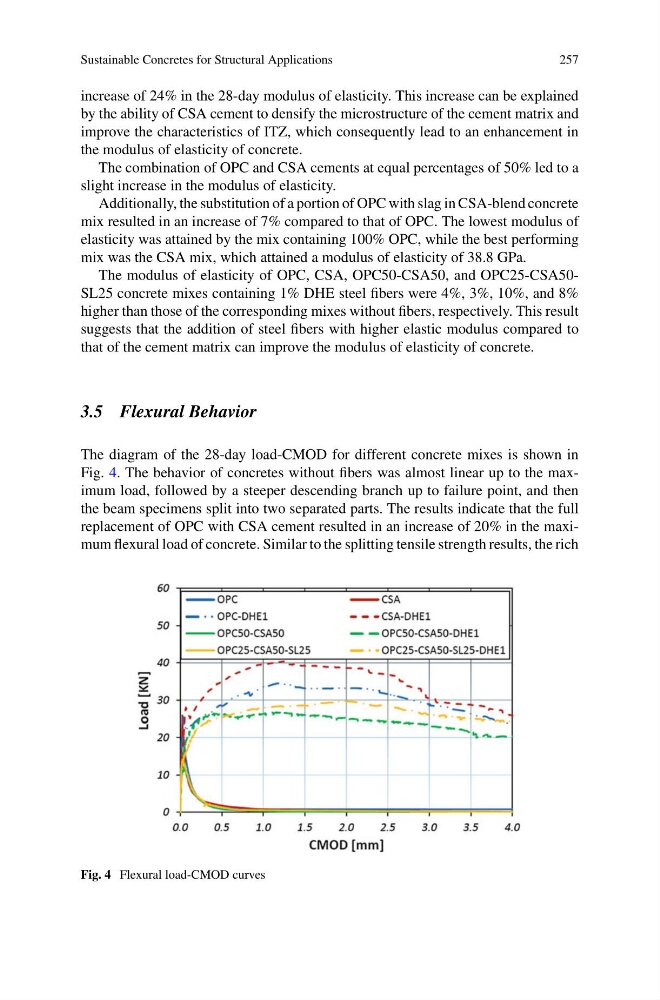
The diagram of the 28-day load-CMOD for different concrete mixes is shown in
Fig. 4. The behavior of concretes without fibers was almost linear up to the maximum load, followed by a steeper descending branch up to failure point, and then
the beam specimens split into two separated parts. The results indicate that the full
replacement of OPC with CSA cement resulted in an increase of 20% in the maximum flexural load of concrete. Similar to the splitting tensile strength results, the rich
Fig. 4 Flexural load-CMOD curves
257
increase of 24% in the 28-day modulus of elasticity. This increase can be explained
by the ability of CSA cement to densify the microstructure of the cement matrix and
improve the characteristics of ITZ, which consequently lead to an enhancement in
the modulus of elasticity of concrete.
The combination of OPC and CSA cements at equal percentages of 50% led to a
slight increase in the modulus of elasticity.
Additionally, the substitution of a portion of OPC with slag in CSA-blend concrete
mix resulted in an increase of 7% compared to that of OPC. The lowest modulus of
elasticity was attained by the mix containing 100% OPC, while the best performing
mix was the CSA mix, which attained a modulus of elasticity of 38.8 GPa.
The modulus of elasticity of OPC, CSA, OPC50-CSA50, and OPC25-CSA50SL25 concrete mixes containing 1% DHE steel fibers were 4%, 3%, 10%, and 8%
higher than those of the corresponding mixes without fibers, respectively. This result
suggests that the addition of steel fibers with higher elastic modulus compared to
that of the cement matrix can improve the modulus of elasticity of concrete.
3.5 Flexural Behavior
The diagram of the 28-day load-CMOD for different concrete mixes is shown in
Fig. 4. The behavior of concretes without fibers was almost linear up to the maximum load, followed by a steeper descending branch up to failure point, and then
the beam specimens split into two separated parts. The results indicate that the full
replacement of OPC with CSA cement resulted in an increase of 20% in the maximum flexural load of concrete. Similar to the splitting tensile strength results, the rich
Fig. 4 Flexural load-CMOD curves