

Sustainable Concretes for Structural Applications
255
been well documented in the literature (Celik et al. 2014). Concretes with steel fibers
exhibited the same trend with a slight increase in compressive strength.
3.3 Splitting Tensile Strength
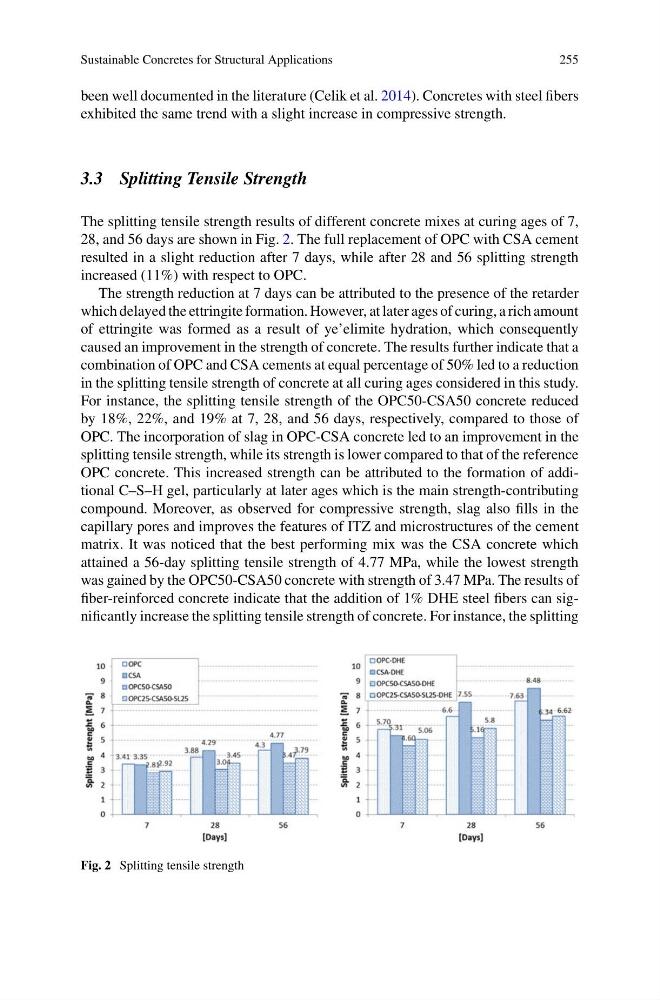
The splitting tensile strength results of different concrete mixes at curing ages of 7,
28, and 56 days are shown in Fig. 2. The full replacement of OPC with CSA cement
resulted in a slight reduction after 7 days, while after 28 and 56 splitting strength
increased (11%) with respect to OPC.
The strength reduction at 7 days can be attributed to the presence of the retarder
which delayed the ettringite formation. However, at later ages of curing, a rich amount
of ettringite was formed as a result of ye’elimite hydration, which consequently
caused an improvement in the strength of concrete. The results further indicate that a
combination of OPC and CSA cements at equal percentage of 50% led to a reduction
in the splitting tensile strength of concrete at all curing ages considered in this study.
For instance, the splitting tensile strength of the OPC50-CSA50 concrete reduced
by 18%, 22%, and 19% at 7, 28, and 56 days, respectively, compared to those of
OPC. The incorporation of slag in OPC-CSA concrete led to an improvement in the
splitting tensile strength, while its strength is lower compared to that of the reference
OPC concrete. This increased strength can be attributed to the formation of additional C–S–H gel, particularly at later ages which is the main strength-contributing
compound. Moreover, as observed for compressive strength, slag also fills in the
capillary pores and improves the features of ITZ and microstructures of the cement
matrix. It was noticed that the best performing mix was the CSA concrete which
attained a 56-day splitting tensile strength of 4.77 MPa, while the lowest strength
was gained by the OPC50-CSA50 concrete with strength of 3.47 MPa. The results of
fiber-reinforced concrete indicate that the addition of 1% DHE steel fibers can significantly increase the splitting tensile strength of concrete. For instance, the splitting
Fig. 2 Splitting tensile strength
255
been well documented in the literature (Celik et al. 2014). Concretes with steel fibers
exhibited the same trend with a slight increase in compressive strength.
3.3 Splitting Tensile Strength
The splitting tensile strength results of different concrete mixes at curing ages of 7,
28, and 56 days are shown in Fig. 2. The full replacement of OPC with CSA cement
resulted in a slight reduction after 7 days, while after 28 and 56 splitting strength
increased (11%) with respect to OPC.
The strength reduction at 7 days can be attributed to the presence of the retarder
which delayed the ettringite formation. However, at later ages of curing, a rich amount
of ettringite was formed as a result of ye’elimite hydration, which consequently
caused an improvement in the strength of concrete. The results further indicate that a
combination of OPC and CSA cements at equal percentage of 50% led to a reduction
in the splitting tensile strength of concrete at all curing ages considered in this study.
For instance, the splitting tensile strength of the OPC50-CSA50 concrete reduced
by 18%, 22%, and 19% at 7, 28, and 56 days, respectively, compared to those of
OPC. The incorporation of slag in OPC-CSA concrete led to an improvement in the
splitting tensile strength, while its strength is lower compared to that of the reference
OPC concrete. This increased strength can be attributed to the formation of additional C–S–H gel, particularly at later ages which is the main strength-contributing
compound. Moreover, as observed for compressive strength, slag also fills in the
capillary pores and improves the features of ITZ and microstructures of the cement
matrix. It was noticed that the best performing mix was the CSA concrete which
attained a 56-day splitting tensile strength of 4.77 MPa, while the lowest strength
was gained by the OPC50-CSA50 concrete with strength of 3.47 MPa. The results of
fiber-reinforced concrete indicate that the addition of 1% DHE steel fibers can significantly increase the splitting tensile strength of concrete. For instance, the splitting
Fig. 2 Splitting tensile strength