

254
L. Biolzi et al.
3.2 Compressive Strength
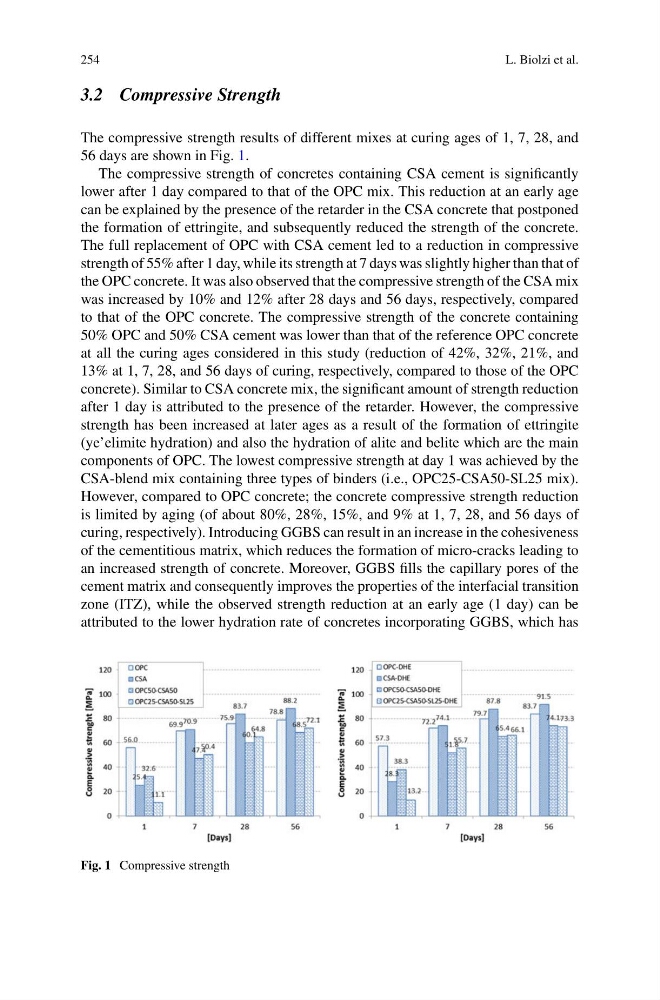
The compressive strength results of different mixes at curing ages of 1, 7, 28, and
56 days are shown in Fig. 1.
The compressive strength of concretes containing CSA cement is significantly
lower after 1 day compared to that of the OPC mix. This reduction at an early age
can be explained by the presence of the retarder in the CSA concrete that postponed
the formation of ettringite, and subsequently reduced the strength of the concrete.
The full replacement of OPC with CSA cement led to a reduction in compressive
strength of 55% after 1 day, while its strength at 7 days was slightly higher than that of
the OPC concrete. It was also observed that the compressive strength of the CSA mix
was increased by 10% and 12% after 28 days and 56 days, respectively, compared
to that of the OPC concrete. The compressive strength of the concrete containing
50% OPC and 50% CSA cement was lower than that of the reference OPC concrete
at all the curing ages considered in this study (reduction of 42%, 32%, 21%, and
13% at 1, 7, 28, and 56 days of curing, respectively, compared to those of the OPC
concrete). Similar to CSA concrete mix, the significant amount of strength reduction
after 1 day is attributed to the presence of the retarder. However, the compressive
strength has been increased at later ages as a result of the formation of ettringite
(ye’elimite hydration) and also the hydration of alite and belite which are the main
components of OPC. The lowest compressive strength at day 1 was achieved by the
CSA-blend mix containing three types of binders (i.e., OPC25-CSA50-SL25 mix).
However, compared to OPC concrete; the concrete compressive strength reduction
is limited by aging (of about 80%, 28%, 15%, and 9% at 1, 7, 28, and 56 days of
curing, respectively). Introducing GGBS can result in an increase in the cohesiveness
of the cementitious matrix, which reduces the formation of micro-cracks leading to
an increased strength of concrete. Moreover, GGBS fills the capillary pores of the
cement matrix and consequently improves the properties of the interfacial transition
zone (ITZ), while the observed strength reduction at an early age (1 day) can be
attributed to the lower hydration rate of concretes incorporating GGBS, which has
Fig. 1 Compressive strength
L. Biolzi et al.
3.2 Compressive Strength
The compressive strength results of different mixes at curing ages of 1, 7, 28, and
56 days are shown in Fig. 1.
The compressive strength of concretes containing CSA cement is significantly
lower after 1 day compared to that of the OPC mix. This reduction at an early age
can be explained by the presence of the retarder in the CSA concrete that postponed
the formation of ettringite, and subsequently reduced the strength of the concrete.
The full replacement of OPC with CSA cement led to a reduction in compressive
strength of 55% after 1 day, while its strength at 7 days was slightly higher than that of
the OPC concrete. It was also observed that the compressive strength of the CSA mix
was increased by 10% and 12% after 28 days and 56 days, respectively, compared
to that of the OPC concrete. The compressive strength of the concrete containing
50% OPC and 50% CSA cement was lower than that of the reference OPC concrete
at all the curing ages considered in this study (reduction of 42%, 32%, 21%, and
13% at 1, 7, 28, and 56 days of curing, respectively, compared to those of the OPC
concrete). Similar to CSA concrete mix, the significant amount of strength reduction
after 1 day is attributed to the presence of the retarder. However, the compressive
strength has been increased at later ages as a result of the formation of ettringite
(ye’elimite hydration) and also the hydration of alite and belite which are the main
components of OPC. The lowest compressive strength at day 1 was achieved by the
CSA-blend mix containing three types of binders (i.e., OPC25-CSA50-SL25 mix).
However, compared to OPC concrete; the concrete compressive strength reduction
is limited by aging (of about 80%, 28%, 15%, and 9% at 1, 7, 28, and 56 days of
curing, respectively). Introducing GGBS can result in an increase in the cohesiveness
of the cementitious matrix, which reduces the formation of micro-cracks leading to
an increased strength of concrete. Moreover, GGBS fills the capillary pores of the
cement matrix and consequently improves the properties of the interfacial transition
zone (ITZ), while the observed strength reduction at an early age (1 day) can be
attributed to the lower hydration rate of concretes incorporating GGBS, which has
Fig. 1 Compressive strength