

Design Strategies and LCA of Alternative Solutions …
211
= 4 and electrically powered. The electricity is supplied via photovoltaic panels of
2037 m
2 , installed on site. In this case, the production of photovoltaic energy exceeds
the requirements. For BAU model, the consumptions considered are related to the
minimum mandatory requirement (so higher than the ones achieved by the project)
and are connected to a heating system with a methane gas condensation boiler and
a cooling system with an air–water heat pump characterized by a COP = 2.8 and
electrically powered. The production of electricity connected to photovoltaic panels
of 243 m
2 , corresponding to the minimum surface area required by the Region of
Lombardy, covers only a minimal part of the need for electricity, making it necessary
to obtain energy from the electrical grid. As a result, there is a significant reduction
in the impacts of the project. The calculation compares the impacts of the project,
considering the production impact of the photovoltaic panels and two cycles of the
photovoltaic panels replaced during the building life, and the impact of the BAU
model, considering the electrical (national electricity mix) and thermal (methane)
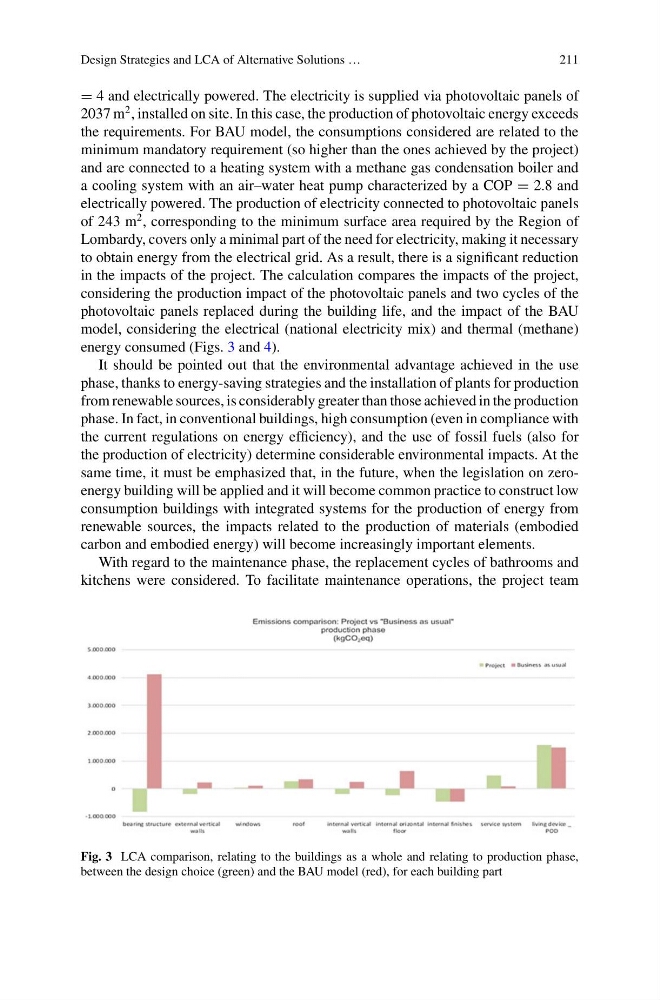
energy consumed (Figs. 3 and 4).
It should be pointed out that the environmental advantage achieved in the use
phase, thanks to energy-saving strategies and the installation of plants for production
from renewable sources, is considerably greater than those achieved in the production
phase. In fact, in conventional buildings, high consumption (even in compliance with
the current regulations on energy efficiency), and the use of fossil fuels (also for
the production of electricity) determine considerable environmental impacts. At the
same time, it must be emphasized that, in the future, when the legislation on zeroenergy building will be applied and it will become common practice to construct low
consumption buildings with integrated systems for the production of energy from
renewable sources, the impacts related to the production of materials (embodied
carbon and embodied energy) will become increasingly important elements.
With regard to the maintenance phase, the replacement cycles of bathrooms and
kitchens were considered. To facilitate maintenance operations, the project team
Fig. 3 LCA comparison, relating to the buildings as a whole and relating to production phase,
between the design choice (green) and the BAU model (red), for each building part
211
= 4 and electrically powered. The electricity is supplied via photovoltaic panels of
2037 m
2 , installed on site. In this case, the production of photovoltaic energy exceeds
the requirements. For BAU model, the consumptions considered are related to the
minimum mandatory requirement (so higher than the ones achieved by the project)
and are connected to a heating system with a methane gas condensation boiler and
a cooling system with an air–water heat pump characterized by a COP = 2.8 and
electrically powered. The production of electricity connected to photovoltaic panels
of 243 m
2 , corresponding to the minimum surface area required by the Region of
Lombardy, covers only a minimal part of the need for electricity, making it necessary
to obtain energy from the electrical grid. As a result, there is a significant reduction
in the impacts of the project. The calculation compares the impacts of the project,
considering the production impact of the photovoltaic panels and two cycles of the
photovoltaic panels replaced during the building life, and the impact of the BAU
model, considering the electrical (national electricity mix) and thermal (methane)
energy consumed (Figs. 3 and 4).
It should be pointed out that the environmental advantage achieved in the use
phase, thanks to energy-saving strategies and the installation of plants for production
from renewable sources, is considerably greater than those achieved in the production
phase. In fact, in conventional buildings, high consumption (even in compliance with
the current regulations on energy efficiency), and the use of fossil fuels (also for
the production of electricity) determine considerable environmental impacts. At the
same time, it must be emphasized that, in the future, when the legislation on zeroenergy building will be applied and it will become common practice to construct low
consumption buildings with integrated systems for the production of energy from
renewable sources, the impacts related to the production of materials (embodied
carbon and embodied energy) will become increasingly important elements.
With regard to the maintenance phase, the replacement cycles of bathrooms and
kitchens were considered. To facilitate maintenance operations, the project team
Fig. 3 LCA comparison, relating to the buildings as a whole and relating to production phase,
between the design choice (green) and the BAU model (red), for each building part