

212
A. Campioli et al.
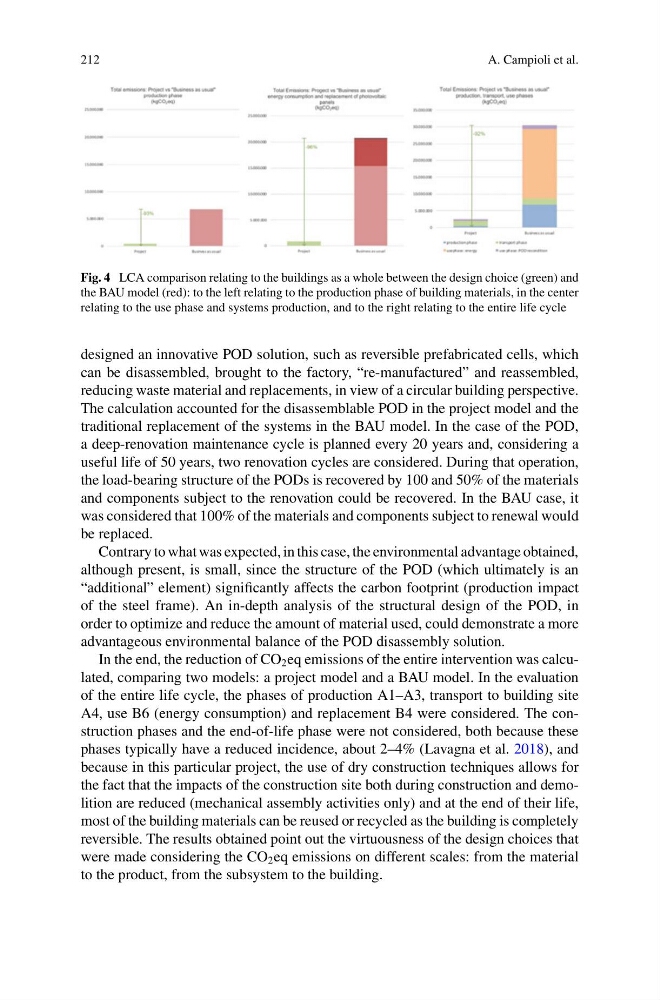
Fig. 4 LCA comparison relating to the buildings as a whole between the design choice (green) and
the BAU model (red): to the left relating to the production phase of building materials, in the center
relating to the use phase and systems production, and to the right relating to the entire life cycle
designed an innovative POD solution, such as reversible prefabricated cells, which
can be disassembled, brought to the factory, “re-manufactured” and reassembled,
reducing waste material and replacements, in view of a circular building perspective.
The calculation accounted for the disassemblable POD in the project model and the
traditional replacement of the systems in the BAU model. In the case of the POD,
a deep-renovation maintenance cycle is planned every 20 years and, considering a
useful life of 50 years, two renovation cycles are considered. During that operation,
the load-bearing structure of the PODs is recovered by 100 and 50% of the materials
and components subject to the renovation could be recovered. In the BAU case, it
was considered that 100% of the materials and components subject to renewal would
be replaced.
Contrary to what was expected, in this case, the environmental advantage obtained,
although present, is small, since the structure of the POD (which ultimately is an
“additional” element) significantly affects the carbon footprint (production impact
of the steel frame). An in-depth analysis of the structural design of the POD, in
order to optimize and reduce the amount of material used, could demonstrate a more
advantageous environmental balance of the POD disassembly solution.
In the end, the reduction of CO 2 eq emissions of the entire intervention was calculated, comparing two models: a project model and a BAU model. In the evaluation
of the entire life cycle, the phases of production A1–A3, transport to building site
A4, use B6 (energy consumption) and replacement B4 were considered. The construction phases and the end-of-life phase were not considered, both because these
phases typically have a reduced incidence, about 2–4% (Lavagna et al. 2018), and
because in this particular project, the use of dry construction techniques allows for
the fact that the impacts of the construction site both during construction and demolition are reduced (mechanical assembly activities only) and at the end of their life,
most of the building materials can be reused or recycled as the building is completely
reversible. The results obtained point out the virtuousness of the design choices that
were made considering the CO 2 eq emissions on different scales: from the material
to the product, from the subsystem to the building.
A. Campioli et al.
Fig. 4 LCA comparison relating to the buildings as a whole between the design choice (green) and
the BAU model (red): to the left relating to the production phase of building materials, in the center
relating to the use phase and systems production, and to the right relating to the entire life cycle
designed an innovative POD solution, such as reversible prefabricated cells, which
can be disassembled, brought to the factory, “re-manufactured” and reassembled,
reducing waste material and replacements, in view of a circular building perspective.
The calculation accounted for the disassemblable POD in the project model and the
traditional replacement of the systems in the BAU model. In the case of the POD,
a deep-renovation maintenance cycle is planned every 20 years and, considering a
useful life of 50 years, two renovation cycles are considered. During that operation,
the load-bearing structure of the PODs is recovered by 100 and 50% of the materials
and components subject to the renovation could be recovered. In the BAU case, it
was considered that 100% of the materials and components subject to renewal would
be replaced.
Contrary to what was expected, in this case, the environmental advantage obtained,
although present, is small, since the structure of the POD (which ultimately is an
“additional” element) significantly affects the carbon footprint (production impact
of the steel frame). An in-depth analysis of the structural design of the POD, in
order to optimize and reduce the amount of material used, could demonstrate a more
advantageous environmental balance of the POD disassembly solution.
In the end, the reduction of CO 2 eq emissions of the entire intervention was calculated, comparing two models: a project model and a BAU model. In the evaluation
of the entire life cycle, the phases of production A1–A3, transport to building site
A4, use B6 (energy consumption) and replacement B4 were considered. The construction phases and the end-of-life phase were not considered, both because these
phases typically have a reduced incidence, about 2–4% (Lavagna et al. 2018), and
because in this particular project, the use of dry construction techniques allows for
the fact that the impacts of the construction site both during construction and demolition are reduced (mechanical assembly activities only) and at the end of their life,
most of the building materials can be reused or recycled as the building is completely
reversible. The results obtained point out the virtuousness of the design choices that
were made considering the CO 2 eq emissions on different scales: from the material
to the product, from the subsystem to the building.