

210
A. Campioli et al.
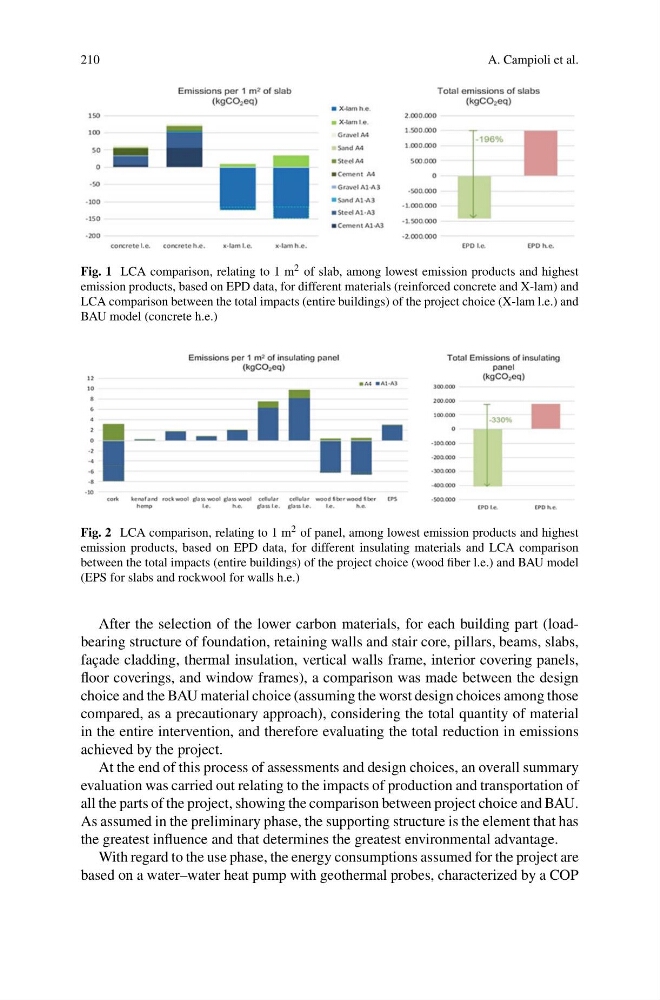
Fig. 1 LCA comparison, relating to 1 m 2 of slab, among lowest emission products and highest
emission products, based on EPD data, for different materials (reinforced concrete and X-lam) and
LCA comparison between the total impacts (entire buildings) of the project choice (X-lam l.e.) and
BAU model (concrete h.e.)
Fig. 2 LCA comparison, relating to 1 m 2 of panel, among lowest emission products and highest
emission products, based on EPD data, for different insulating materials and LCA comparison
between the total impacts (entire buildings) of the project choice (wood fiber l.e.) and BAU model
(EPS for slabs and rockwool for walls h.e.)
After the selection of the lower carbon materials, for each building part (loadbearing structure of foundation, retaining walls and stair core, pillars, beams, slabs,
façade cladding, thermal insulation, vertical walls frame, interior covering panels,
floor coverings, and window frames), a comparison was made between the design
choice and the BAU material choice (assuming the worst design choices among those
compared, as a precautionary approach), considering the total quantity of material
in the entire intervention, and therefore evaluating the total reduction in emissions
achieved by the project.
At the end of this process of assessments and design choices, an overall summary
evaluation was carried out relating to the impacts of production and transportation of
all the parts of the project, showing the comparison between project choice and BAU.
As assumed in the preliminary phase, the supporting structure is the element that has
the greatest influence and that determines the greatest environmental advantage.
With regard to the use phase, the energy consumptions assumed for the project are
based on a water–water heat pump with geothermal probes, characterized by a COP
A. Campioli et al.
Fig. 1 LCA comparison, relating to 1 m 2 of slab, among lowest emission products and highest
emission products, based on EPD data, for different materials (reinforced concrete and X-lam) and
LCA comparison between the total impacts (entire buildings) of the project choice (X-lam l.e.) and
BAU model (concrete h.e.)
Fig. 2 LCA comparison, relating to 1 m 2 of panel, among lowest emission products and highest
emission products, based on EPD data, for different insulating materials and LCA comparison
between the total impacts (entire buildings) of the project choice (wood fiber l.e.) and BAU model
(EPS for slabs and rockwool for walls h.e.)
After the selection of the lower carbon materials, for each building part (loadbearing structure of foundation, retaining walls and stair core, pillars, beams, slabs,
façade cladding, thermal insulation, vertical walls frame, interior covering panels,
floor coverings, and window frames), a comparison was made between the design
choice and the BAU material choice (assuming the worst design choices among those
compared, as a precautionary approach), considering the total quantity of material
in the entire intervention, and therefore evaluating the total reduction in emissions
achieved by the project.
At the end of this process of assessments and design choices, an overall summary
evaluation was carried out relating to the impacts of production and transportation of
all the parts of the project, showing the comparison between project choice and BAU.
As assumed in the preliminary phase, the supporting structure is the element that has
the greatest influence and that determines the greatest environmental advantage.
With regard to the use phase, the energy consumptions assumed for the project are
based on a water–water heat pump with geothermal probes, characterized by a COP