

172
R. Neri
2 Asylum. City-Refuge. The Milan Barracks: Replacement,
Conservation, Adaptation or Physiological
Transformation?
The project takes on board the task of requalifying the civil life of fairly heterogeneous
communities, the current and real representation of the other “total institutions” (the
prison system, those of education and professional training, health, social security,
labor organisations, et cetera) in their direct relations with social society, according
to two strategies to be considered interlinked:
– the first for ordinary administration, with the building of a Cité de Refuge aimed
at reorganizing activities to curb the hardships and privations of outcasts, the
“wretched of the earth” (from the title of Frantz Fanon’s 1961 essay);
– the second for extraordinary management, with the establishment of a “Center for
Strategic Coordination of the Environment.”
In short, we are not talking about “liberating”—emptying ad excludendum—
military zones and barracks, but instead about making use of them through compatible
activities, reconverting the military arrangement into an internal front—i.e. to the
problems of civil society—to redeem through typological devices—Asylums—the
segregation regime of “total institutions.” Even if the extant building types can be
adapted for use as temporary residences, nonetheless the need emerges to conceive
functions of social integration, such as training courses at various levels along with
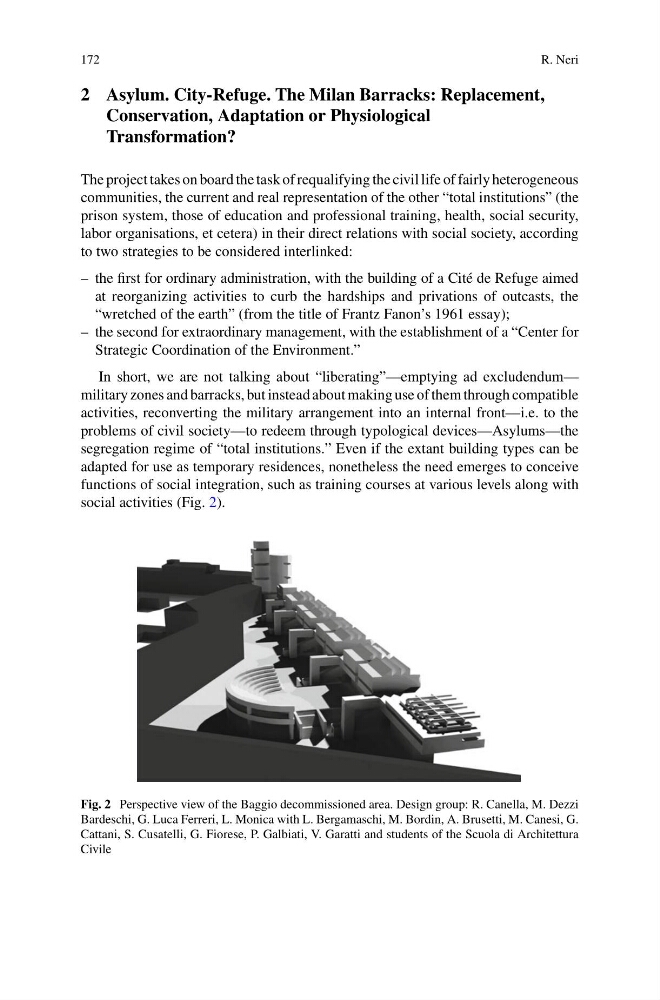
social activities (Fig. 2).
Fig. 2 Perspective view of the Baggio decommissioned area. Design group: R. Canella, M. Dezzi
Bardeschi, G. Luca Ferreri, L. Monica with L. Bergamaschi, M. Bordin, A. Brusetti, M. Canesi, G.
Cattani, S. Cusatelli, G. Fiorese, P. Galbiati, V. Garatti and students of the Scuola di Architettura
Civile
R. Neri
2 Asylum. City-Refuge. The Milan Barracks: Replacement,
Conservation, Adaptation or Physiological
Transformation?
The project takes on board the task of requalifying the civil life of fairly heterogeneous
communities, the current and real representation of the other “total institutions” (the
prison system, those of education and professional training, health, social security,
labor organisations, et cetera) in their direct relations with social society, according
to two strategies to be considered interlinked:
– the first for ordinary administration, with the building of a Cité de Refuge aimed
at reorganizing activities to curb the hardships and privations of outcasts, the
“wretched of the earth” (from the title of Frantz Fanon’s 1961 essay);
– the second for extraordinary management, with the establishment of a “Center for
Strategic Coordination of the Environment.”
In short, we are not talking about “liberating”—emptying ad excludendum—
military zones and barracks, but instead about making use of them through compatible
activities, reconverting the military arrangement into an internal front—i.e. to the
problems of civil society—to redeem through typological devices—Asylums—the
segregation regime of “total institutions.” Even if the extant building types can be
adapted for use as temporary residences, nonetheless the need emerges to conceive
functions of social integration, such as training courses at various levels along with
social activities (Fig. 2).
Fig. 2 Perspective view of the Baggio decommissioned area. Design group: R. Canella, M. Dezzi
Bardeschi, G. Luca Ferreri, L. Monica with L. Bergamaschi, M. Bordin, A. Brusetti, M. Canesi, G.
Cattani, S. Cusatelli, G. Fiorese, P. Galbiati, V. Garatti and students of the Scuola di Architettura
Civile