

4.6 Swarms and Colonies
83
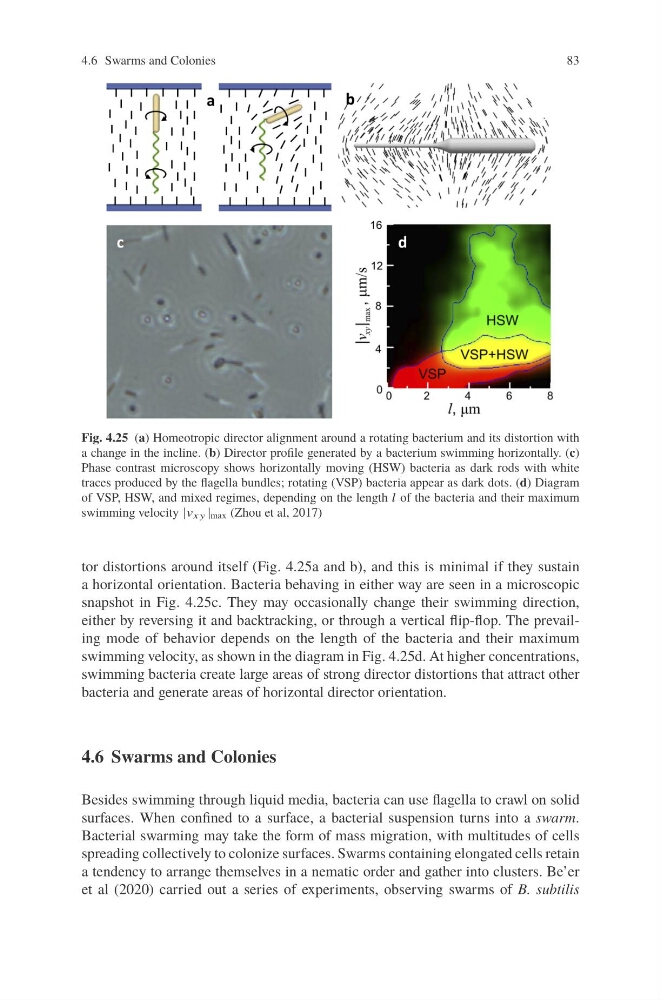
Fig. 4.25 (a) Homeotropic director alignment around a rotating bacterium and its distortion with
a change in the incline. (b) Director profile generated by a bacterium swimming horizontally. (c)
Phase contrast microscopy shows horizontally moving (HSW) bacteria as dark rods with white
traces produced by the flagella bundles; rotating (VSP) bacteria appear as dark dots. (d) Diagram
of VSP, HSW, and mixed regimes, depending on the length l of the bacteria and their maximum
swimming velocity |v x y | max (Zhou et al, 2017)
tor distortions around itself (Fig. 4.25a and b), and this is minimal if they sustain
a horizontal orientation. Bacteria behaving in either way are seen in a microscopic
snapshot in Fig. 4.25c. They may occasionally change their swimming direction,
either by reversing it and backtracking, or through a vertical flip-flop. The prevailing mode of behavior depends on the length of the bacteria and their maximum
swimming velocity, as shown in the diagram in Fig. 4.25d. At higher concentrations,
swimming bacteria create large areas of strong director distortions that attract other
bacteria and generate areas of horizontal director orientation.
4.6 Swarms and Colonies
Besides swimming through liquid media, bacteria can use flagella to crawl on solid
surfaces. When confined to a surface, a bacterial suspension turns into a swarm.
Bacterial swarming may take the form of mass migration, with multitudes of cells
spreading collectively to colonize surfaces. Swarms containing elongated cells retain
a tendency to arrange themselves in a nematic order and gather into clusters. Be’er
et al (2020) carried out a series of experiments, observing swarms of B. subtilis
83
Fig. 4.25 (a) Homeotropic director alignment around a rotating bacterium and its distortion with
a change in the incline. (b) Director profile generated by a bacterium swimming horizontally. (c)
Phase contrast microscopy shows horizontally moving (HSW) bacteria as dark rods with white
traces produced by the flagella bundles; rotating (VSP) bacteria appear as dark dots. (d) Diagram
of VSP, HSW, and mixed regimes, depending on the length l of the bacteria and their maximum
swimming velocity |v x y | max (Zhou et al, 2017)
tor distortions around itself (Fig. 4.25a and b), and this is minimal if they sustain
a horizontal orientation. Bacteria behaving in either way are seen in a microscopic
snapshot in Fig. 4.25c. They may occasionally change their swimming direction,
either by reversing it and backtracking, or through a vertical flip-flop. The prevailing mode of behavior depends on the length of the bacteria and their maximum
swimming velocity, as shown in the diagram in Fig. 4.25d. At higher concentrations,
swimming bacteria create large areas of strong director distortions that attract other
bacteria and generate areas of horizontal director orientation.
4.6 Swarms and Colonies
Besides swimming through liquid media, bacteria can use flagella to crawl on solid
surfaces. When confined to a surface, a bacterial suspension turns into a swarm.
Bacterial swarming may take the form of mass migration, with multitudes of cells
spreading collectively to colonize surfaces. Swarms containing elongated cells retain
a tendency to arrange themselves in a nematic order and gather into clusters. Be’er
et al (2020) carried out a series of experiments, observing swarms of B. subtilis