

74
4 Motion of Microorganisms
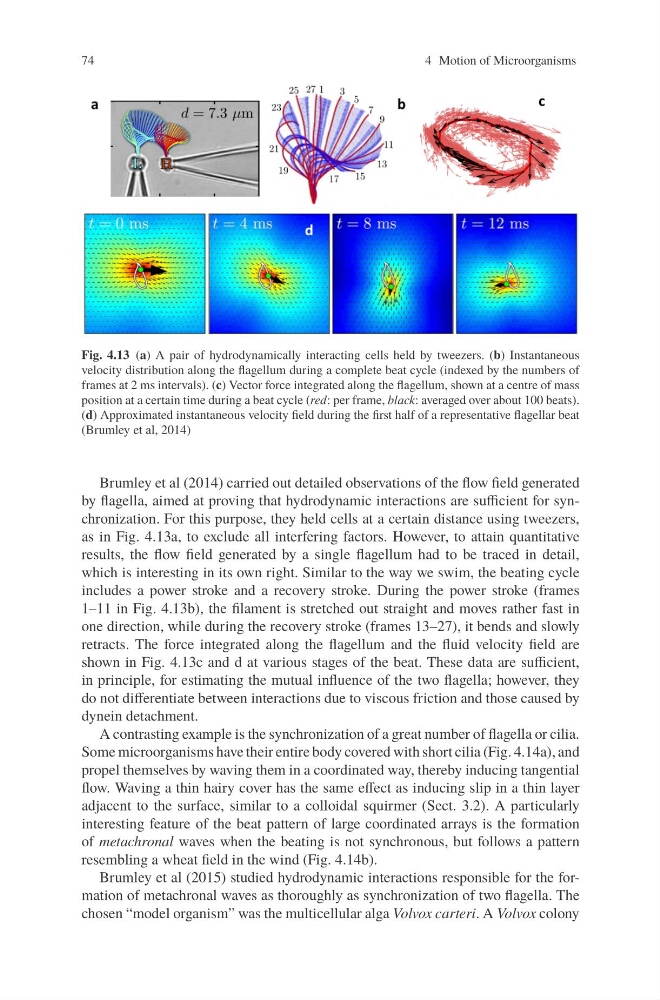
Fig. 4.13 (a) A pair of hydrodynamically interacting cells held by tweezers. (b) Instantaneous
velocity distribution along the flagellum during a complete beat cycle (indexed by the numbers of
frames at 2 ms intervals). (c) Vector force integrated along the flagellum, shown at a centre of mass
position at a certain time during a beat cycle (red: per frame, black: averaged over about 100 beats).
(d) Approximated instantaneous velocity field during the first half of a representative flagellar beat
(Brumley et al, 2014)
Brumley et al (2014) carried out detailed observations of the flow field generated
by flagella, aimed at proving that hydrodynamic interactions are sufficient for synchronization. For this purpose, they held cells at a certain distance using tweezers,
as in Fig. 4.13a, to exclude all interfering factors. However, to attain quantitative
results, the flow field generated by a single flagellum had to be traced in detail,
which is interesting in its own right. Similar to the way we swim, the beating cycle
includes a power stroke and a recovery stroke. During the power stroke (frames
1–11 in Fig. 4.13b), the filament is stretched out straight and moves rather fast in
one direction, while during the recovery stroke (frames 13–27), it bends and slowly
retracts. The force integrated along the flagellum and the fluid velocity field are
shown in Fig. 4.13c and d at various stages of the beat. These data are sufficient,
in principle, for estimating the mutual influence of the two flagella; however, they
do not differentiate between interactions due to viscous friction and those caused by
dynein detachment.
A contrasting example is the synchronization of a great number of flagella or cilia.
Some microorganisms have their entire body covered with short cilia (Fig. 4.14a), and
propel themselves by waving them in a coordinated way, thereby inducing tangential
flow. Waving a thin hairy cover has the same effect as inducing slip in a thin layer
adjacent to the surface, similar to a colloidal squirmer (Sect. 3.2). A particularly
interesting feature of the beat pattern of large coordinated arrays is the formation
of metachronal waves when the beating is not synchronous, but follows a pattern
resembling a wheat field in the wind (Fig. 4.14b).
Brumley et al (2015) studied hydrodynamic interactions responsible for the formation of metachronal waves as thoroughly as synchronization of two flagella. The
chosen “model organism” was the multicellular alga Volvox carteri. A Volvox colony
4 Motion of Microorganisms
Fig. 4.13 (a) A pair of hydrodynamically interacting cells held by tweezers. (b) Instantaneous
velocity distribution along the flagellum during a complete beat cycle (indexed by the numbers of
frames at 2 ms intervals). (c) Vector force integrated along the flagellum, shown at a centre of mass
position at a certain time during a beat cycle (red: per frame, black: averaged over about 100 beats).
(d) Approximated instantaneous velocity field during the first half of a representative flagellar beat
(Brumley et al, 2014)
Brumley et al (2014) carried out detailed observations of the flow field generated
by flagella, aimed at proving that hydrodynamic interactions are sufficient for synchronization. For this purpose, they held cells at a certain distance using tweezers,
as in Fig. 4.13a, to exclude all interfering factors. However, to attain quantitative
results, the flow field generated by a single flagellum had to be traced in detail,
which is interesting in its own right. Similar to the way we swim, the beating cycle
includes a power stroke and a recovery stroke. During the power stroke (frames
1–11 in Fig. 4.13b), the filament is stretched out straight and moves rather fast in
one direction, while during the recovery stroke (frames 13–27), it bends and slowly
retracts. The force integrated along the flagellum and the fluid velocity field are
shown in Fig. 4.13c and d at various stages of the beat. These data are sufficient,
in principle, for estimating the mutual influence of the two flagella; however, they
do not differentiate between interactions due to viscous friction and those caused by
dynein detachment.
A contrasting example is the synchronization of a great number of flagella or cilia.
Some microorganisms have their entire body covered with short cilia (Fig. 4.14a), and
propel themselves by waving them in a coordinated way, thereby inducing tangential
flow. Waving a thin hairy cover has the same effect as inducing slip in a thin layer
adjacent to the surface, similar to a colloidal squirmer (Sect. 3.2). A particularly
interesting feature of the beat pattern of large coordinated arrays is the formation
of metachronal waves when the beating is not synchronous, but follows a pattern
resembling a wheat field in the wind (Fig. 4.14b).
Brumley et al (2015) studied hydrodynamic interactions responsible for the formation of metachronal waves as thoroughly as synchronization of two flagella. The
chosen “model organism” was the multicellular alga Volvox carteri. A Volvox colony