

4.3 Synchronization
73
corresponding swimming modes (which include unusual polygonal movements) in
response to illumination gradients, as illustrated in Fig. 4.11 (Tsang et al, 2018).
These motions change the cell’s spatial orientation, which in turn affects the detected light signal, allowing the alga, depending on circumstances, either to enhance
photosynthesis or to avoid ultraviolet damage.
4.3 Synchronization
Experiments with sperm may have been favored not only because of its availability
and ease of handling but due to relative simplicity of navigation with the help of
a single flagellum. Having several flagella brings about the additional problem of
synchronizing them. A model organism serving to elucidate this problem is as simple
as possible, as it has just two flagella. This is the unicellular green alga Chlamydomonas, swimming in a breast-stroke manner, which necessitates synchronizing the
flagellar beats: they should be in-phase for efficient straight-line propulsion, while
finer coordination is necessary for turns.
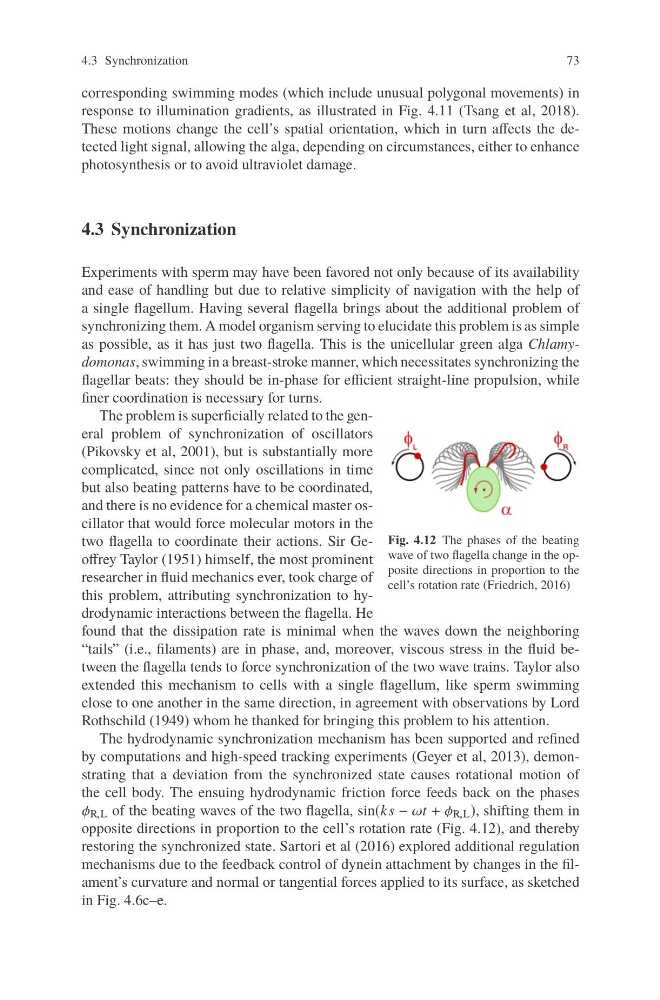
Fig. 4.12 The phases of the beating
wave of two flagella change in the opposite directions in proportion to the
cell’s rotation rate (Friedrich, 2016)
The problem is superficially related to the general problem of synchronization of oscillators
(Pikovsky et al, 2001), but is substantially more
complicated, since not only oscillations in time
but also beating patterns have to be coordinated,
and there is no evidence for a chemical master oscillator that would force molecular motors in the
two flagella to coordinate their actions. Sir Geoffrey Taylor (1951) himself, the most prominent
researcher in fluid mechanics ever, took charge of
this problem, attributing synchronization to hydrodynamic interactions between the flagella. He
found that the dissipation rate is minimal when the waves down the neighboring
“tails” (i.e., filaments) are in phase, and, moreover, viscous stress in the fluid between the flagella tends to force synchronization of the two wave trains. Taylor also
extended this mechanism to cells with a single flagellum, like sperm swimming
close to one another in the same direction, in agreement with observations by Lord
Rothschild (1949) whom he thanked for bringing this problem to his attention.
The hydrodynamic synchronization mechanism has been supported and refined
by computations and high-speed tracking experiments (Geyer et al, 2013), demonstrating that a deviation from the synchronized state causes rotational motion of
the cell body. The ensuing hydrodynamic friction force feeds back on the phases
φ R,L of the beating waves of the two flagella, sin(ks − ωt + φ R,L ), shifting them in
opposite directions in proportion to the cell’s rotation rate (Fig. 4.12), and thereby
restoring the synchronized state. Sartori et al (2016) explored additional regulation
mechanisms due to the feedback control of dynein attachment by changes in the filament’s curvature and normal or tangential forces applied to its surface, as sketched
in Fig. 4.6c–e.
73
corresponding swimming modes (which include unusual polygonal movements) in
response to illumination gradients, as illustrated in Fig. 4.11 (Tsang et al, 2018).
These motions change the cell’s spatial orientation, which in turn affects the detected light signal, allowing the alga, depending on circumstances, either to enhance
photosynthesis or to avoid ultraviolet damage.
4.3 Synchronization
Experiments with sperm may have been favored not only because of its availability
and ease of handling but due to relative simplicity of navigation with the help of
a single flagellum. Having several flagella brings about the additional problem of
synchronizing them. A model organism serving to elucidate this problem is as simple
as possible, as it has just two flagella. This is the unicellular green alga Chlamydomonas, swimming in a breast-stroke manner, which necessitates synchronizing the
flagellar beats: they should be in-phase for efficient straight-line propulsion, while
finer coordination is necessary for turns.
Fig. 4.12 The phases of the beating
wave of two flagella change in the opposite directions in proportion to the
cell’s rotation rate (Friedrich, 2016)
The problem is superficially related to the general problem of synchronization of oscillators
(Pikovsky et al, 2001), but is substantially more
complicated, since not only oscillations in time
but also beating patterns have to be coordinated,
and there is no evidence for a chemical master oscillator that would force molecular motors in the
two flagella to coordinate their actions. Sir Geoffrey Taylor (1951) himself, the most prominent
researcher in fluid mechanics ever, took charge of
this problem, attributing synchronization to hydrodynamic interactions between the flagella. He
found that the dissipation rate is minimal when the waves down the neighboring
“tails” (i.e., filaments) are in phase, and, moreover, viscous stress in the fluid between the flagella tends to force synchronization of the two wave trains. Taylor also
extended this mechanism to cells with a single flagellum, like sperm swimming
close to one another in the same direction, in agreement with observations by Lord
Rothschild (1949) whom he thanked for bringing this problem to his attention.
The hydrodynamic synchronization mechanism has been supported and refined
by computations and high-speed tracking experiments (Geyer et al, 2013), demonstrating that a deviation from the synchronized state causes rotational motion of
the cell body. The ensuing hydrodynamic friction force feeds back on the phases
φ R,L of the beating waves of the two flagella, sin(ks − ωt + φ R,L ), shifting them in
opposite directions in proportion to the cell’s rotation rate (Fig. 4.12), and thereby
restoring the synchronized state. Sartori et al (2016) explored additional regulation
mechanisms due to the feedback control of dynein attachment by changes in the filament’s curvature and normal or tangential forces applied to its surface, as sketched
in Fig. 4.6c–e.