

72
4 Motion of Microorganisms
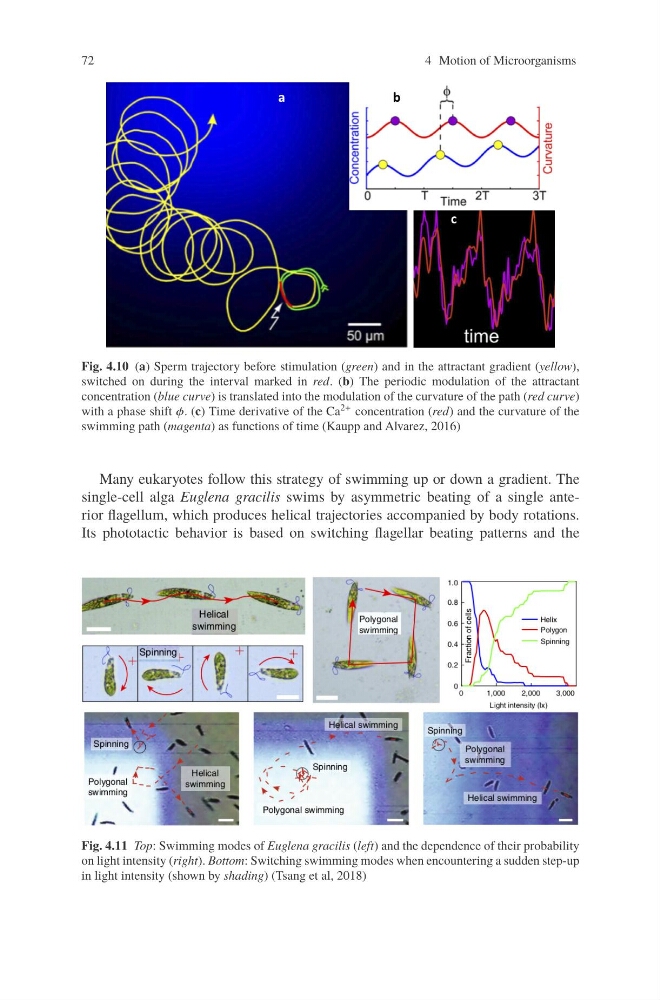
Fig. 4.10 (a) Sperm trajectory before stimulation (green) and in the attractant gradient (yellow),
switched on during the interval marked in red. (b) The periodic modulation of the attractant
concentration (blue curve) is translated into the modulation of the curvature of the path (red curve)
with a phase shift φ. (c) Time derivative of the Ca 2+ concentration (red) and the curvature of the
swimming path (magenta) as functions of time (Kaupp and Alvarez, 2016)
Many eukaryotes follow this strategy of swimming up or down a gradient. The
single-cell alga Euglena gracilis swims by asymmetric beating of a single anterior flagellum, which produces helical trajectories accompanied by body rotations.
Its phototactic behavior is based on switching flagellar beating patterns and the
Fig. 4.11 Top: Swimming modes of Euglena gracilis (left) and the dependence of their probability
on light intensity (right). Bottom: Switching swimming modes when encountering a sudden step-up
in light intensity (shown by shading) (Tsang et al, 2018)
4 Motion of Microorganisms
Fig. 4.10 (a) Sperm trajectory before stimulation (green) and in the attractant gradient (yellow),
switched on during the interval marked in red. (b) The periodic modulation of the attractant
concentration (blue curve) is translated into the modulation of the curvature of the path (red curve)
with a phase shift φ. (c) Time derivative of the Ca 2+ concentration (red) and the curvature of the
swimming path (magenta) as functions of time (Kaupp and Alvarez, 2016)
Many eukaryotes follow this strategy of swimming up or down a gradient. The
single-cell alga Euglena gracilis swims by asymmetric beating of a single anterior flagellum, which produces helical trajectories accompanied by body rotations.
Its phototactic behavior is based on switching flagellar beating patterns and the
Fig. 4.11 Top: Swimming modes of Euglena gracilis (left) and the dependence of their probability
on light intensity (right). Bottom: Switching swimming modes when encountering a sudden step-up
in light intensity (shown by shading) (Tsang et al, 2018)