

4.4 Bacterial Suspensions
75
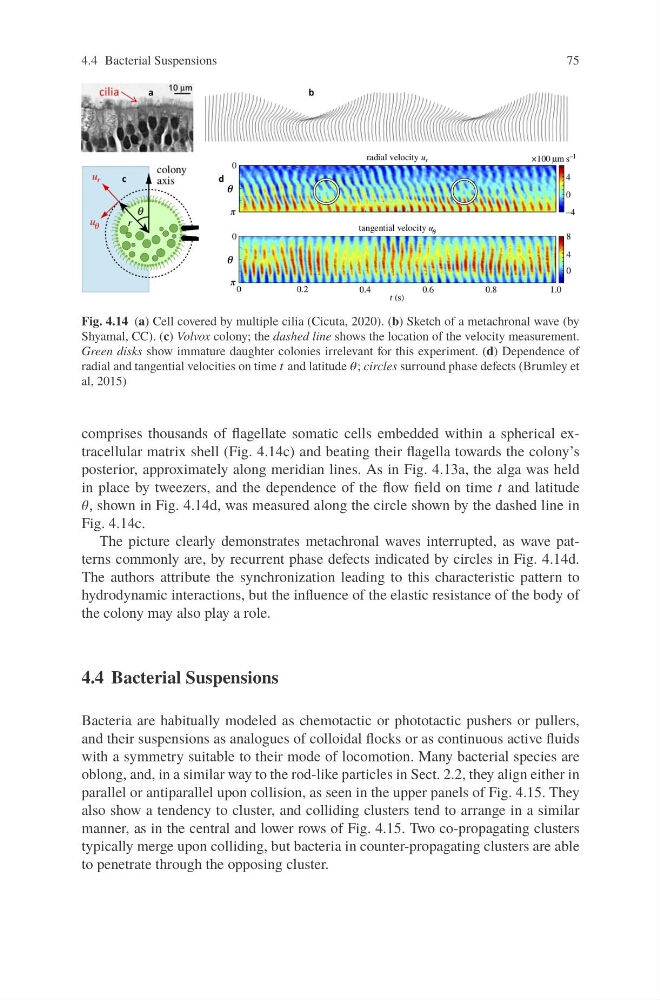
Fig. 4.14 (a) Cell covered by multiple cilia (Cicuta, 2020). (b) Sketch of a metachronal wave (by
Shyamal, CC). (c) Volvox colony; the dashed line shows the location of the velocity measurement.
Green disks show immature daughter colonies irrelevant for this experiment. (d) Dependence of
radial and tangential velocities on time t and latitude θ; circles surround phase defects (Brumley et
al, 2015)
comprises thousands of flagellate somatic cells embedded within a spherical extracellular matrix shell (Fig. 4.14c) and beating their flagella towards the colony’s
posterior, approximately along meridian lines. As in Fig. 4.13a, the alga was held
in place by tweezers, and the dependence of the flow field on time t and latitude
θ, shown in Fig. 4.14d, was measured along the circle shown by the dashed line in
Fig. 4.14c.
The picture clearly demonstrates metachronal waves interrupted, as wave patterns commonly are, by recurrent phase defects indicated by circles in Fig. 4.14d.
The authors attribute the synchronization leading to this characteristic pattern to
hydrodynamic interactions, but the influence of the elastic resistance of the body of
the colony may also play a role.
4.4 Bacterial Suspensions
Bacteria are habitually modeled as chemotactic or phototactic pushers or pullers,
and their suspensions as analogues of colloidal flocks or as continuous active fluids
with a symmetry suitable to their mode of locomotion. Many bacterial species are
oblong, and, in a similar way to the rod-like particles in Sect. 2.2, they align either in
parallel or antiparallel upon collision, as seen in the upper panels of Fig. 4.15. They
also show a tendency to cluster, and colliding clusters tend to arrange in a similar
manner, as in the central and lower rows of Fig. 4.15. Two co-propagating clusters
typically merge upon colliding, but bacteria in counter-propagating clusters are able
to penetrate through the opposing cluster.
75
Fig. 4.14 (a) Cell covered by multiple cilia (Cicuta, 2020). (b) Sketch of a metachronal wave (by
Shyamal, CC). (c) Volvox colony; the dashed line shows the location of the velocity measurement.
Green disks show immature daughter colonies irrelevant for this experiment. (d) Dependence of
radial and tangential velocities on time t and latitude θ; circles surround phase defects (Brumley et
al, 2015)
comprises thousands of flagellate somatic cells embedded within a spherical extracellular matrix shell (Fig. 4.14c) and beating their flagella towards the colony’s
posterior, approximately along meridian lines. As in Fig. 4.13a, the alga was held
in place by tweezers, and the dependence of the flow field on time t and latitude
θ, shown in Fig. 4.14d, was measured along the circle shown by the dashed line in
Fig. 4.14c.
The picture clearly demonstrates metachronal waves interrupted, as wave patterns commonly are, by recurrent phase defects indicated by circles in Fig. 4.14d.
The authors attribute the synchronization leading to this characteristic pattern to
hydrodynamic interactions, but the influence of the elastic resistance of the body of
the colony may also play a role.
4.4 Bacterial Suspensions
Bacteria are habitually modeled as chemotactic or phototactic pushers or pullers,
and their suspensions as analogues of colloidal flocks or as continuous active fluids
with a symmetry suitable to their mode of locomotion. Many bacterial species are
oblong, and, in a similar way to the rod-like particles in Sect. 2.2, they align either in
parallel or antiparallel upon collision, as seen in the upper panels of Fig. 4.15. They
also show a tendency to cluster, and colliding clusters tend to arrange in a similar
manner, as in the central and lower rows of Fig. 4.15. Two co-propagating clusters
typically merge upon colliding, but bacteria in counter-propagating clusters are able
to penetrate through the opposing cluster.