

Chapter 4
Motion of Microorganisms
4.1 Prokaryotic Flagella
Microorganisms, with their moving appendages and the ability to deform their body,
display a much wider variety of propulsion modes than colloidal particles. The most
common propulsion aid is a flagellum (“whip” in Latin). Prokaryotic bacteria have
invented it as an advanced rotational motion device; their helical filaments do not
actually deform in a whiplike way at all. This design principle was not taken over
by eukaryotes, which developed more whiplike flagella (Sect. 4.2), and it was left to
humans to reinvent the propeller.
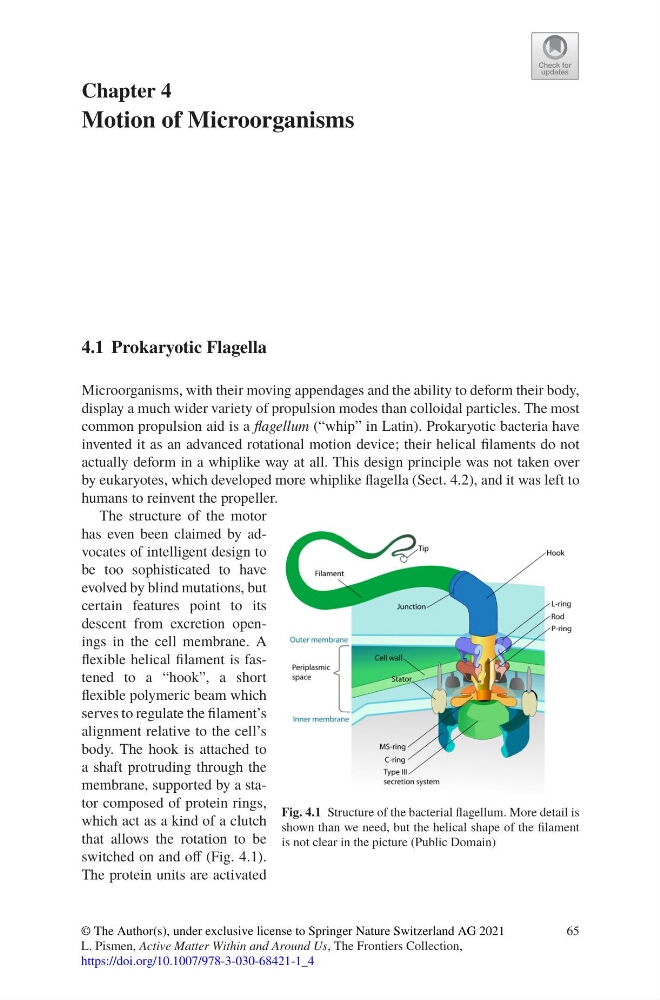
Fig. 4.1 Structure of the bacterial flagellum. More detail is
shown than we need, but the helical shape of the filament
is not clear in the picture (Public Domain)
The structure of the motor
has even been claimed by advocates of intelligent design to
be too sophisticated to have
evolved by blind mutations, but
certain features point to its
descent from excretion openings in the cell membrane. A
flexible helical filament is fastened to a “hook”, a short
flexible polymeric beam which
serves to regulate the filament’s
alignment relative to the cell’s
body. The hook is attached to
a shaft protruding through the
membrane, supported by a stator composed of protein rings,
which act as a kind of a clutch
that allows the rotation to be
switched on and off (Fig. 4.1).
The protein units are activated
65
L. Pismen, Active Matter Within and Around Us, The Frontiers Collection,
https://doi.org/10.1007/978-3-030-68421-1_4
© The Author(s), under exclusive license to Springer Nature Switzerland AG 2021
Motion of Microorganisms
4.1 Prokaryotic Flagella
Microorganisms, with their moving appendages and the ability to deform their body,
display a much wider variety of propulsion modes than colloidal particles. The most
common propulsion aid is a flagellum (“whip” in Latin). Prokaryotic bacteria have
invented it as an advanced rotational motion device; their helical filaments do not
actually deform in a whiplike way at all. This design principle was not taken over
by eukaryotes, which developed more whiplike flagella (Sect. 4.2), and it was left to
humans to reinvent the propeller.
Fig. 4.1 Structure of the bacterial flagellum. More detail is
shown than we need, but the helical shape of the filament
is not clear in the picture (Public Domain)
The structure of the motor
has even been claimed by advocates of intelligent design to
be too sophisticated to have
evolved by blind mutations, but
certain features point to its
descent from excretion openings in the cell membrane. A
flexible helical filament is fastened to a “hook”, a short
flexible polymeric beam which
serves to regulate the filament’s
alignment relative to the cell’s
body. The hook is attached to
a shaft protruding through the
membrane, supported by a stator composed of protein rings,
which act as a kind of a clutch
that allows the rotation to be
switched on and off (Fig. 4.1).
The protein units are activated
65
L. Pismen, Active Matter Within and Around Us, The Frontiers Collection,
https://doi.org/10.1007/978-3-030-68421-1_4
© The Author(s), under exclusive license to Springer Nature Switzerland AG 2021