

64
3 Active Colloids
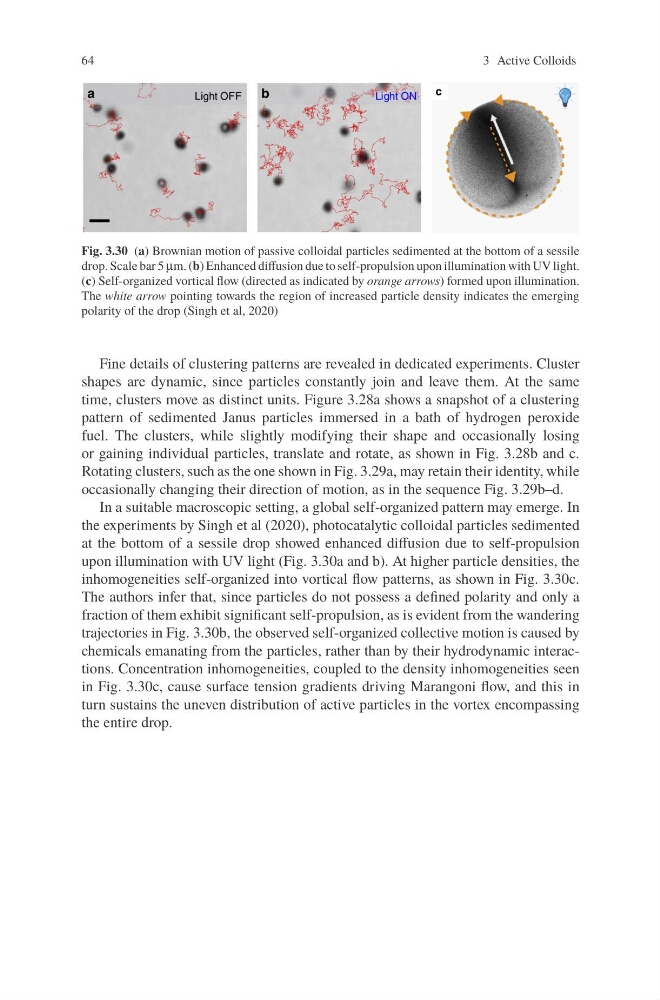
Fig. 3.30 (a) Brownian motion of passive colloidal particles sedimented at the bottom of a sessile
drop. Scale bar 5 μm. (b) Enhanced diffusion due to self-propulsion upon illumination with UV light.
(c) Self-organized vortical flow (directed as indicated by orange arrows) formed upon illumination.
The white arrow pointing towards the region of increased particle density indicates the emerging
polarity of the drop (Singh et al, 2020)
Fine details of clustering patterns are revealed in dedicated experiments. Cluster
shapes are dynamic, since particles constantly join and leave them. At the same
time, clusters move as distinct units. Figure 3.28a shows a snapshot of a clustering
pattern of sedimented Janus particles immersed in a bath of hydrogen peroxide
fuel. The clusters, while slightly modifying their shape and occasionally losing
or gaining individual particles, translate and rotate, as shown in Fig. 3.28b and c.
Rotating clusters, such as the one shown in Fig. 3.29a, may retain their identity, while
occasionally changing their direction of motion, as in the sequence Fig. 3.29b–d.
In a suitable macroscopic setting, a global self-organized pattern may emerge. In
the experiments by Singh et al (2020), photocatalytic colloidal particles sedimented
at the bottom of a sessile drop showed enhanced diffusion due to self-propulsion
upon illumination with UV light (Fig. 3.30a and b). At higher particle densities, the
inhomogeneities self-organized into vortical flow patterns, as shown in Fig. 3.30c.
The authors infer that, since particles do not possess a defined polarity and only a
fraction of them exhibit significant self-propulsion, as is evident from the wandering
trajectories in Fig. 3.30b, the observed self-organized collective motion is caused by
chemicals emanating from the particles, rather than by their hydrodynamic interactions. Concentration inhomogeneities, coupled to the density inhomogeneities seen
in Fig. 3.30c, cause surface tension gradients driving Marangoni flow, and this in
turn sustains the uneven distribution of active particles in the vortex encompassing
the entire drop.
3 Active Colloids
Fig. 3.30 (a) Brownian motion of passive colloidal particles sedimented at the bottom of a sessile
drop. Scale bar 5 μm. (b) Enhanced diffusion due to self-propulsion upon illumination with UV light.
(c) Self-organized vortical flow (directed as indicated by orange arrows) formed upon illumination.
The white arrow pointing towards the region of increased particle density indicates the emerging
polarity of the drop (Singh et al, 2020)
Fine details of clustering patterns are revealed in dedicated experiments. Cluster
shapes are dynamic, since particles constantly join and leave them. At the same
time, clusters move as distinct units. Figure 3.28a shows a snapshot of a clustering
pattern of sedimented Janus particles immersed in a bath of hydrogen peroxide
fuel. The clusters, while slightly modifying their shape and occasionally losing
or gaining individual particles, translate and rotate, as shown in Fig. 3.28b and c.
Rotating clusters, such as the one shown in Fig. 3.29a, may retain their identity, while
occasionally changing their direction of motion, as in the sequence Fig. 3.29b–d.
In a suitable macroscopic setting, a global self-organized pattern may emerge. In
the experiments by Singh et al (2020), photocatalytic colloidal particles sedimented
at the bottom of a sessile drop showed enhanced diffusion due to self-propulsion
upon illumination with UV light (Fig. 3.30a and b). At higher particle densities, the
inhomogeneities self-organized into vortical flow patterns, as shown in Fig. 3.30c.
The authors infer that, since particles do not possess a defined polarity and only a
fraction of them exhibit significant self-propulsion, as is evident from the wandering
trajectories in Fig. 3.30b, the observed self-organized collective motion is caused by
chemicals emanating from the particles, rather than by their hydrodynamic interactions. Concentration inhomogeneities, coupled to the density inhomogeneities seen
in Fig. 3.30c, cause surface tension gradients driving Marangoni flow, and this in
turn sustains the uneven distribution of active particles in the vortex encompassing
the entire drop.