

58
3 Active Colloids
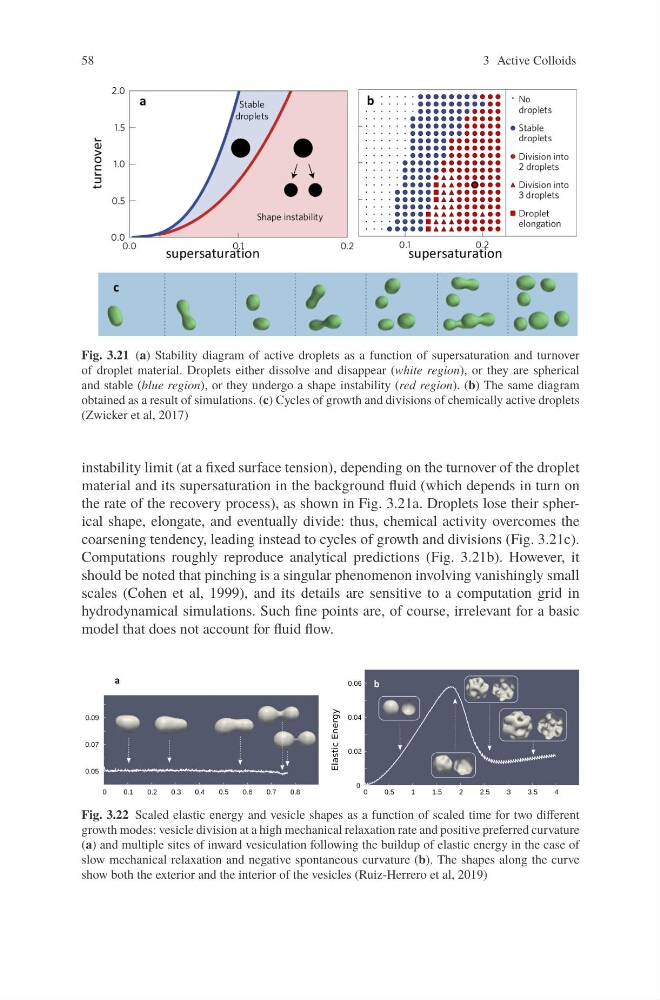
Fig. 3.21 (a) Stability diagram of active droplets as a function of supersaturation and turnover
of droplet material. Droplets either dissolve and disappear (white region), or they are spherical
and stable (blue region), or they undergo a shape instability (red region). (b) The same diagram
obtained as a result of simulations. (c) Cycles of growth and divisions of chemically active droplets
(Zwicker et al, 2017)
instability limit (at a fixed surface tension), depending on the turnover of the droplet
material and its supersaturation in the background fluid (which depends in turn on
the rate of the recovery process), as shown in Fig. 3.21a. Droplets lose their spherical shape, elongate, and eventually divide: thus, chemical activity overcomes the
coarsening tendency, leading instead to cycles of growth and divisions (Fig. 3.21c).
Computations roughly reproduce analytical predictions (Fig. 3.21b). However, it
should be noted that pinching is a singular phenomenon involving vanishingly small
scales (Cohen et al, 1999), and its details are sensitive to a computation grid in
hydrodynamical simulations. Such fine points are, of course, irrelevant for a basic
model that does not account for fluid flow.
Fig. 3.22 Scaled elastic energy and vesicle shapes as a function of scaled time for two different
growth modes: vesicle division at a high mechanical relaxation rate and positive preferred curvature
(a) and multiple sites of inward vesiculation following the buildup of elastic energy in the case of
slow mechanical relaxation and negative spontaneous curvature (b). The shapes along the curve
show both the exterior and the interior of the vesicles (Ruiz-Herrero et al, 2019)
3 Active Colloids
Fig. 3.21 (a) Stability diagram of active droplets as a function of supersaturation and turnover
of droplet material. Droplets either dissolve and disappear (white region), or they are spherical
and stable (blue region), or they undergo a shape instability (red region). (b) The same diagram
obtained as a result of simulations. (c) Cycles of growth and divisions of chemically active droplets
(Zwicker et al, 2017)
instability limit (at a fixed surface tension), depending on the turnover of the droplet
material and its supersaturation in the background fluid (which depends in turn on
the rate of the recovery process), as shown in Fig. 3.21a. Droplets lose their spherical shape, elongate, and eventually divide: thus, chemical activity overcomes the
coarsening tendency, leading instead to cycles of growth and divisions (Fig. 3.21c).
Computations roughly reproduce analytical predictions (Fig. 3.21b). However, it
should be noted that pinching is a singular phenomenon involving vanishingly small
scales (Cohen et al, 1999), and its details are sensitive to a computation grid in
hydrodynamical simulations. Such fine points are, of course, irrelevant for a basic
model that does not account for fluid flow.
Fig. 3.22 Scaled elastic energy and vesicle shapes as a function of scaled time for two different
growth modes: vesicle division at a high mechanical relaxation rate and positive preferred curvature
(a) and multiple sites of inward vesiculation following the buildup of elastic energy in the case of
slow mechanical relaxation and negative spontaneous curvature (b). The shapes along the curve
show both the exterior and the interior of the vesicles (Ruiz-Herrero et al, 2019)