

3.6 Imitated Cells
57
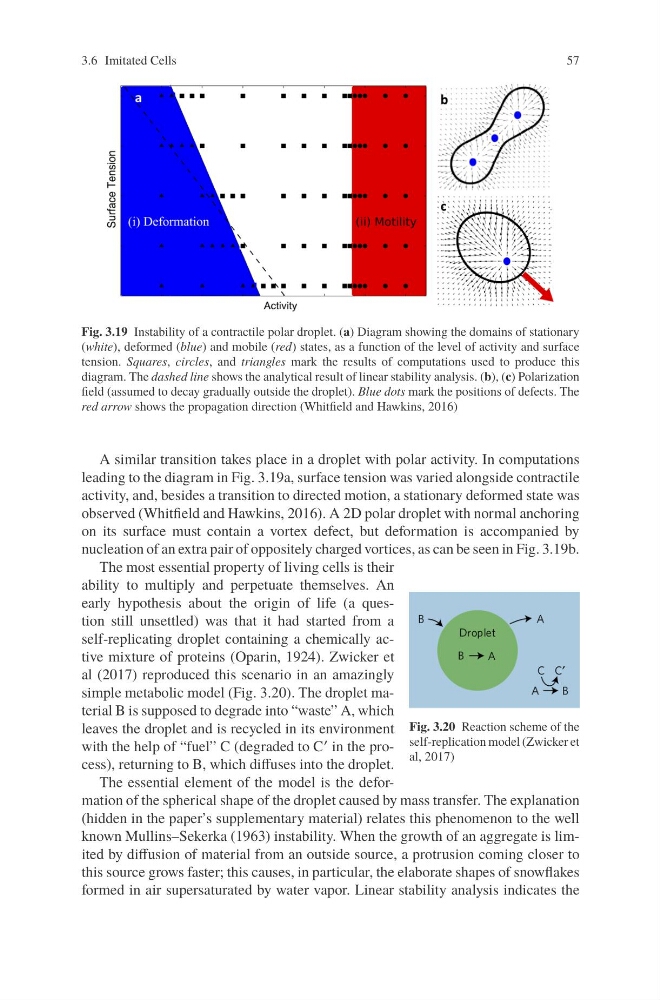
Fig. 3.19 Instability of a contractile polar droplet. (a) Diagram showing the domains of stationary
(white), deformed (blue) and mobile (red) states, as a function of the level of activity and surface
tension. Squares, circles, and triangles mark the results of computations used to produce this
diagram. The dashed line shows the analytical result of linear stability analysis. (b), (c) Polarization
field (assumed to decay gradually outside the droplet). Blue dots mark the positions of defects. The
red arrow shows the propagation direction (Whitfield and Hawkins, 2016)
A similar transition takes place in a droplet with polar activity. In computations
leading to the diagram in Fig. 3.19a, surface tension was varied alongside contractile
activity, and, besides a transition to directed motion, a stationary deformed state was
observed (Whitfield and Hawkins, 2016). A 2D polar droplet with normal anchoring
on its surface must contain a vortex defect, but deformation is accompanied by
nucleation of an extra pair of oppositely charged vortices, as can be seen in Fig. 3.19b.
Fig. 3.20 Reaction scheme of the
self-replication model (Zwicker et
al, 2017)
The most essential property of living cells is their
ability to multiply and perpetuate themselves. An
early hypothesis about the origin of life (a question still unsettled) was that it had started from a
self-replicating droplet containing a chemically active mixture of proteins (Oparin, 1924). Zwicker et
al (2017) reproduced this scenario in an amazingly
simple metabolic model (Fig. 3.20). The droplet material B is supposed to degrade into “waste” A, which
leaves the droplet and is recycled in its environment
with the help of “fuel” C (degraded to C in the process), returning to B, which diffuses into the droplet.
The essential element of the model is the deformation of the spherical shape of the droplet caused by mass transfer. The explanation
(hidden in the paper’s supplementary material) relates this phenomenon to the well
known Mullins–Sekerka (1963) instability. When the growth of an aggregate is limited by diffusion of material from an outside source, a protrusion coming closer to
this source grows faster; this causes, in particular, the elaborate shapes of snowflakes
formed in air supersaturated by water vapor. Linear stability analysis indicates the
57
Fig. 3.19 Instability of a contractile polar droplet. (a) Diagram showing the domains of stationary
(white), deformed (blue) and mobile (red) states, as a function of the level of activity and surface
tension. Squares, circles, and triangles mark the results of computations used to produce this
diagram. The dashed line shows the analytical result of linear stability analysis. (b), (c) Polarization
field (assumed to decay gradually outside the droplet). Blue dots mark the positions of defects. The
red arrow shows the propagation direction (Whitfield and Hawkins, 2016)
A similar transition takes place in a droplet with polar activity. In computations
leading to the diagram in Fig. 3.19a, surface tension was varied alongside contractile
activity, and, besides a transition to directed motion, a stationary deformed state was
observed (Whitfield and Hawkins, 2016). A 2D polar droplet with normal anchoring
on its surface must contain a vortex defect, but deformation is accompanied by
nucleation of an extra pair of oppositely charged vortices, as can be seen in Fig. 3.19b.
Fig. 3.20 Reaction scheme of the
self-replication model (Zwicker et
al, 2017)
The most essential property of living cells is their
ability to multiply and perpetuate themselves. An
early hypothesis about the origin of life (a question still unsettled) was that it had started from a
self-replicating droplet containing a chemically active mixture of proteins (Oparin, 1924). Zwicker et
al (2017) reproduced this scenario in an amazingly
simple metabolic model (Fig. 3.20). The droplet material B is supposed to degrade into “waste” A, which
leaves the droplet and is recycled in its environment
with the help of “fuel” C (degraded to C in the process), returning to B, which diffuses into the droplet.
The essential element of the model is the deformation of the spherical shape of the droplet caused by mass transfer. The explanation
(hidden in the paper’s supplementary material) relates this phenomenon to the well
known Mullins–Sekerka (1963) instability. When the growth of an aggregate is limited by diffusion of material from an outside source, a protrusion coming closer to
this source grows faster; this causes, in particular, the elaborate shapes of snowflakes
formed in air supersaturated by water vapor. Linear stability analysis indicates the