

56
3 Active Colloids
and Yoshikawa (2014), it caused interfacial blebbing on the oil–water interface
(Fig. 3.17 left), which became more pronounced when the oil droplet floated on
the surface of the aqueous phase. The droplet spontaneously moved, deformed, and
split, as shown in Fig. 3.17 (right). Interfacial blebbing continued for about 100
seconds until the surfactant distribution over the interface came to equilibrium. The
droplets in blebbing and crawling experiments are in the millimeter range, far above
colloidal sizes, but the principal actors in their motion are nanometer-range surfactant
structures.
3.6 Imitated Cells
Some aspects of autonomous droplet dynamics are reminiscent of the motion of
living cells. Precluding the more realistic description in Chap. 5, a droplet filled
by an active nematic fluid, like the one considered in Sect. 2.5, may be viewed as
a rough model of a cell with cytoskeletal filaments stressed by molecular motors.
A contractile nematic fluid is generically unstable (Simha and Ramaswamy, 2002).
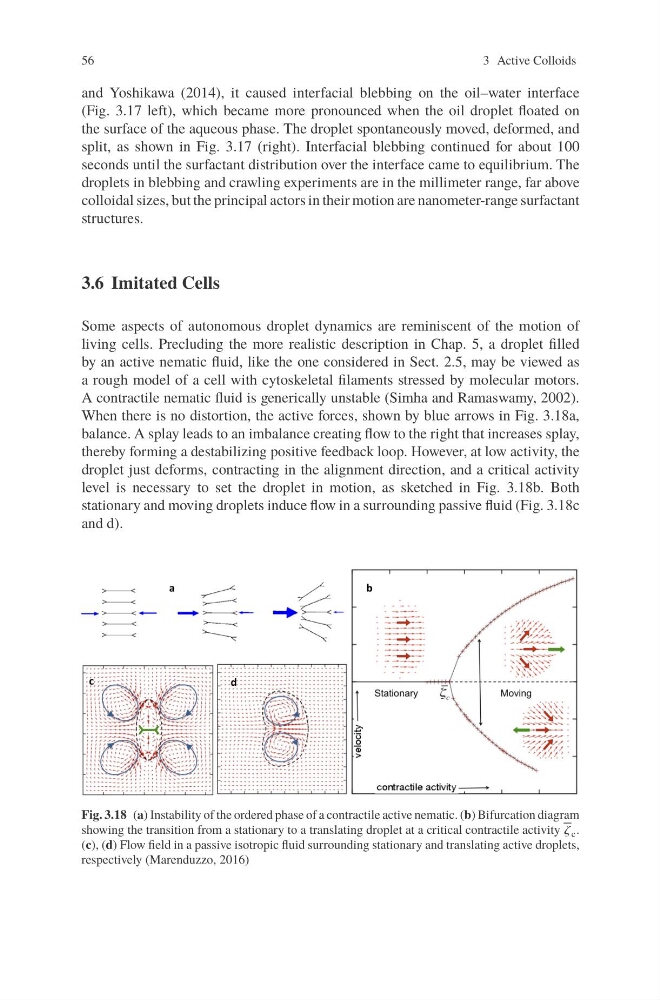
When there is no distortion, the active forces, shown by blue arrows in Fig. 3.18a,
balance. A splay leads to an imbalance creating flow to the right that increases splay,
thereby forming a destabilizing positive feedback loop. However, at low activity, the
droplet just deforms, contracting in the alignment direction, and a critical activity
level is necessary to set the droplet in motion, as sketched in Fig. 3.18b. Both
stationary and moving droplets induce flow in a surrounding passive fluid (Fig. 3.18c
and d).
Fig. 3.18 (a) Instability of the ordered phase of a contractile active nematic. (b) Bifurcation diagram
showing the transition from a stationary to a translating droplet at a critical contractile activity ζ c .
(c), (d) Flow field in a passive isotropic fluid surrounding stationary and translating active droplets,
respectively (Marenduzzo, 2016)
3 Active Colloids
and Yoshikawa (2014), it caused interfacial blebbing on the oil–water interface
(Fig. 3.17 left), which became more pronounced when the oil droplet floated on
the surface of the aqueous phase. The droplet spontaneously moved, deformed, and
split, as shown in Fig. 3.17 (right). Interfacial blebbing continued for about 100
seconds until the surfactant distribution over the interface came to equilibrium. The
droplets in blebbing and crawling experiments are in the millimeter range, far above
colloidal sizes, but the principal actors in their motion are nanometer-range surfactant
structures.
3.6 Imitated Cells
Some aspects of autonomous droplet dynamics are reminiscent of the motion of
living cells. Precluding the more realistic description in Chap. 5, a droplet filled
by an active nematic fluid, like the one considered in Sect. 2.5, may be viewed as
a rough model of a cell with cytoskeletal filaments stressed by molecular motors.
A contractile nematic fluid is generically unstable (Simha and Ramaswamy, 2002).
When there is no distortion, the active forces, shown by blue arrows in Fig. 3.18a,
balance. A splay leads to an imbalance creating flow to the right that increases splay,
thereby forming a destabilizing positive feedback loop. However, at low activity, the
droplet just deforms, contracting in the alignment direction, and a critical activity
level is necessary to set the droplet in motion, as sketched in Fig. 3.18b. Both
stationary and moving droplets induce flow in a surrounding passive fluid (Fig. 3.18c
and d).
Fig. 3.18 (a) Instability of the ordered phase of a contractile active nematic. (b) Bifurcation diagram
showing the transition from a stationary to a translating droplet at a critical contractile activity ζ c .
(c), (d) Flow field in a passive isotropic fluid surrounding stationary and translating active droplets,
respectively (Marenduzzo, 2016)