

3.5 Autophoretic Droplets
55
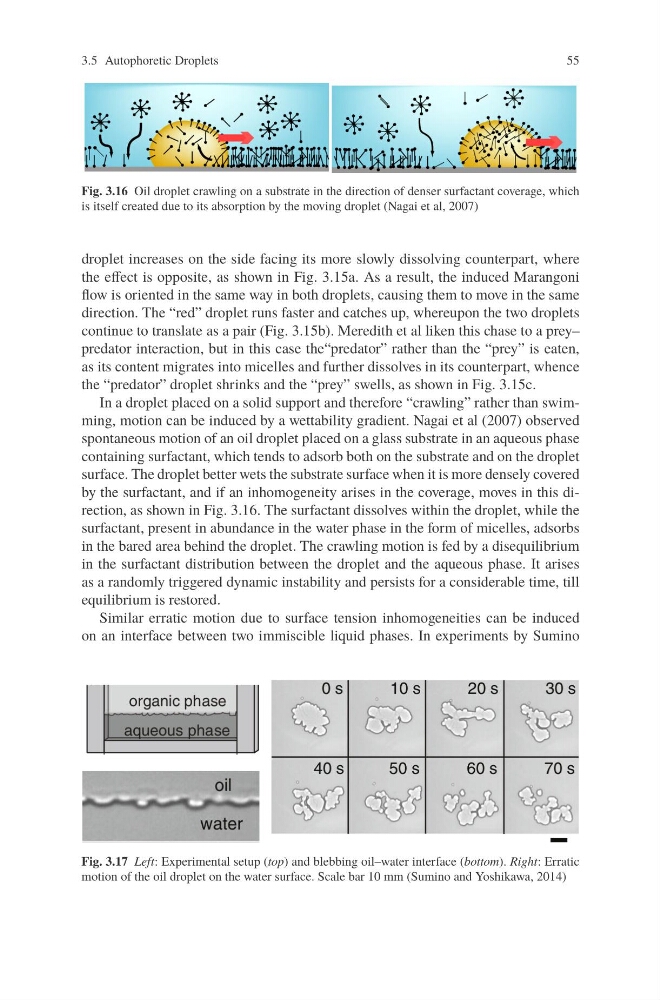
Fig. 3.16 Oil droplet crawling on a substrate in the direction of denser surfactant coverage, which
is itself created due to its absorption by the moving droplet (Nagai et al, 2007)
droplet increases on the side facing its more slowly dissolving counterpart, where
the effect is opposite, as shown in Fig. 3.15a. As a result, the induced Marangoni
flow is oriented in the same way in both droplets, causing them to move in the same
direction. The “red” droplet runs faster and catches up, whereupon the two droplets
continue to translate as a pair (Fig. 3.15b). Meredith et al liken this chase to a prey–
predator interaction, but in this case the“predator” rather than the “prey” is eaten,
as its content migrates into micelles and further dissolves in its counterpart, whence
the “predator” droplet shrinks and the “prey” swells, as shown in Fig. 3.15c.
In a droplet placed on a solid support and therefore “crawling” rather than swimming, motion can be induced by a wettability gradient. Nagai et al (2007) observed
spontaneous motion of an oil droplet placed on a glass substrate in an aqueous phase
containing surfactant, which tends to adsorb both on the substrate and on the droplet
surface. The droplet better wets the substrate surface when it is more densely covered
by the surfactant, and if an inhomogeneity arises in the coverage, moves in this direction, as shown in Fig. 3.16. The surfactant dissolves within the droplet, while the
surfactant, present in abundance in the water phase in the form of micelles, adsorbs
in the bared area behind the droplet. The crawling motion is fed by a disequilibrium
in the surfactant distribution between the droplet and the aqueous phase. It arises
as a randomly triggered dynamic instability and persists for a considerable time, till
equilibrium is restored.
Similar erratic motion due to surface tension inhomogeneities can be induced
on an interface between two immiscible liquid phases. In experiments by Sumino
Fig. 3.17 Left: Experimental setup (top) and blebbing oil–water interface (bottom). Right: Erratic
motion of the oil droplet on the water surface. Scale bar 10 mm (Sumino and Yoshikawa, 2014)
55
Fig. 3.16 Oil droplet crawling on a substrate in the direction of denser surfactant coverage, which
is itself created due to its absorption by the moving droplet (Nagai et al, 2007)
droplet increases on the side facing its more slowly dissolving counterpart, where
the effect is opposite, as shown in Fig. 3.15a. As a result, the induced Marangoni
flow is oriented in the same way in both droplets, causing them to move in the same
direction. The “red” droplet runs faster and catches up, whereupon the two droplets
continue to translate as a pair (Fig. 3.15b). Meredith et al liken this chase to a prey–
predator interaction, but in this case the“predator” rather than the “prey” is eaten,
as its content migrates into micelles and further dissolves in its counterpart, whence
the “predator” droplet shrinks and the “prey” swells, as shown in Fig. 3.15c.
In a droplet placed on a solid support and therefore “crawling” rather than swimming, motion can be induced by a wettability gradient. Nagai et al (2007) observed
spontaneous motion of an oil droplet placed on a glass substrate in an aqueous phase
containing surfactant, which tends to adsorb both on the substrate and on the droplet
surface. The droplet better wets the substrate surface when it is more densely covered
by the surfactant, and if an inhomogeneity arises in the coverage, moves in this direction, as shown in Fig. 3.16. The surfactant dissolves within the droplet, while the
surfactant, present in abundance in the water phase in the form of micelles, adsorbs
in the bared area behind the droplet. The crawling motion is fed by a disequilibrium
in the surfactant distribution between the droplet and the aqueous phase. It arises
as a randomly triggered dynamic instability and persists for a considerable time, till
equilibrium is restored.
Similar erratic motion due to surface tension inhomogeneities can be induced
on an interface between two immiscible liquid phases. In experiments by Sumino
Fig. 3.17 Left: Experimental setup (top) and blebbing oil–water interface (bottom). Right: Erratic
motion of the oil droplet on the water surface. Scale bar 10 mm (Sumino and Yoshikawa, 2014)