

3.5 Autophoretic Droplets
53
a
Ac ve
par cle
c
U ow
Δ
b
c
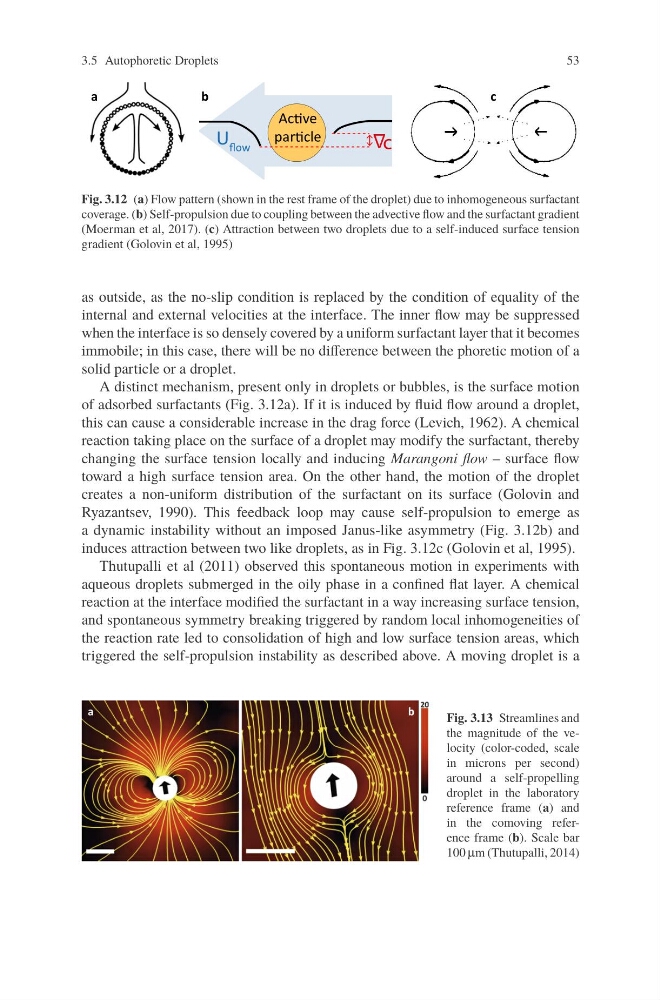
Fig. 3.12 (a) Flow pattern (shown in the rest frame of the droplet) due to inhomogeneous surfactant
coverage. (b) Self-propulsion due to coupling between the advective flow and the surfactant gradient
(Moerman et al, 2017). (c) Attraction between two droplets due to a self-induced surface tension
gradient (Golovin et al, 1995)
as outside, as the no-slip condition is replaced by the condition of equality of the
internal and external velocities at the interface. The inner flow may be suppressed
when the interface is so densely covered by a uniform surfactant layer that it becomes
immobile; in this case, there will be no difference between the phoretic motion of a
solid particle or a droplet.
A distinct mechanism, present only in droplets or bubbles, is the surface motion
of adsorbed surfactants (Fig. 3.12a). If it is induced by fluid flow around a droplet,
this can cause a considerable increase in the drag force (Levich, 1962). A chemical
reaction taking place on the surface of a droplet may modify the surfactant, thereby
changing the surface tension locally and inducing Marangoni flow – surface flow
toward a high surface tension area. On the other hand, the motion of the droplet
creates a non-uniform distribution of the surfactant on its surface (Golovin and
Ryazantsev, 1990). This feedback loop may cause self-propulsion to emerge as
a dynamic instability without an imposed Janus-like asymmetry (Fig. 3.12b) and
induces attraction between two like droplets, as in Fig. 3.12c (Golovin et al, 1995).
Thutupalli et al (2011) observed this spontaneous motion in experiments with
aqueous droplets submerged in the oily phase in a confined flat layer. A chemical
reaction at the interface modified the surfactant in a way increasing surface tension,
and spontaneous symmetry breaking triggered by random local inhomogeneities of
the reaction rate led to consolidation of high and low surface tension areas, which
triggered the self-propulsion instability as described above. A moving droplet is a
Fig. 3.13 Streamlines and
the magnitude of the velocity (color-coded, scale
in microns per second)
around a self-propelling
droplet in the laboratory
reference frame (a) and
in the comoving reference frame (b). Scale bar
100 μm (Thutupalli, 2014)
53
a
Ac ve
par cle
c
U ow
Δ
b
c
Fig. 3.12 (a) Flow pattern (shown in the rest frame of the droplet) due to inhomogeneous surfactant
coverage. (b) Self-propulsion due to coupling between the advective flow and the surfactant gradient
(Moerman et al, 2017). (c) Attraction between two droplets due to a self-induced surface tension
gradient (Golovin et al, 1995)
as outside, as the no-slip condition is replaced by the condition of equality of the
internal and external velocities at the interface. The inner flow may be suppressed
when the interface is so densely covered by a uniform surfactant layer that it becomes
immobile; in this case, there will be no difference between the phoretic motion of a
solid particle or a droplet.
A distinct mechanism, present only in droplets or bubbles, is the surface motion
of adsorbed surfactants (Fig. 3.12a). If it is induced by fluid flow around a droplet,
this can cause a considerable increase in the drag force (Levich, 1962). A chemical
reaction taking place on the surface of a droplet may modify the surfactant, thereby
changing the surface tension locally and inducing Marangoni flow – surface flow
toward a high surface tension area. On the other hand, the motion of the droplet
creates a non-uniform distribution of the surfactant on its surface (Golovin and
Ryazantsev, 1990). This feedback loop may cause self-propulsion to emerge as
a dynamic instability without an imposed Janus-like asymmetry (Fig. 3.12b) and
induces attraction between two like droplets, as in Fig. 3.12c (Golovin et al, 1995).
Thutupalli et al (2011) observed this spontaneous motion in experiments with
aqueous droplets submerged in the oily phase in a confined flat layer. A chemical
reaction at the interface modified the surfactant in a way increasing surface tension,
and spontaneous symmetry breaking triggered by random local inhomogeneities of
the reaction rate led to consolidation of high and low surface tension areas, which
triggered the self-propulsion instability as described above. A moving droplet is a
Fig. 3.13 Streamlines and
the magnitude of the velocity (color-coded, scale
in microns per second)
around a self-propelling
droplet in the laboratory
reference frame (a) and
in the comoving reference frame (b). Scale bar
100 μm (Thutupalli, 2014)