

50
3 Active Colloids
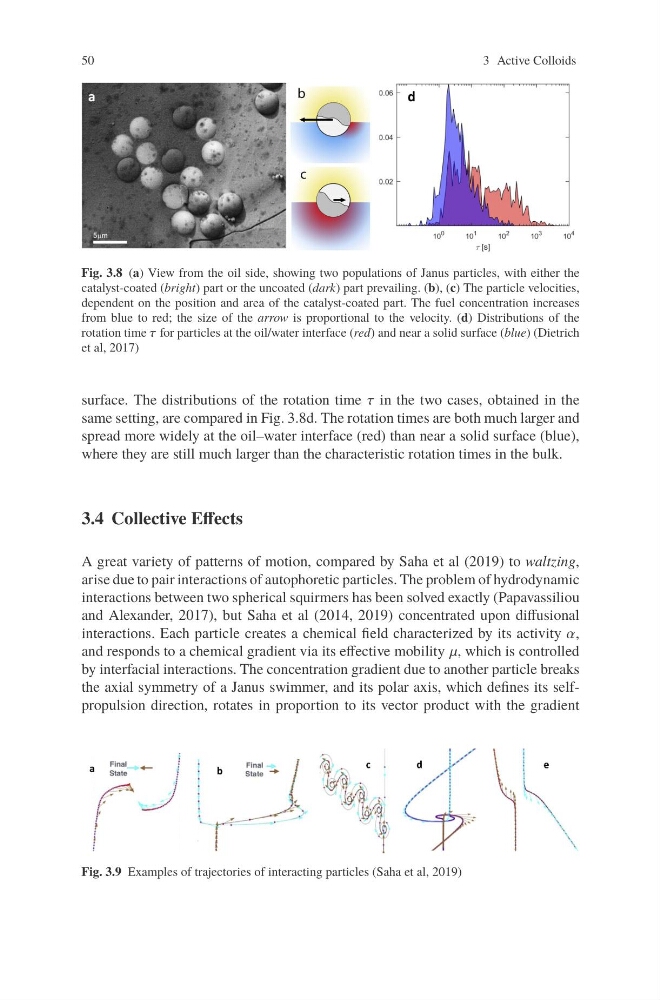
Fig. 3.8 (a) View from the oil side, showing two populations of Janus particles, with either the
catalyst-coated (bright) part or the uncoated (dark) part prevailing. (b), (c) The particle velocities,
dependent on the position and area of the catalyst-coated part. The fuel concentration increases
from blue to red; the size of the arrow is proportional to the velocity. (d) Distributions of the
rotation time τ for particles at the oil/water interface (red) and near a solid surface (blue) (Dietrich
et al, 2017)
surface. The distributions of the rotation time τ in the two cases, obtained in the
same setting, are compared in Fig. 3.8d. The rotation times are both much larger and
spread more widely at the oil–water interface (red) than near a solid surface (blue),
where they are still much larger than the characteristic rotation times in the bulk.
3.4 Collective Effects
A great variety of patterns of motion, compared by Saha et al (2019) to waltzing,
arise due to pair interactions of autophoretic particles. The problem of hydrodynamic
interactions between two spherical squirmers has been solved exactly (Papavassiliou
and Alexander, 2017), but Saha et al (2014, 2019) concentrated upon diffusional
interactions. Each particle creates a chemical field characterized by its activity α,
and responds to a chemical gradient via its effective mobility μ, which is controlled
by interfacial interactions. The concentration gradient due to another particle breaks
the axial symmetry of a Janus swimmer, and its polar axis, which defines its selfpropulsion direction, rotates in proportion to its vector product with the gradient
Fig. 3.9 Examples of trajectories of interacting particles (Saha et al, 2019)
3 Active Colloids
Fig. 3.8 (a) View from the oil side, showing two populations of Janus particles, with either the
catalyst-coated (bright) part or the uncoated (dark) part prevailing. (b), (c) The particle velocities,
dependent on the position and area of the catalyst-coated part. The fuel concentration increases
from blue to red; the size of the arrow is proportional to the velocity. (d) Distributions of the
rotation time τ for particles at the oil/water interface (red) and near a solid surface (blue) (Dietrich
et al, 2017)
surface. The distributions of the rotation time τ in the two cases, obtained in the
same setting, are compared in Fig. 3.8d. The rotation times are both much larger and
spread more widely at the oil–water interface (red) than near a solid surface (blue),
where they are still much larger than the characteristic rotation times in the bulk.
3.4 Collective Effects
A great variety of patterns of motion, compared by Saha et al (2019) to waltzing,
arise due to pair interactions of autophoretic particles. The problem of hydrodynamic
interactions between two spherical squirmers has been solved exactly (Papavassiliou
and Alexander, 2017), but Saha et al (2014, 2019) concentrated upon diffusional
interactions. Each particle creates a chemical field characterized by its activity α,
and responds to a chemical gradient via its effective mobility μ, which is controlled
by interfacial interactions. The concentration gradient due to another particle breaks
the axial symmetry of a Janus swimmer, and its polar axis, which defines its selfpropulsion direction, rotates in proportion to its vector product with the gradient
Fig. 3.9 Examples of trajectories of interacting particles (Saha et al, 2019)