

48
3 Active Colloids
either. The nontrivial result is that the direction of motion reverses as the separation
increases from direct contact d c = 0 to a distance of the same order of magnitude as
the radius of the larger particle.
All the above kinds of behavior can also be induced by an electrochemical reaction
on the active surface of a Janus particle that causes a change of ion concentration
in the solution and, if the particle is conductive, electron transfer between the active
and passive parts. A surface charge induces an electrical double layer with a dense
layer of counter-ions and a diffuse layer of ions of the same charge. The surface
energy depends on the thickness and composition of the double layer. Again, its
gradient induces electroosmotic flow saturating to a slip velocity at a small distance
of the same order of magnitude as the thickness of the double layer, and leading to
self-electrophoretic propulsion toward the region where the energy is lower. These
effects are often hard to separate from self-diffusiophoresis due to composition
changes caused by the same reaction (Kuron et al, 2018).
3.3 Surface Effects
The direction of autophoretic motion is influenced by the immediate environment
of colloidal particles, which allows one to steer them by applying external gradients
or bringing other particles or droplets into their vicinity. The particles interact
both chemically and hydrodynamically, which influences their motion and mutual
orientation. The most immediate effect is geometrical. Bounding walls affect the
motion of Janus particles through both the induced flow pattern and the concentration
distribution, caused, respectively, by the no-slip and no-flux boundary conditions at
the wall. The change in the solute distribution leads to changes in the phoretic slip at
the particle surface, which translate into changes in the flow induced by the particle.
On the other hand, flow induced by the particle is reflected by the wall, creating a
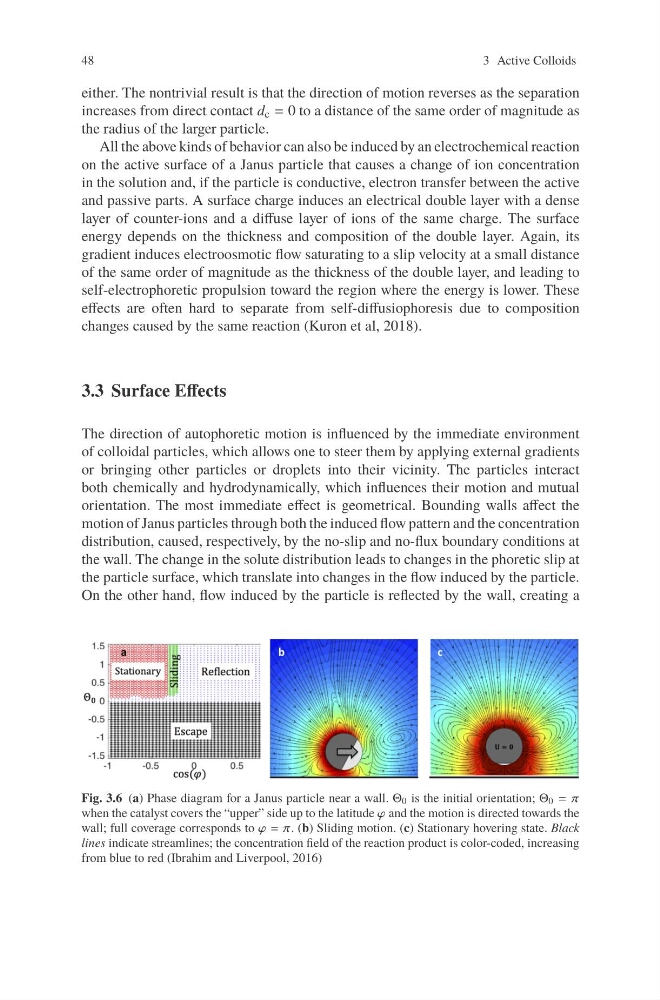
Fig. 3.6 (a) Phase diagram for a Janus particle near a wall. Θ 0 is the initial orientation; Θ 0 = π
when the catalyst covers the “upper” side up to the latitude ϕ and the motion is directed towards the
wall; full coverage corresponds to ϕ = π. (b) Sliding motion. (c) Stationary hovering state. Black
lines indicate streamlines; the concentration field of the reaction product is color-coded, increasing
from blue to red (Ibrahim and Liverpool, 2016)
3 Active Colloids
either. The nontrivial result is that the direction of motion reverses as the separation
increases from direct contact d c = 0 to a distance of the same order of magnitude as
the radius of the larger particle.
All the above kinds of behavior can also be induced by an electrochemical reaction
on the active surface of a Janus particle that causes a change of ion concentration
in the solution and, if the particle is conductive, electron transfer between the active
and passive parts. A surface charge induces an electrical double layer with a dense
layer of counter-ions and a diffuse layer of ions of the same charge. The surface
energy depends on the thickness and composition of the double layer. Again, its
gradient induces electroosmotic flow saturating to a slip velocity at a small distance
of the same order of magnitude as the thickness of the double layer, and leading to
self-electrophoretic propulsion toward the region where the energy is lower. These
effects are often hard to separate from self-diffusiophoresis due to composition
changes caused by the same reaction (Kuron et al, 2018).
3.3 Surface Effects
The direction of autophoretic motion is influenced by the immediate environment
of colloidal particles, which allows one to steer them by applying external gradients
or bringing other particles or droplets into their vicinity. The particles interact
both chemically and hydrodynamically, which influences their motion and mutual
orientation. The most immediate effect is geometrical. Bounding walls affect the
motion of Janus particles through both the induced flow pattern and the concentration
distribution, caused, respectively, by the no-slip and no-flux boundary conditions at
the wall. The change in the solute distribution leads to changes in the phoretic slip at
the particle surface, which translate into changes in the flow induced by the particle.
On the other hand, flow induced by the particle is reflected by the wall, creating a
Fig. 3.6 (a) Phase diagram for a Janus particle near a wall. Θ 0 is the initial orientation; Θ 0 = π
when the catalyst covers the “upper” side up to the latitude ϕ and the motion is directed towards the
wall; full coverage corresponds to ϕ = π. (b) Sliding motion. (c) Stationary hovering state. Black
lines indicate streamlines; the concentration field of the reaction product is color-coded, increasing
from blue to red (Ibrahim and Liverpool, 2016)