

3.2 Autophoretic Particles
47
kinematic viscosity entering the Reynolds number. Still, a microscopic particle has
to propel itself at several hundred body lengths per second to attain a Péclet number
of order unity. A small Péclet number means that advection plays a negligible role
in mass transport, compared to diffusion, and therefore the concentration field is
determined by solving the linear diffusion equation.
In this way, flow and mass transport are uncoupled, which makes computations
far easier. An example of the concentration field computed under this assumption
is shown in Fig. 3.4a. Once the concentration distribution is known, this defines
the local slip around the particle surface proportional to the concentration gradient,
and the flow field can be computed by expanding in spherical harmonics. The flow
field, computed in this way (Campbell et al, 2019) and shown in Fig. 3.4b, has
been compared with experimental measurements and found to yield a qualitatively
similar but noisy picture (Fig. 3.4c). Microscopic colloidal particles experience
Brownian motion due to thermal fluctuations in the fluid, which causes their random
reorientation. They are therefore called active Brownian particles – a term introduced
by Schimansky-Geier et al (1995).
Besides the asymmetric chemical activity of Janus particles, asymmetry leading
to autophoresis can be geometrical. Michelin and Lauga (2015) achieved this by
combining two particles with equal and uniform activity but different size. This
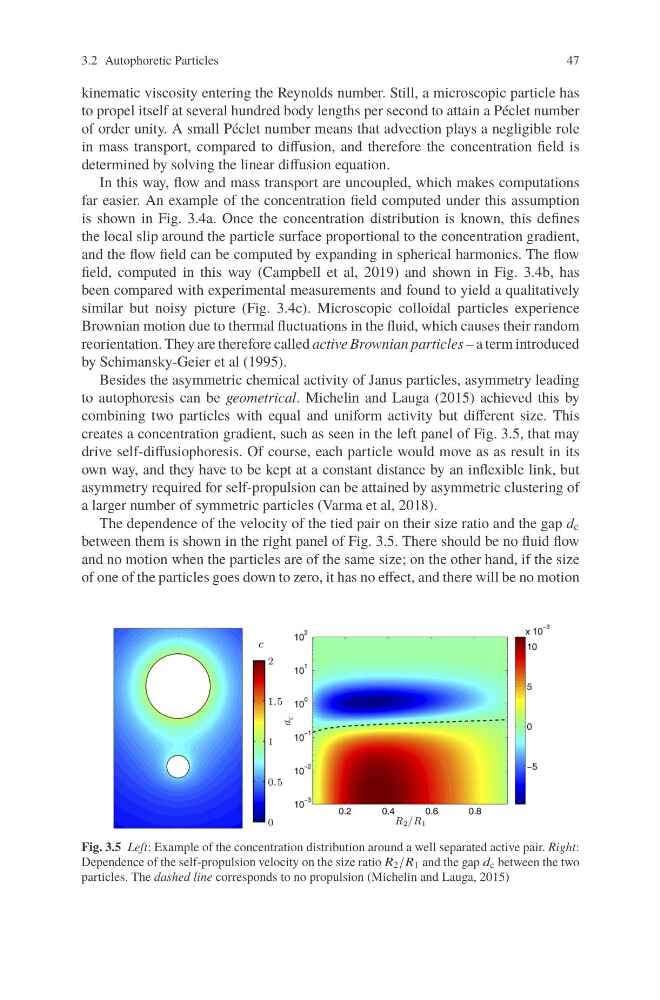
creates a concentration gradient, such as seen in the left panel of Fig. 3.5, that may
drive self-diffusiophoresis. Of course, each particle would move as as result in its
own way, and they have to be kept at a constant distance by an inflexible link, but
asymmetry required for self-propulsion can be attained by asymmetric clustering of
a larger number of symmetric particles (Varma et al, 2018).
The dependence of the velocity of the tied pair on their size ratio and the gap d c
between them is shown in the right panel of Fig. 3.5. There should be no fluid flow
and no motion when the particles are of the same size; on the other hand, if the size
of one of the particles goes down to zero, it has no effect, and there will be no motion
Fig. 3.5 Left: Example of the concentration distribution around a well separated active pair. Right:
Dependence of the self-propulsion velocity on the size ratio R 2 /R 1 and the gap d c between the two
particles. The dashed line corresponds to no propulsion (Michelin and Lauga, 2015)
47
kinematic viscosity entering the Reynolds number. Still, a microscopic particle has
to propel itself at several hundred body lengths per second to attain a Péclet number
of order unity. A small Péclet number means that advection plays a negligible role
in mass transport, compared to diffusion, and therefore the concentration field is
determined by solving the linear diffusion equation.
In this way, flow and mass transport are uncoupled, which makes computations
far easier. An example of the concentration field computed under this assumption
is shown in Fig. 3.4a. Once the concentration distribution is known, this defines
the local slip around the particle surface proportional to the concentration gradient,
and the flow field can be computed by expanding in spherical harmonics. The flow
field, computed in this way (Campbell et al, 2019) and shown in Fig. 3.4b, has
been compared with experimental measurements and found to yield a qualitatively
similar but noisy picture (Fig. 3.4c). Microscopic colloidal particles experience
Brownian motion due to thermal fluctuations in the fluid, which causes their random
reorientation. They are therefore called active Brownian particles – a term introduced
by Schimansky-Geier et al (1995).
Besides the asymmetric chemical activity of Janus particles, asymmetry leading
to autophoresis can be geometrical. Michelin and Lauga (2015) achieved this by
combining two particles with equal and uniform activity but different size. This
creates a concentration gradient, such as seen in the left panel of Fig. 3.5, that may
drive self-diffusiophoresis. Of course, each particle would move as as result in its
own way, and they have to be kept at a constant distance by an inflexible link, but
asymmetry required for self-propulsion can be attained by asymmetric clustering of
a larger number of symmetric particles (Varma et al, 2018).
The dependence of the velocity of the tied pair on their size ratio and the gap d c
between them is shown in the right panel of Fig. 3.5. There should be no fluid flow
and no motion when the particles are of the same size; on the other hand, if the size
of one of the particles goes down to zero, it has no effect, and there will be no motion
Fig. 3.5 Left: Example of the concentration distribution around a well separated active pair. Right:
Dependence of the self-propulsion velocity on the size ratio R 2 /R 1 and the gap d c between the two
particles. The dashed line corresponds to no propulsion (Michelin and Lauga, 2015)