

46
3 Active Colloids
much smaller than the size of a microscopic particle. The velocity of osmotic flow
vanishes at the solid boundary and saturates to some effective slip velocity at a
distance measured by the range of molecular interaction forces, while a tangential
gradient driving the osmotic flow does not change over this tiny distance.
Surface slip generates a relative motion between the particle and fluid. As the
molecular-scale distance is negligible, the induced flow pattern is the same as if the
surface itself was slipping in the direction opposite to the particle’s propulsion, as
a squirmer’s surface does. Ideally, it generates a force dipole, but the precise flow
field depends on the tangential distribution of thermodynamic variables affecting
the surface energy, and hence, slip velocity. The migration velocity of the particle is
equal in magnitude to the area average of the slip velocity over the particle surface.
Self-thermophoresis of a Janus particle can be realized in the simplest way by
an external source such as a defocused laser beam differentially heating the metalcovered part of the surface. Thermoosmotic flow can be directed either way and
depends, besides the surface energy, on the sign of the thermodiffusion (Soret)
coefficient. In the example illustrated in Fig. 3.3 (Kroy et al, 2016), the slip velocity is
directed toward the heated part, inducing self-thermophoretic motion in the opposite
direction, as shown in the central panel. In this way, the particle can even be driven
to a target by switching on the heating source only when the unheated part of the
surface is facing the right way.
Self-diffusiophoresis is encountered more often, and can be driven in a more
natural way, by a catalytic reaction taking place on the active part of a Janus particle
that changes the local surface energy. The induced velocity is proportional to the
concentration gradient tangential to the surface or, more precisely, the gradient
of chemical potential. In its turn, the concentration distribution around a surface
with non-uniform reaction rates is determined by mass transport equations, which
generally include advective and diffusional terms. Here another dimensional number
comes into play – the Péclet number: linear dimension times velocity divided by
diffusivity. In liquids, diffusivity is several orders of magnitude smaller than the
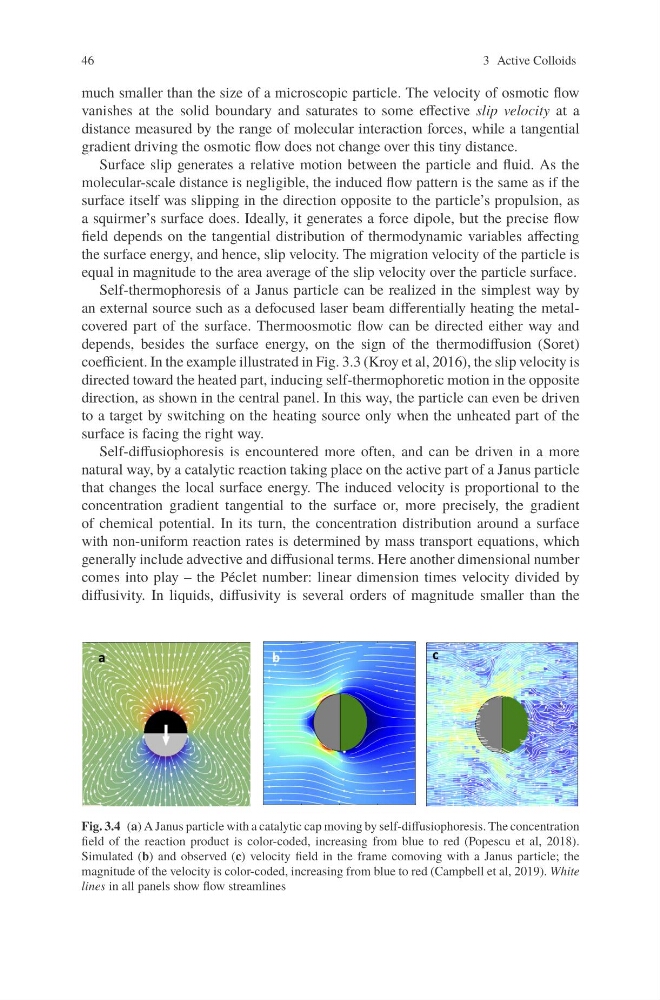
Fig. 3.4 (a) A Janus particle with a catalytic cap moving by self-diffusiophoresis. The concentration
field of the reaction product is color-coded, increasing from blue to red (Popescu et al, 2018).
Simulated (b) and observed (c) velocity field in the frame comoving with a Janus particle; the
magnitude of the velocity is color-coded, increasing from blue to red (Campbell et al, 2019). White
lines in all panels show flow streamlines
3 Active Colloids
much smaller than the size of a microscopic particle. The velocity of osmotic flow
vanishes at the solid boundary and saturates to some effective slip velocity at a
distance measured by the range of molecular interaction forces, while a tangential
gradient driving the osmotic flow does not change over this tiny distance.
Surface slip generates a relative motion between the particle and fluid. As the
molecular-scale distance is negligible, the induced flow pattern is the same as if the
surface itself was slipping in the direction opposite to the particle’s propulsion, as
a squirmer’s surface does. Ideally, it generates a force dipole, but the precise flow
field depends on the tangential distribution of thermodynamic variables affecting
the surface energy, and hence, slip velocity. The migration velocity of the particle is
equal in magnitude to the area average of the slip velocity over the particle surface.
Self-thermophoresis of a Janus particle can be realized in the simplest way by
an external source such as a defocused laser beam differentially heating the metalcovered part of the surface. Thermoosmotic flow can be directed either way and
depends, besides the surface energy, on the sign of the thermodiffusion (Soret)
coefficient. In the example illustrated in Fig. 3.3 (Kroy et al, 2016), the slip velocity is
directed toward the heated part, inducing self-thermophoretic motion in the opposite
direction, as shown in the central panel. In this way, the particle can even be driven
to a target by switching on the heating source only when the unheated part of the
surface is facing the right way.
Self-diffusiophoresis is encountered more often, and can be driven in a more
natural way, by a catalytic reaction taking place on the active part of a Janus particle
that changes the local surface energy. The induced velocity is proportional to the
concentration gradient tangential to the surface or, more precisely, the gradient
of chemical potential. In its turn, the concentration distribution around a surface
with non-uniform reaction rates is determined by mass transport equations, which
generally include advective and diffusional terms. Here another dimensional number
comes into play – the Péclet number: linear dimension times velocity divided by
diffusivity. In liquids, diffusivity is several orders of magnitude smaller than the
Fig. 3.4 (a) A Janus particle with a catalytic cap moving by self-diffusiophoresis. The concentration
field of the reaction product is color-coded, increasing from blue to red (Popescu et al, 2018).
Simulated (b) and observed (c) velocity field in the frame comoving with a Janus particle; the
magnitude of the velocity is color-coded, increasing from blue to red (Campbell et al, 2019). White
lines in all panels show flow streamlines