

3.2 Autophoretic Particles
45
slip – is a nontrivial task, except for some symmetric shapes and motions, and
approximations are necessarily involved.
3.2 Autophoretic Particles
Inanimate active particles, such as Quincke rollers (Sect. 1.7) or grains in a vibrated
layer (Sect. 2.3), use external energy sources to power their activity. Such sources can
also be found in the surrounding medium when motion along the gradient of some
field reduces the overall energy. Those are “phoretic” processes, with the name of a
field (thermo-, diffusio-, electro-) attached to this suffix (Anderson, 1989). Colloidal
particles moving in this way are not qualified as active, but they are when they
create such gradients themselves via surface reactions (Moran and Posner, 2017). Of
course, such autophoretic particles or droplets are driven in the end either by stored
chemical energy or by an external energy source, but, after all, living organisms also
depend on nutrients or solar light, although they utilize these resources in a far more
sophisticated way.
Autophoretic particles driven by chemical or electrochemical reaction have to
be asymmetric, designed in a way that breaks fore–aft symmetry. Any asymmetry,
in either surface energy, or activity, or geometric shape, is suitable, but the most
straightforward case we will consider is a Janus particle, named after the two-faced
Roman god. Such a particle may be coated by a catalyst in an asymmetric way or have
asymmetric photoactive or heat-adsorbing properties; then ensuing concentration,
temperature, or electric potential gradients near the surface cause a local osmotic
flow that propels the particle in the opposite direction.
Osmotic flow is driven by gradients of the surface energy due to changes in the
state of both the surface itself and the adjacent fluid. The driving force is applied
not to the particle itself but to a thin fluid layer within the range of molecular
interactions that determine the surface energy. If it was applied on the surface itself,
no motion would arise due to the no-slip condition. However, molecular interactions
are not concentrated at the surface but extend into the fluid for a nanoscale distance,
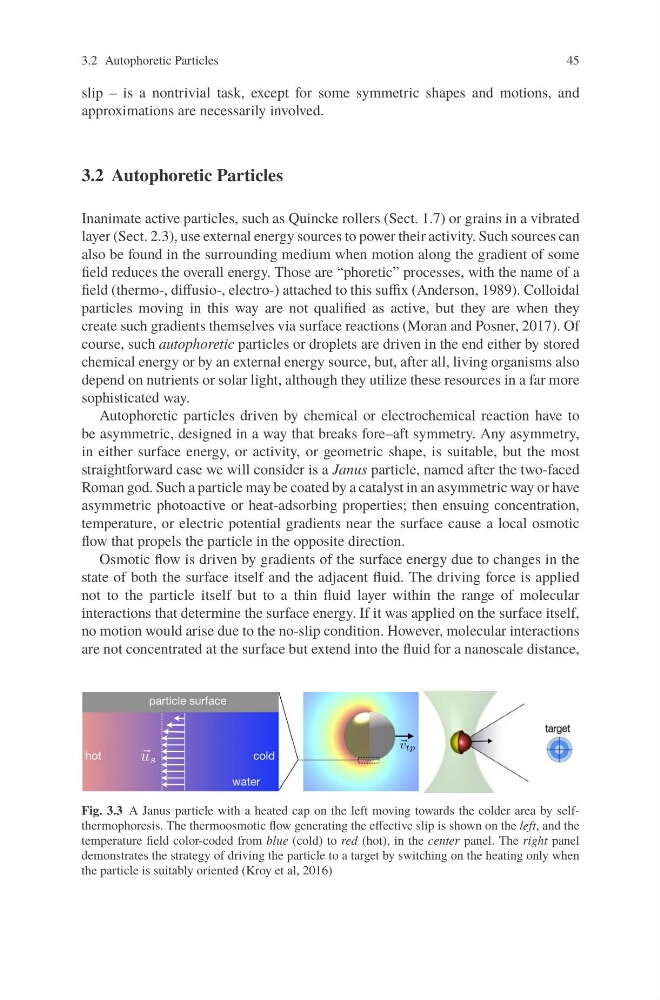
Fig. 3.3 A Janus particle with a heated cap on the left moving towards the colder area by selfthermophoresis. The thermoosmotic flow generating the effective slip is shown on the left, and the
temperature field color-coded from blue (cold) to red (hot), in the center panel. The right panel
demonstrates the strategy of driving the particle to a target by switching on the heating only when
the particle is suitably oriented (Kroy et al, 2016)
45
slip – is a nontrivial task, except for some symmetric shapes and motions, and
approximations are necessarily involved.
3.2 Autophoretic Particles
Inanimate active particles, such as Quincke rollers (Sect. 1.7) or grains in a vibrated
layer (Sect. 2.3), use external energy sources to power their activity. Such sources can
also be found in the surrounding medium when motion along the gradient of some
field reduces the overall energy. Those are “phoretic” processes, with the name of a
field (thermo-, diffusio-, electro-) attached to this suffix (Anderson, 1989). Colloidal
particles moving in this way are not qualified as active, but they are when they
create such gradients themselves via surface reactions (Moran and Posner, 2017). Of
course, such autophoretic particles or droplets are driven in the end either by stored
chemical energy or by an external energy source, but, after all, living organisms also
depend on nutrients or solar light, although they utilize these resources in a far more
sophisticated way.
Autophoretic particles driven by chemical or electrochemical reaction have to
be asymmetric, designed in a way that breaks fore–aft symmetry. Any asymmetry,
in either surface energy, or activity, or geometric shape, is suitable, but the most
straightforward case we will consider is a Janus particle, named after the two-faced
Roman god. Such a particle may be coated by a catalyst in an asymmetric way or have
asymmetric photoactive or heat-adsorbing properties; then ensuing concentration,
temperature, or electric potential gradients near the surface cause a local osmotic
flow that propels the particle in the opposite direction.
Osmotic flow is driven by gradients of the surface energy due to changes in the
state of both the surface itself and the adjacent fluid. The driving force is applied
not to the particle itself but to a thin fluid layer within the range of molecular
interactions that determine the surface energy. If it was applied on the surface itself,
no motion would arise due to the no-slip condition. However, molecular interactions
are not concentrated at the surface but extend into the fluid for a nanoscale distance,
Fig. 3.3 A Janus particle with a heated cap on the left moving towards the colder area by selfthermophoresis. The thermoosmotic flow generating the effective slip is shown on the left, and the
temperature field color-coded from blue (cold) to red (hot), in the center panel. The right panel
demonstrates the strategy of driving the particle to a target by switching on the heating only when
the particle is suitably oriented (Kroy et al, 2016)