

44
3 Active Colloids
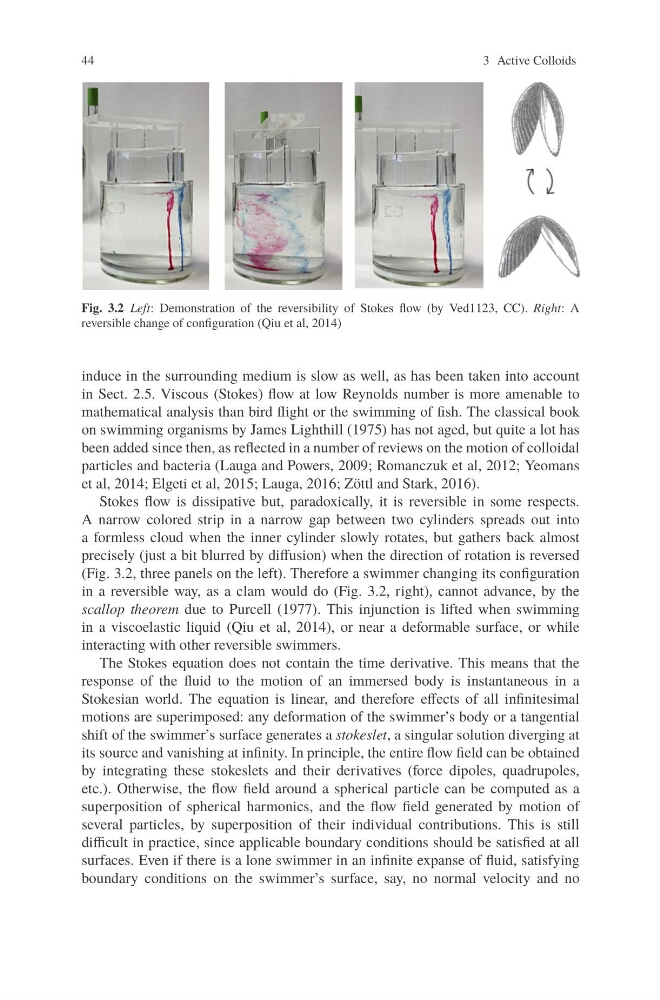
Fig. 3.2 Left: Demonstration of the reversibility of Stokes flow (by Ved1123, CC). Right: A
reversible change of configuration (Qiu et al, 2014)
induce in the surrounding medium is slow as well, as has been taken into account
in Sect. 2.5. Viscous (Stokes) flow at low Reynolds number is more amenable to
mathematical analysis than bird flight or the swimming of fish. The classical book
on swimming organisms by James Lighthill (1975) has not aged, but quite a lot has
been added since then, as reflected in a number of reviews on the motion of colloidal
particles and bacteria (Lauga and Powers, 2009; Romanczuk et al, 2012; Yeomans
et al, 2014; Elgeti et al, 2015; Lauga, 2016; Zöttl and Stark, 2016).
Stokes flow is dissipative but, paradoxically, it is reversible in some respects.
A narrow colored strip in a narrow gap between two cylinders spreads out into
a formless cloud when the inner cylinder slowly rotates, but gathers back almost
precisely (just a bit blurred by diffusion) when the direction of rotation is reversed
(Fig. 3.2, three panels on the left). Therefore a swimmer changing its configuration
in a reversible way, as a clam would do (Fig. 3.2, right), cannot advance, by the
scallop theorem due to Purcell (1977). This injunction is lifted when swimming
in a viscoelastic liquid (Qiu et al, 2014), or near a deformable surface, or while
interacting with other reversible swimmers.
The Stokes equation does not contain the time derivative. This means that the
response of the fluid to the motion of an immersed body is instantaneous in a
Stokesian world. The equation is linear, and therefore effects of all infinitesimal
motions are superimposed: any deformation of the swimmer’s body or a tangential
shift of the swimmer’s surface generates a stokeslet, a singular solution diverging at
its source and vanishing at infinity. In principle, the entire flow field can be obtained
by integrating these stokeslets and their derivatives (force dipoles, quadrupoles,
etc.). Otherwise, the flow field around a spherical particle can be computed as a
superposition of spherical harmonics, and the flow field generated by motion of
several particles, by superposition of their individual contributions. This is still
difficult in practice, since applicable boundary conditions should be satisfied at all
surfaces. Even if there is a lone swimmer in an infinite expanse of fluid, satisfying
boundary conditions on the swimmer’s surface, say, no normal velocity and no
3 Active Colloids
Fig. 3.2 Left: Demonstration of the reversibility of Stokes flow (by Ved1123, CC). Right: A
reversible change of configuration (Qiu et al, 2014)
induce in the surrounding medium is slow as well, as has been taken into account
in Sect. 2.5. Viscous (Stokes) flow at low Reynolds number is more amenable to
mathematical analysis than bird flight or the swimming of fish. The classical book
on swimming organisms by James Lighthill (1975) has not aged, but quite a lot has
been added since then, as reflected in a number of reviews on the motion of colloidal
particles and bacteria (Lauga and Powers, 2009; Romanczuk et al, 2012; Yeomans
et al, 2014; Elgeti et al, 2015; Lauga, 2016; Zöttl and Stark, 2016).
Stokes flow is dissipative but, paradoxically, it is reversible in some respects.
A narrow colored strip in a narrow gap between two cylinders spreads out into
a formless cloud when the inner cylinder slowly rotates, but gathers back almost
precisely (just a bit blurred by diffusion) when the direction of rotation is reversed
(Fig. 3.2, three panels on the left). Therefore a swimmer changing its configuration
in a reversible way, as a clam would do (Fig. 3.2, right), cannot advance, by the
scallop theorem due to Purcell (1977). This injunction is lifted when swimming
in a viscoelastic liquid (Qiu et al, 2014), or near a deformable surface, or while
interacting with other reversible swimmers.
The Stokes equation does not contain the time derivative. This means that the
response of the fluid to the motion of an immersed body is instantaneous in a
Stokesian world. The equation is linear, and therefore effects of all infinitesimal
motions are superimposed: any deformation of the swimmer’s body or a tangential
shift of the swimmer’s surface generates a stokeslet, a singular solution diverging at
its source and vanishing at infinity. In principle, the entire flow field can be obtained
by integrating these stokeslets and their derivatives (force dipoles, quadrupoles,
etc.). Otherwise, the flow field around a spherical particle can be computed as a
superposition of spherical harmonics, and the flow field generated by motion of
several particles, by superposition of their individual contributions. This is still
difficult in practice, since applicable boundary conditions should be satisfied at all
surfaces. Even if there is a lone swimmer in an infinite expanse of fluid, satisfying
boundary conditions on the swimmer’s surface, say, no normal velocity and no