

Chapter 3
Active Colloids
3.1 Irreversible Movements in Reversible Flow
Active fluids are stirred by microscopic agents. We considered above their bulk
effect smeared over their multitude together with the surrounding medium, but they
also have an individuality that determines how they interact with the fluid they are
immersed in. Live organisms commonly move by deforming their body, something
inanimate particles cannot do. However, it is possible to swim even without external
appendages, and even with no deformation, just by inducing tangential flow along
the particle’s surface. This kind of a swimmer is called a squirmer, further classified
as a pusher if the surface displacement in the direction of motion is stronger behind,
or a puller if it is strongest on the forward side. Rather than propelling the swimmer
directly, this generates fluid flow, and its back reaction moves the swimmer ahead.
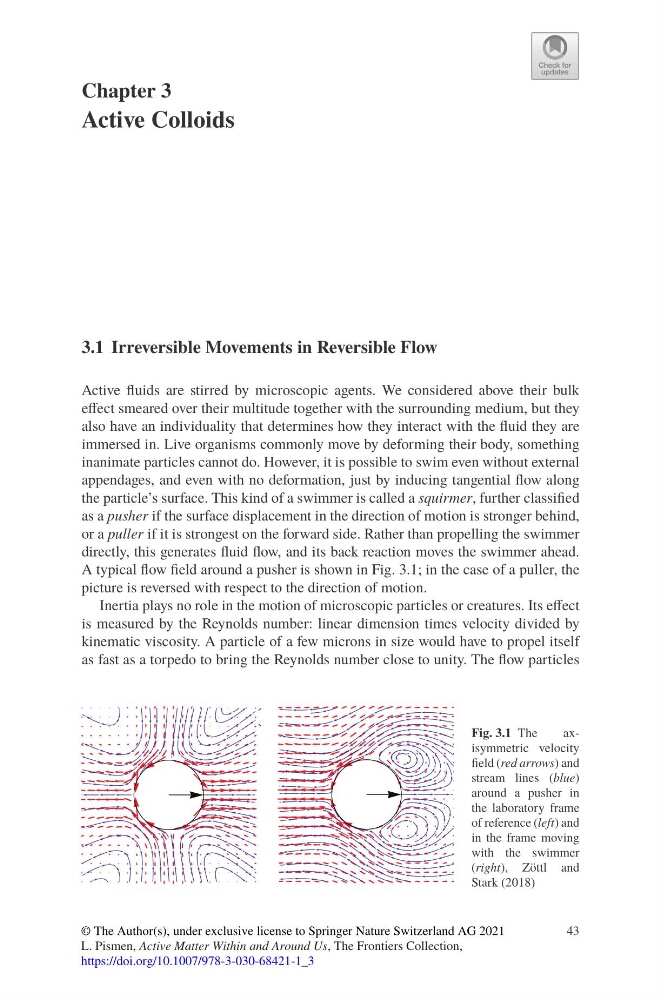
A typical flow field around a pusher is shown in Fig. 3.1; in the case of a puller, the
picture is reversed with respect to the direction of motion.
Inertia plays no role in the motion of microscopic particles or creatures. Its effect
is measured by the Reynolds number: linear dimension times velocity divided by
kinematic viscosity. A particle of a few microns in size would have to propel itself
as fast as a torpedo to bring the Reynolds number close to unity. The flow particles
Fig. 3.1 The
axisymmetric velocity
field (red arrows) and
stream lines (blue)
around a pusher in
the laboratory frame
of reference (left) and
in the frame moving
with the swimmer
(right), Zöttl and
Stark (2018)
43
L. Pismen, Active Matter Within and Around Us, The Frontiers Collection,
https://doi.org/10.1007/978-3-030-68421-1_3
© The Author(s), under exclusive license to Springer Nature Switzerland AG 2021
Active Colloids
3.1 Irreversible Movements in Reversible Flow
Active fluids are stirred by microscopic agents. We considered above their bulk
effect smeared over their multitude together with the surrounding medium, but they
also have an individuality that determines how they interact with the fluid they are
immersed in. Live organisms commonly move by deforming their body, something
inanimate particles cannot do. However, it is possible to swim even without external
appendages, and even with no deformation, just by inducing tangential flow along
the particle’s surface. This kind of a swimmer is called a squirmer, further classified
as a pusher if the surface displacement in the direction of motion is stronger behind,
or a puller if it is strongest on the forward side. Rather than propelling the swimmer
directly, this generates fluid flow, and its back reaction moves the swimmer ahead.
A typical flow field around a pusher is shown in Fig. 3.1; in the case of a puller, the
picture is reversed with respect to the direction of motion.
Inertia plays no role in the motion of microscopic particles or creatures. Its effect
is measured by the Reynolds number: linear dimension times velocity divided by
kinematic viscosity. A particle of a few microns in size would have to propel itself
as fast as a torpedo to bring the Reynolds number close to unity. The flow particles
Fig. 3.1 The
axisymmetric velocity
field (red arrows) and
stream lines (blue)
around a pusher in
the laboratory frame
of reference (left) and
in the frame moving
with the swimmer
(right), Zöttl and
Stark (2018)
43
L. Pismen, Active Matter Within and Around Us, The Frontiers Collection,
https://doi.org/10.1007/978-3-030-68421-1_3
© The Author(s), under exclusive license to Springer Nature Switzerland AG 2021