

34
2 Active Nematics
2.5 Extensile and Contractile Activity
Activity may be expressed not in autonomous motion but in forces applied by
“agents” on the medium they are immersed in. This is characteristic of “wet” active
matter dominated by interactions carried by a surrounding medium. Most complex
active assemblies, from colloidal suspensions and emulsions to living cells, colonies,
and tissues, belong to this class. On a basic level of description, both the medium
and the “agents” can be lumped into a continuous active fluid, where the “agents”
are characterized only by their symmetry and the matching action. A particle with
nematic symmetry can exert a force along its axis, which can be either tensile or
contractile.
Converting this action into a continuous description does not require a sophisticated (and not quite reliable) kinetic theory. The flow of active nematics, whatever
the origin of activity (which may come from active colloidal particles, bacterial
suspensions, filaments driven by molecular motors, or living cells), can be modeled
by viewing them as homogeneous fluids and solving hydrodynamic equations of
motion amended by adding the force exerted by microscopic particles uniformly
distributed in the fluid. In such a “wet” medium, active agents stir the fluid they are
immersed in and are advected by the collectively generated flow. The continuous
approach is justified by the assumption that, similar to passive liquid crystals, the
flow and alignment patterns develop on a scale far exceeding the size of individual
anisotropic active entities, even though the latter now far exceed the molecular scale.
Commonly, the motion is slow, so inertia is neglected, and the model is based on the
Stokes equation of viscous motion supplemented by the effects of nematic elasticity
and activity.
In addition to the pressure and mechanical stress tensor σ m that defines the flow
pattern of isotropic fluids, nematic fluids are also subject to the elastic stress σ n
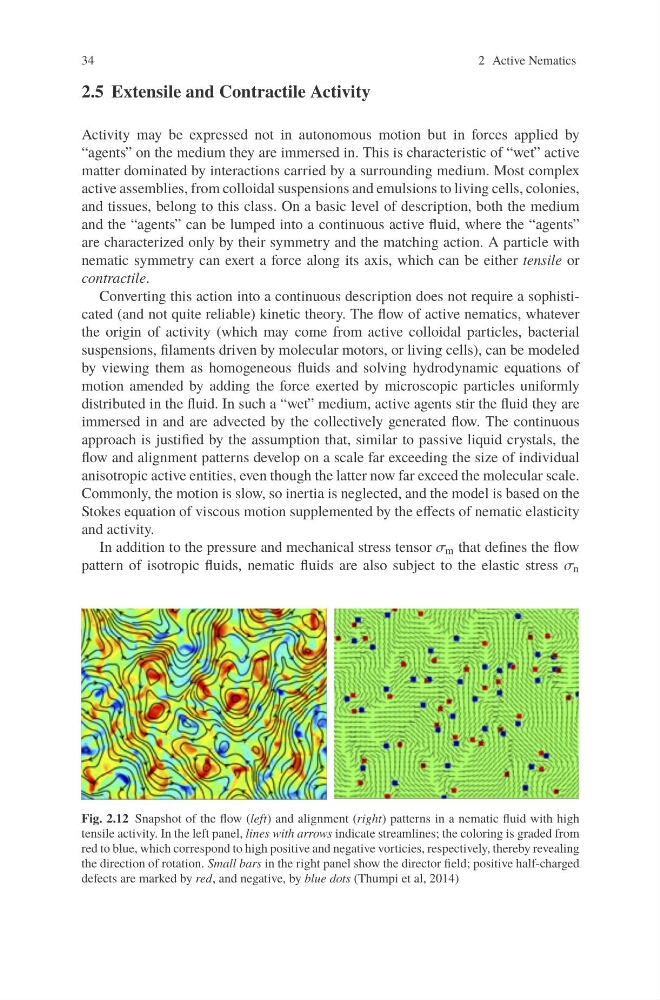
Fig. 2.12 Snapshot of the flow (left) and alignment (right) patterns in a nematic fluid with high
tensile activity. In the left panel, lines with arrows indicate streamlines; the coloring is graded from
red to blue, which correspond to high positive and negative vorticies, respectively, thereby revealing
the direction of rotation. Small bars in the right panel show the director field; positive half-charged
defects are marked by red, and negative, by blue dots (Thumpi et al, 2014)
2 Active Nematics
2.5 Extensile and Contractile Activity
Activity may be expressed not in autonomous motion but in forces applied by
“agents” on the medium they are immersed in. This is characteristic of “wet” active
matter dominated by interactions carried by a surrounding medium. Most complex
active assemblies, from colloidal suspensions and emulsions to living cells, colonies,
and tissues, belong to this class. On a basic level of description, both the medium
and the “agents” can be lumped into a continuous active fluid, where the “agents”
are characterized only by their symmetry and the matching action. A particle with
nematic symmetry can exert a force along its axis, which can be either tensile or
contractile.
Converting this action into a continuous description does not require a sophisticated (and not quite reliable) kinetic theory. The flow of active nematics, whatever
the origin of activity (which may come from active colloidal particles, bacterial
suspensions, filaments driven by molecular motors, or living cells), can be modeled
by viewing them as homogeneous fluids and solving hydrodynamic equations of
motion amended by adding the force exerted by microscopic particles uniformly
distributed in the fluid. In such a “wet” medium, active agents stir the fluid they are
immersed in and are advected by the collectively generated flow. The continuous
approach is justified by the assumption that, similar to passive liquid crystals, the
flow and alignment patterns develop on a scale far exceeding the size of individual
anisotropic active entities, even though the latter now far exceed the molecular scale.
Commonly, the motion is slow, so inertia is neglected, and the model is based on the
Stokes equation of viscous motion supplemented by the effects of nematic elasticity
and activity.
In addition to the pressure and mechanical stress tensor σ m that defines the flow
pattern of isotropic fluids, nematic fluids are also subject to the elastic stress σ n
Fig. 2.12 Snapshot of the flow (left) and alignment (right) patterns in a nematic fluid with high
tensile activity. In the left panel, lines with arrows indicate streamlines; the coloring is graded from
red to blue, which correspond to high positive and negative vorticies, respectively, thereby revealing
the direction of rotation. Small bars in the right panel show the director field; positive half-charged
defects are marked by red, and negative, by blue dots (Thumpi et al, 2014)