

2.4 Topological Defects
33
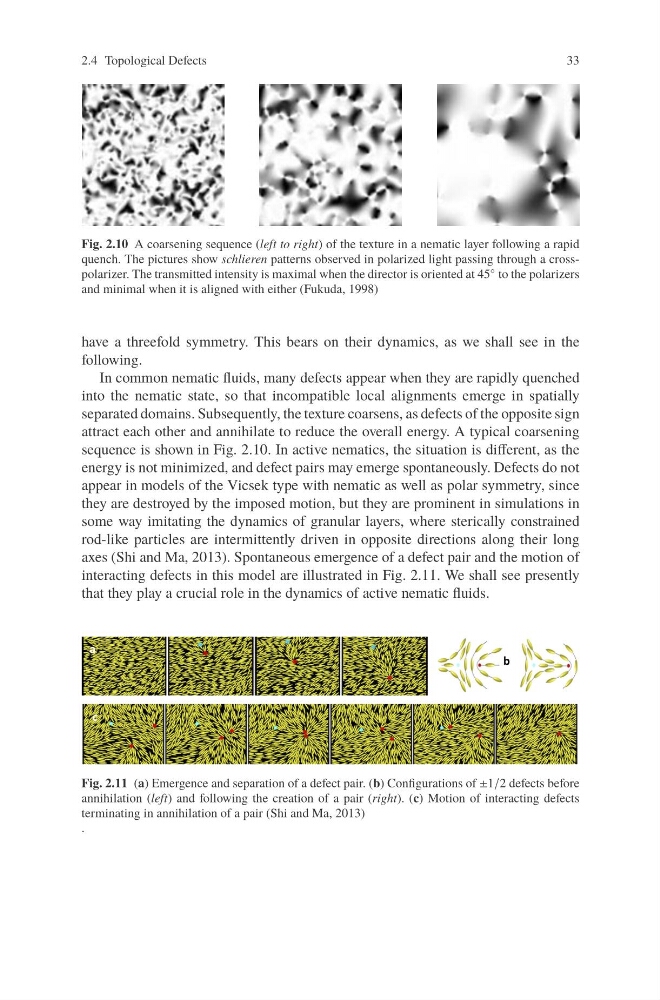
Fig. 2.10 A coarsening sequence (left to right) of the texture in a nematic layer following a rapid
quench. The pictures show schlieren patterns observed in polarized light passing through a crosspolarizer. The transmitted intensity is maximal when the director is oriented at 45 ◦ to the polarizers
and minimal when it is aligned with either (Fukuda, 1998)
have a threefold symmetry. This bears on their dynamics, as we shall see in the
following.
In common nematic fluids, many defects appear when they are rapidly quenched
into the nematic state, so that incompatible local alignments emerge in spatially
separated domains. Subsequently, the texture coarsens, as defects of the opposite sign
attract each other and annihilate to reduce the overall energy. A typical coarsening
sequence is shown in Fig. 2.10. In active nematics, the situation is different, as the
energy is not minimized, and defect pairs may emerge spontaneously. Defects do not
appear in models of the Vicsek type with nematic as well as polar symmetry, since
they are destroyed by the imposed motion, but they are prominent in simulations in
some way imitating the dynamics of granular layers, where sterically constrained
rod-like particles are intermittently driven in opposite directions along their long
axes (Shi and Ma, 2013). Spontaneous emergence of a defect pair and the motion of
interacting defects in this model are illustrated in Fig. 2.11. We shall see presently
that they play a crucial role in the dynamics of active nematic fluids.
Fig. 2.11 (a) Emergence and separation of a defect pair. (b) Configurations of ±1/2 defects before
annihilation (left) and following the creation of a pair (right). (c) Motion of interacting defects
terminating in annihilation of a pair (Shi and Ma, 2013)
.
33
Fig. 2.10 A coarsening sequence (left to right) of the texture in a nematic layer following a rapid
quench. The pictures show schlieren patterns observed in polarized light passing through a crosspolarizer. The transmitted intensity is maximal when the director is oriented at 45 ◦ to the polarizers
and minimal when it is aligned with either (Fukuda, 1998)
have a threefold symmetry. This bears on their dynamics, as we shall see in the
following.
In common nematic fluids, many defects appear when they are rapidly quenched
into the nematic state, so that incompatible local alignments emerge in spatially
separated domains. Subsequently, the texture coarsens, as defects of the opposite sign
attract each other and annihilate to reduce the overall energy. A typical coarsening
sequence is shown in Fig. 2.10. In active nematics, the situation is different, as the
energy is not minimized, and defect pairs may emerge spontaneously. Defects do not
appear in models of the Vicsek type with nematic as well as polar symmetry, since
they are destroyed by the imposed motion, but they are prominent in simulations in
some way imitating the dynamics of granular layers, where sterically constrained
rod-like particles are intermittently driven in opposite directions along their long
axes (Shi and Ma, 2013). Spontaneous emergence of a defect pair and the motion of
interacting defects in this model are illustrated in Fig. 2.11. We shall see presently
that they play a crucial role in the dynamics of active nematic fluids.
Fig. 2.11 (a) Emergence and separation of a defect pair. (b) Configurations of ±1/2 defects before
annihilation (left) and following the creation of a pair (right). (c) Motion of interacting defects
terminating in annihilation of a pair (Shi and Ma, 2013)
.