

32
2 Active Nematics
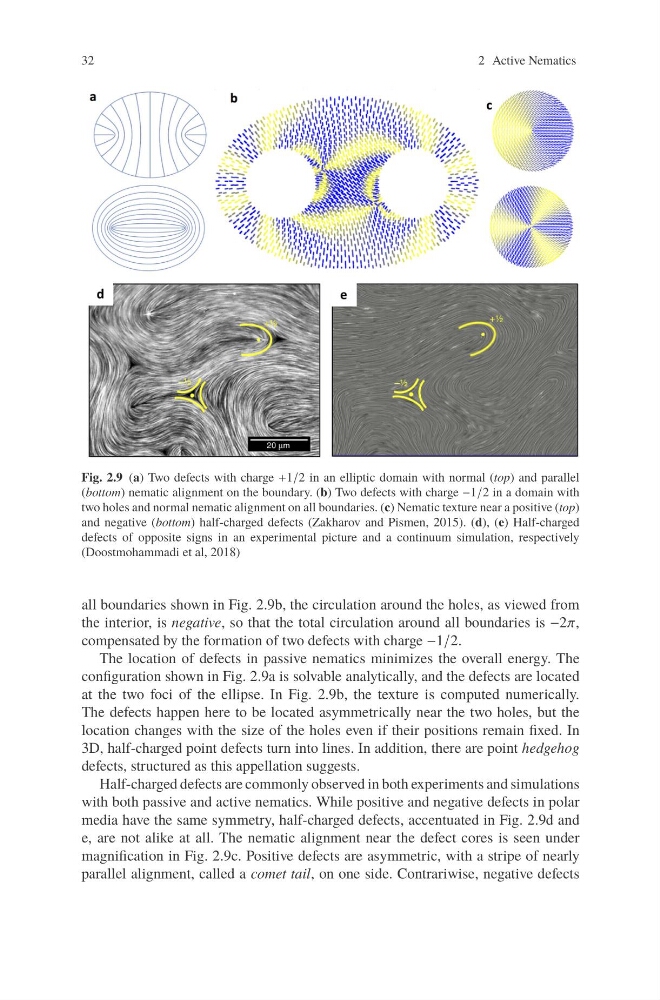
Fig. 2.9 (a) Two defects with charge +1/2 in an elliptic domain with normal (top) and parallel
(bottom) nematic alignment on the boundary. (b) Two defects with charge −1/2 in a domain with
two holes and normal nematic alignment on all boundaries. (c) Nematic texture near a positive (top)
and negative (bottom) half-charged defects (Zakharov and Pismen, 2015). (d), (e) Half-charged
defects of opposite signs in an experimental picture and a continuum simulation, respectively
(Doostmohammadi et al, 2018)
all boundaries shown in Fig. 2.9b, the circulation around the holes, as viewed from
the interior, is negative, so that the total circulation around all boundaries is −2π,
compensated by the formation of two defects with charge −1/2.
The location of defects in passive nematics minimizes the overall energy. The
configuration shown in Fig. 2.9a is solvable analytically, and the defects are located
at the two foci of the ellipse. In Fig. 2.9b, the texture is computed numerically.
The defects happen here to be located asymmetrically near the two holes, but the
location changes with the size of the holes even if their positions remain fixed. In
3D, half-charged point defects turn into lines. In addition, there are point hedgehog
defects, structured as this appellation suggests.
Half-charged defects are commonly observed in both experiments and simulations
with both passive and active nematics. While positive and negative defects in polar
media have the same symmetry, half-charged defects, accentuated in Fig. 2.9d and
e, are not alike at all. The nematic alignment near the defect cores is seen under
magnification in Fig. 2.9c. Positive defects are asymmetric, with a stripe of nearly
parallel alignment, called a comet tail, on one side. Contrariwise, negative defects
2 Active Nematics
Fig. 2.9 (a) Two defects with charge +1/2 in an elliptic domain with normal (top) and parallel
(bottom) nematic alignment on the boundary. (b) Two defects with charge −1/2 in a domain with
two holes and normal nematic alignment on all boundaries. (c) Nematic texture near a positive (top)
and negative (bottom) half-charged defects (Zakharov and Pismen, 2015). (d), (e) Half-charged
defects of opposite signs in an experimental picture and a continuum simulation, respectively
(Doostmohammadi et al, 2018)
all boundaries shown in Fig. 2.9b, the circulation around the holes, as viewed from
the interior, is negative, so that the total circulation around all boundaries is −2π,
compensated by the formation of two defects with charge −1/2.
The location of defects in passive nematics minimizes the overall energy. The
configuration shown in Fig. 2.9a is solvable analytically, and the defects are located
at the two foci of the ellipse. In Fig. 2.9b, the texture is computed numerically.
The defects happen here to be located asymmetrically near the two holes, but the
location changes with the size of the holes even if their positions remain fixed. In
3D, half-charged point defects turn into lines. In addition, there are point hedgehog
defects, structured as this appellation suggests.
Half-charged defects are commonly observed in both experiments and simulations
with both passive and active nematics. While positive and negative defects in polar
media have the same symmetry, half-charged defects, accentuated in Fig. 2.9d and
e, are not alike at all. The nematic alignment near the defect cores is seen under
magnification in Fig. 2.9c. Positive defects are asymmetric, with a stripe of nearly
parallel alignment, called a comet tail, on one side. Contrariwise, negative defects